Modern Style FURNITURE ................Illustrated Architecture Dictionary.................Styles of Architecture
Modern Style FURNITURE ................Illustrated
Architecture Dictionary.................Styles of Architecture
Modern / International / Mid-Century Modern styles
Late 19th and early 20th century Modernism - the conviction that the traditional forms of art, architecture, literature, religious faith, social organization and daily life were becoming outdated in the new economic, social, and political conditions of an emerging fully industrialized world.
All would agree that the principal distinguishing features are simplification of form and the elimination of ornament - radical departure from Western architecture rooted in the Greek and Roman eras. One frequently quoted rule is Louis Sullivan's "Form follows function."
Some would argue that Art Deco is an early modern design because it uses modern technology, i.e., steel, and it geometrically stylizes or "modernizes" Classical and Egyptian ornamentation. However, at the same time, the Bauhaus Germans are eliminating ornamentation altogether.
Beaux Arts Classical style, even though it embraces modern technology, also embraces Classical ornamentation; thus, it is not considered modern.
In Early Modern style, one common thread is the rejection of Classical ornamentation. In some forms, nature motifs are substituted for traditional ornamentation. Examples:
Another type of Early Modern architecture, steel-reinforced concrete grain elevators reject ornamentation altogether, and this influences the German Bauhaus architects to do the same. This Bauhaus International style will spread to the US after Hitler closes the Bauhaus and Walter Gropius, Marcel Breuer, and Mies van der Rohe flee to the US.
- Antoni Gaudi - Art Nouveau
- Louis Sullivan - Art Nouveau
- Frank Lloyd Wright - Prairie style
- Daylight Factory
Another type of Early Modern architecture is Expressionist style.The style was characterized by an early-modernist adoption of novel materials, formal innovation, and very unusual massing, sometimes inspired by natural biomorphic forms, sometimes by the new technical possibilities offered by the mass production of brick, steel and especially glass.
In the middle of the twentieth century, in the 50s and 60s, architects began designing in a manner reminiscent of Expressionist architecture, i.e., Neo Expressionist style.
One important group of Modernist architects is commonly referred to as the "Harvard Five": Marcel Breuer, Landis Gores, John Johansen, Philip Johnson, and Eliot Noyes. All these men either taught with or were students of Walter Gropius, the legendary head of Harvard's Graduate School of Design.
"International Style" describes a type of design that developed mainly in Germany, Holland and France, during the 1920s, before spreading to America in the 1930s, where it became the dominant tendency in American architecture during the middle decades of the 20th century. The German Bauhaus was closed by Hitler in 1933, and several of the professors, like Ludwig Mies van der Rohe, were given influential positions in American architecture schools and they helped popularize the style in the US.
Some historians make a a distinction between a "Tower in the Plaza" (One Seneca Tower) and "Platform and Tower" (Main Place Mall Tower ).
Mid-Century Modern: An architectural, interior, product and graphic design that generally describes mid-20th century developments in modern design, architecture and urban development from roughly 1933 to 1965. In architecture, it is primarily the International style
Brutalism: Some historians classify Brutalism as the last phase of Modern; others argue it is a separate style.
See also: Techbuilt and Carl Koch
There are multiple lenses through which the evolution of modern architecture may be viewed.
Some historians see it as a social matter, closely tied to the project of Modernity and thus the Enlightenment. Modern architecture developed, in their opinion, as a result of social and political revolutions.
Others see Modern architecture as primarily driven by technological and engineering developments.
Still other historians regard Modernism as a matter of taste, a reaction against eclecticism and the lavish stylistic excesses of Victorian and Edwardian architecture.
----
With the Industrial Revolution, the availability of newly-available building materials such as iron, steel, and sheet glass drove the invention of new building techniques.
The Crystal Palace by Joseph Paxton at the Great Exhibition of 1851 was an early example of iron and glass construction, followed in 1864 by the first glass and metal curtain wall. A further development was that of the steel-framed skyscraper in Chicago around 1890 by William Le Baron Jenney and Louis Sullivan.
Around 1900, a number of architects and designers around the world began developing new solutions to integrate traditional precedents (classicism or Gothic, for instance) with new technological possibilities.
The various styles or approaches of Modernism have similar characteristics— primarily the simplification of form and elimination of ornament. This was a significant departure from Western architecture, which was based on principles of Greek and Roman design.
While the exact characteristics and origins of Modern architecture are still open to interpretation and debate, it is generally accepted that “Modernism” was superseded by Postmodernism and is now regarded as a historical style. Below are images and examples of the various sub-types within the Modern movement:
- A Frame (1950-1980)
- Brutalism (1960-1975)
- Corporate Modern / Slick Skin (1960 - 1990)
- Curtain Wall (1948 - 1965)
- Geodesic Dome (1960 - 1990)
- International
- Mansard
- Miesian (1965 - 1980)
- Neo Expressionism
- New Formalism (1960 - 1975)
- Pavilion (1960 - 1980)
- Populuxe/Googie
- Quonset Hut (1941 - 1960)
- Shed Style (1965 - 1985)
- Wrightian (1950 - 1975)
- WWII Era Cottage (1935 - 1950)
Rejecting ornament and embracing minimalism, Modernism became the dominant global movement in 20th-century architecture and design.
Modernism is the single most important new style or philosophy of architecture and design of the 20th century, associated with an analytical approach to the function of buildings, a strictly rational use of (often new) materials, an openness to structural innovation and the elimination of ornament. It has also been called International Modern or International, after an exhibition of modernist architecture in America in 1932 by Philip Johnson.
The style is characterised by:
Plans would be loosely arranged, often with open-plan interiors.
- asymmetrical compositions
- use of general cubic or cylindrical shapes
- flat roofs
- use of reinforced concrete
- metal and glass frameworks often resulting in large windows in horizontal bands
- an absence of ornament or mouldings
- a tendency for white or cream render, often emphasised by black and white photography
WHAT TO LOOK FOR IN A MODERNIST BUILDING:
1. Rectangular or cubist shapes
2. Minimal or no ornamentation
3. Steel and or reinforced concrete
4. Large windows
5. Open plan
Excerpts
A Brief History of Modern Architecture and Design
By Maggie Larkin
Pub. on Daily News, Nov. 6, 2015 (online May 2016)
Modernity is also read as a reaction to eclecticism and the lavish, detail-oriented styles of the Victorian era and later Art Nouveau. Early examples of modern architecture, like Paxton's Crystal Palace in London and Frank Lloyd Wright's Unity Temple in Chicago make use of these new construction materials, respectively iron and concrete.
The Bauhaus School, founded by Walter Gropius in 1919, was a leading voice in early modern styles. The Bauhaus distanced itself from ornamentation and earlier ideas of "beauty", opting for rationalization.
"Form follows function" was an architectural battle cry by the 1930s, and although many modern buildings do feature lovely ornamentation, it was the goal of the modernists to shift the focal point of architecture from ornamentation and interior design to construction and form.
Frank Lloyd Wright is likely the most well-known modern architect, if not the most well-known general architect to world audiences.Excerpts
What is Modernism?
By Sudip Bose
Reprinted from From Preservation | May/June 2008, p. 36Trying to define modernism can be a frustrating exercise. As a style, it is less coherent, its boundaries looser, than, say, classicism. Many critics would argue that modernism is not even a singular style, that it incorporates a great variety of aesthetics and sensibilities.
And just who were the modernists? Frank Lloyd Wright vehemently opposed being grouped with them, but modernist architecture would not have been the same without him.
Modernism roughly spans the time between World War I and the early 1970s. What we generally think of as the modernist ethic evolved first in Europe, among such architects as Le Corbusier, Ludwig Mies van der Rohe, and Walter Gropius, the latter two of the German Bauhaus school.The European modernists imbued their work with an inherent morality and social consciousness and were often associated with left-wing politics.
Intrigued by the emerging technologies of the day, they embraced concrete, glass, and steel in their revolutionary creations. They eschewed ornament, rejecting what they saw as the frivolous strokes of Victorian and Art Nouveau styles. Their work was both spare (think of Mies' famous dictum "Less is more") and lyrical. Perhaps above all, they believed in function dictating form, though many architects, such as Le Corbusier, would eventually distance themselves from that tenet.
In 1932, Philip Johnson and Henry-Russell Hitchcock curated a landmark exhibition at New York City's Museum of Modern Art in which they coined the term International (Bauhaus). Aside from introducing the work of architects such as Mies to the American public, the exhibit consciously tried to define a movement. The ground was now broken for a distinctly American modernism to emerge, and the architects who subsequently worked in this country became less concerned with the moral and social aspects of building and more interested in appearance.
Modern Architecture
The Columbia Encyclopedia, 6th ed. | 2016
as found on Encyclopedia.com (online May 2016)
... modern architecture, new architectural style that emerged in many Western countries in the decade after World War I. It was based on the "rational" use of modern materials, the principles of functionalist planning, and the rejection of historical precedent and ornament. This style has been generally designated as modern, although the labels International style, Neue Sachlichkeit, and functionalism have also been used.
Since the mid-19th cent. there had been repeated attempts to assimilate modern technology in practice and theory and to formulate a modern style of architecture suitable to its age.
... iron, steel, and glass enabled architects and engineers to enclose the vast interior spaces of train sheds, department stores, and market halls, but often the structural forms were clothed with irrelevant ornament.
By 1920 there was an increasingly wide understanding that building forms must be determined by their functions and materials if they were to achieve intrinsic significance or beauty in contemporary terms, without resorting to traditional ornament.
In 1932 the label "International style" was applied to modern architecture by the Museum of Modern Art, New York City, anticipating its growing acceptance around the world. The United States became a stronghold of modern architecture after the emigration of Gropius, Mies, and Breuer from Germany during the 1930s.
Large architectural firms such as Harrison and Abramovitz and Skidmore, Owings, and Merrill [Marine Midland Bank] did much to popularize modern architecture around the world after World War II.
A dynamic sculptural unity distinguished the buildings of Eero Saarinen [e.g., Kleinhans Music Hall]
Mid-century Modern (MCM) is an overused and often misunderstood concept and term, which actually spans a variety of styles from the era. It is most often associated with the 50s and 60s, while the earliest days of the movement had roots in the 20s in Europe. Today its label can be seen creeping onto styles as late as the mid 70s.
In Europe, Bauhaus (a school operating 1919-1933) and the International Style (which emerged throughout the 20s & 30s) are largely credited with spurring the modern design of this era. But it was the end of World War II that provided the environment for the modern design movement to be advanced and “made American.”
During World War II, traditional building materials, such as steel, became scarce. This forced designers, builders, and architects to explore new technologies and materials, both in support of the war effort and for domestic projects. This sparked innovations in aluminum, plastics, textiles, and fiberglass.
When the war ended, and resources and manufacturing capacity were freed up, these advances spurred a wave of homeware manufacturing and home building. This is the period that marks the most commonly accepted “beginning” of what we now call MCM.
As the baby boom started in the late 40s and 50s, architects of the era explored new building forms that made homes simple and quick to build, with a larger emphasis on indoor/outdoor flow and an emphasis on privacy. Post and beam construction enabled larger windows and more natural light, creating more integrated and organic environments.
Leading furniture and houseware designers placed a high value on accessibility, so it was mandatory that furniture could be mass-produced at a reasonable cost. They replaced fussy carving and details on their furniture with rectilinear forms, curves and geometric shapes, leveraging the latest in new technology. As Americans started amassing this mass produced “stuff”, built-in storage became an important design feature in homes for the first time.
MCM was a natural outgrowth of the needs of the rapidly growing American population post- World War II, creating homes and products with a strong sense of functional style that mirrored that era of unprecedented modern advances. The result was thoughtful living spaces that are—to this day—elegantly simple, open, and with a unity between the indoor and outdoor. This makes them timeless in form and function and highly desirable to this day.
Mid-century modern, or MCM as devotees call it in shorthand, was spawned from the Modernist movement. Modernism defined a cultural movement that spanned the realms of architecture, literature, philosophy, and music in the late 19th century in Europe. The guiding principle of the movement was function over fussiness, and making conceptual artistry attainable through everyday objects. The Bauhaus School in Germany, which operated from until 1933, served as an early creative venue for these ideas to be explored with Ludwig Mies van de Rohe serving as a director. America would soon follow suit with World War II coming to an end and people feeling a shift towards experimentation with new technology and materials. The period between 1933-1965 would come to define a style that would become popularized and accessible to the masses, mid-century modern.
So what are some defining characteristics of MCM architecture and furniture? There are far too many to name, but some of the most recognizable and distinguishing are the use of steel, large flat panes of glass, clerestory windows, decorative screens, cantilevered roofs, flat roofs, split-level rooms, Japanese influence, partial walls, stacked brick, and integration with nature.
The use of these characteristics varies depending on the style of home, whether it’s a sprawling ranch or case study type dwelling.
In furniture, some characteristics would be the use of woods like teak, walnut, burl and rosewood, organic kidney bean shapes, fiberglass, resin, brass, steel, and textiles that were often wool and nubby in texture.
Mid-century modern design is alive and booming with a resurgence of interest in the design world. For some, it has always been a mainstay that they grew up with. Others have ventured out only to be beckoned back, and then there is the younger generation embracing past relics and the nostalgia of it all. Because of this, companies like Thayer Coggin have re-released pieces from their archives featuring original designs of the time, and the authentic vs. knock-off question is one we explain regularly in regards to Barcelona chairs, Saarinen tables, and Eames chairs. At the end of the day, it’s hard to argue with the timelessness and beauty of well designed furniture from or inspired by this era.
Mid-century modern
Wikipedia (online Sept. 2016)
Mid-century modern is an architectural, interior, product and graphic design that describes mid-20th century developments in modern design, architecture and urban development from roughly 1933 to 1965. The term, employed as a style descriptor as early as the mid-1950s, was reaffirmed in 1983 by Cara Greenberg in the title of her book, Mid-Century Modern: Furniture of the 1950s (Random House), celebrating the style that is now recognized by scholars and museums worldwide as a significant design movement.
Architecture
The Mid-Century modern movement in the U.S. was an American reflection of the International and Bauhaus movements, including the works of Gropius, Florence Knoll, Le Corbusier and Ludwig Mies van der Rohe. Though the American component was slightly more organic in form and less formal than the International Style, it is more firmly related to it than any other.
Brazilian and Scandinavian architects were very influential at this time, with a style characterized by clean simplicity and integration with nature. Like many of Wright's designs, Mid-Century architecture was frequently employed in residential structures with the goal of bringing modernism into America's post-war suburbs. This style emphasized creating structures with ample windows and open floor plans, with the intention of opening up interior spaces and bringing the outdoors in. Many Mid-century houses utilized then-groundbreaking post and beam architectural design that eliminated bulky support walls in favor of walls seemingly made of glass. Function was as important as form in Mid-Century designs, with an emphasis placed specifically on targeting the needs of the average American family.
Eichler Homes
Pioneering builder and real estate developer Joseph Eichler was instrumental in bringing Mid-Century Modern architecture ("Eichler Homes") to subdivisions in the Los Angeles area and the San Francisco Bay region of California, and select housing developments on the east coast. George Fred Keck, his brother Willam Keck, Henry P. Glass, Ludwig Mies van der Rohe, and Edward Humrich created Mid-Century Modern residences in the Chicago area. Mies van der Rohe's Farnsworth House is extremely difficult to heat or cool, while Keck and Keck were pioneers in the incorporation of passive solar features in their houses to compensate for their large glass windows.See also:
Mid Century Modern Buffalo
(online November 2016)
Mid Century Modern Buffalo is designed to raise awareness, educate and appreciate Mid Century Architecture in Western New YorkSee also:
DOCOMOMO
(online November 2016)
International committee for the documentation and conservation of buildings, sites, and neighborhoods of the modern movement
As articulated by Reyner Banham in A Concrete Atlantis (1986), the grain elevators in general and those in Buffalo in particular were an inspiration to modern architects in Europe.
Le Corbusier declared, “Thus we have the American grain elevators and factories, the magnificent FIRST FRUITS of the new age.”
It was the power of the visual image that moved these architects, and the adoption of their formal qualities had a long term effect on modern architecture. The simple but powerful geometric structures and the ideology of practical design without ornamentation conformed to the purposes of modernism.
- Lynda H. Schneekloth, p. 15 (online Jan. 2013)
In the 1910s and 1920s, photographs of grain elevators circulated in European architectural publications dedicated to modern architecture, prominent Buffalo examples included. That the functional dictates of grain storage could produce the uncontrived beauty of the platonic cylinder was taken as proof of modernist values. Such industrial buildings, it followed, were at least as modern as any contemporary architecture with masterly authors, such as Louis Sullivan or Frank Lloyd Wright.
On the authority of these images, avant-garde European architects began to design non-industrial buildings that resembled an American industrial type that they had never physically experienced ....
A Concrete Atlantis [by Reyner Banham, 1986] made the claim that the quintessence of European modernism was rooted in two types of American industrial buildings, the daylight factory and the grain elevator ....
The association of elevators with pure form appears to have entered modernist consciousness via Wilhelm Worringer’s comparison of contemporary silos to the monuments of ancient Egyptians in his celebrated text, Abstraction and Empathy (1908). In addition to the fact that the concrete silos bore an uncanny likeness to the massive columns of New Kingdom temples, ancient Egypt was associated with the history of grain storage through the biblical story of Joseph stockpiling grain for the seven years of famine, as well as the myth that the pyramids functioned as silos.
In 1913, Gropius’ [Water Gropius, founder of the Bauhaus School] conclusion that America -- rather than Germany -- was the ‘Industrial Motherland’ would have come as a surprise the industrialists, artists, and architects to whom the manifesto was most immediately addressed.
- Hadas Steiner, pp. 106-107 (online Jan. 2013)
Buildings in Buffalo
Kleinhans Music Hall 1938-40
Eliel and Eero Saarinen
AM&A's Department Store Eagle Street elevation 1948
Starrett & Van Vleck
Buffalo VA Medical Center
1950
Eggers & Higgins; Green & James
Tishman Building / Hilton Garden Inn
1958-59
Emery Roth & Sons
International Robert T. Coles House & Studio
1961
Robert T. Coles
Modern: Techbuilt
Knox Addition, Albright-Knox
1962
Gordon Bunshaft, Skidmore, Owings, & Merrill
International
Public Library
1964
Kideney Architects
International Western Savings Bank / Main Court Building
1963-64
Duane Lyman Associates
International Trinity United Methodist Church
1964-65
Roy Calligan
Neo-Expressionist M&T Bank
1964-66
Minoru Yamasaki, with Duane Lyman and Assoc.
International Merchants Mutual Insurance Co.
1965
James, Meadows & Howard
Modern
Main Place Tower and Mall 1969
Tower: Harrison and Abramovitz International
Examples Outside of Buffalo:
- Illustration above: Barcelona Pavilion
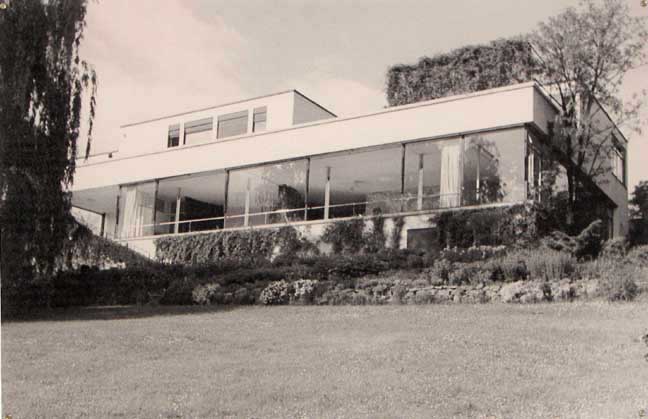
- Villa Tugendhat, by Mies van der Rohe - Hofmobileliendepot Imperial Furniture Collection,Vienna, Austria On display in 2005
- Villa Tugendhat, by Mies van der Rohe (Great Buildings) (online Sept. 2016)
- The Seagram Building, by Mies van der Rohe (Great Buildings) (online Sept. 2016)
- The Farnsworth House, by Mies van der Rohe (Great Buildings) (online Sept. 2016)
- Garden Grove Church, by Philip Johnson (Great Buildings) (online Sept. 2016)
- United Nations Headquarters, by Le Corbusier (Great Buildings) (online Sept. 2016)
- Kaufmann Desert House, by Richard Neutra (Great Buildings) (online Sept. 2016)
- The Lovell House, by Richard Neutra (Great Buildings) (online Sept. 2016)