Stained Glass - Table of Contents ................................ Illustrated Architecture Dictionary
John LaFarge Stained Glass Windows in Western New York
Left: Lafarge in 1902
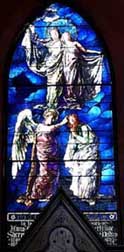
Right: The Sealing of the Twelve Tribes, Trinity Episcopal Church in Buffalo
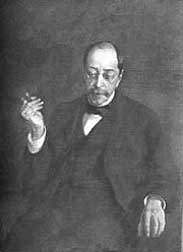
John La Farge (1835-1910) was an American painter, stained glass window maker, decorator, and writer.
Born in New York City to wealthy French émigré Roman Catholic parents, La Farge grew up in a cultured French-speaking household. He received a Catholic education at St. John's College (later Fordham) in New York and at Mt. Saint Mary's College in Maryland, where he graduated in 1853.
Uncertain about a career in law that he began to pursue, he went to Paris in 1856 and briefly studied painting with Thomas Couture. Returning to New York, he took a space in the new Tenth Street Studio Building. In 1859 he went to work with painter William Morris Hunt in Newport, Rhode Island, but soon left the studio to paint directly from nature, inspired by Newport's beautiful environment and his own advanced approach to aesthetics. It was in Newport during the 1860s and early 1870s that some critics suggest that La Farge produced the first impressionist experiments painted on American soil and also some of the most beautiful flower paintings ever created.
In the late 1850s and early 1860s, La Farge became a pioneer in collecting Japanese art and incorporating Japanese effects into his work. He may have purchased his first Japanese prints in Paris in 1856, and this interest was probably encouraged by his marriage in 1860 to Margaret Perry (with whom he had ten children), niece of the Commodore who had opened Japan to the West. By the early 1860s, La Farge was not only collecting Japanese prints, but was also making use of Japanese compositional ideas in his paintings to create effects which looked strange, empty, and unbalanced by Western standards. In 1869, La Farge published an essay on Japanese art, the first ever written by a Western artist, in which he particularly noted the asymmetrical compositions, high horizons, and clear, heightened color of Japanese prints.
La Farge began his career as a painter of landscapes and figure compositions. Hewas commissioned in 1876 to decorate H. H. Richardson's Trinity Church, Boston. This was the first real mural painting in America and marks an epoch in art: he is considered the father of the American mural movement. Thereafter, he engaged primarily in mural painting and designing stained glass.
(The LaFarge Decorative Art Company was dissolved in October 1885, leaving La Farge an independent agent.)
LaFarge achieved international fame for his stained glass at the 1889 Exposition Universale in Paris where he won first prize with his entry The Sealing of the Twelve Tribes. The French government offered to buy the window after the Exposition, but the window was a commission by a Buffalonian and the window was (and still is) installed in Buffalo. In 1901 he was awarded a gold medal at the Pan- American Exposition at Buffalo.
A lifelong Roman Catholic, he did much of his best work for churches. His splendid windows may be seen in the churches of Buffalo, N.Y., and Worcester, Mass., and in the chapels of Harvard and Columbia universities.
La Farge worked in many media. His watercolors and drawings are well known, particularly those commemorating his visit to the South Seas in 1886. His easel paintings are in many leading American museums. His writings and lectures on art are distinguished for their urbanity and judgment.
LaFarge's contributions to stained glass technique include the following:
- The development and use of opalescent glass - now generally known as American stained glass - which he first patented in 1880
- Incorporating molded glass embellishments into his creations, usually in the shapes of jewels or flowers
- Plating, the layering of glass pieces directly on top of each other to achieve detailed depth and minimize the need for painting
- Use of thin copper wire or foil to replace heavy lead lines, techniques that made possible the work of Louis Comfort Tiffany
For an instructive description of some of LaFarge's techniques, see Trinity Church, Boston - Condition Study
La Farge's intense admiration for the monuments of the past and his commitment to innovation of the present encouraged his experimentation with opalescent glass. The material evoked an older, tactile adornment of early Christian stone inlay and mosaic.
La Farge later described his combining selected stained glass in a variety of tones and a new material, an opalescent type of commercial glass previously used mainly as a porcelain substitute in toiletries such as brushes and mirrors.
He applied for a patent for these techniques in November 1879. The application makes it clear that he did not claim to have invented the milky glass of variegated color we now call opalescent. Rather, he claimed a patent for its use in plated stained-glass windows where areas of the window are comprised of several layers of glass stacked one on top of the other and leaded together. Plating adds depth to the play of color and light in the composition.
With such work, La Farge was seen as a designer of promise, and in 1880 Herter Brothers, a decorating firm in New York, hired him to provide windows for the homes of American millionaires,including Cyrus W. Field, Darius Ogden Mills, andJ. Pierpont Morgan in New York.
- Virginia Chieffo Raguin, Stained Glass: From Its Origins to the Present, 2003, p. 229-30
"La Farge and [Louis C.] Tiffany, dissatisfied with the anemic colors and poor quality of available window glass, experimented with novel types of materials, achieving a more varied palette with richer hues and greater density. Working independently, they explored the pictorial, coloristic, and textural qualities of stained glass in new and daring ways that completely changed the look of the medium. By 1881, each artist had patented an opalescent glass, which has a milky, opaque, and sometimes rainbow-hued appearance when light shines through it. It was a uniquely American phenomenon that proved to be among the most important advances in decorative windows since the Middle Ages."
- Louis Comfort Tiffany at the Metropolitan Museum. 1998 catalog
John La Farge is known as the inventor of the opalescent stained glass window and is the father of the American mural movement in the late nineteenth century. He was regarded as the premier American muralist of his time and an eloquent art critic. La Farge studied painting in France and with William Morris Hunt of Newport, Rhode Island.
La Farge's earliest opalescent glass experiments were conducted at Francis Thill's glass house in Brooklyn; glass discs made by James Baker, a Manhattan window artist, also inspired La Farge. La Farge and Louis Comfort Tiffany independently financed the experimental production of opalescent window glass conducted at Louis Heidt's glass house, also in Brooklyn. Tiffany quickly began the production of pressed glass tiles.La Farge and Tiffany's friendship came to a bitter end over the rights to use opalescent glass in windows, which La Farge patented in 1880. Tiffany filed a similar patent in 1881.
Their glass experiments resulted in opalescent glass with multiple colors mixed in the same sheet. Under their direction, confetti glass; streamer; ridged; drapery; and thick, faceted glass nuggets and chunks were made at Heidt's shop. Several glass houses also made great varieties of pressed glass jewels. In 1887, Kokomo Opalescent Glass Company began production; in 1889, they won a gold medal at the Paris World Exposition for their multi-colored window glass.
The creation of opalescent glass in the 1870s was independently arrived at by both Tiffany and John LaFarge (1835-1910), and enabled the artists to make glass containing exaggerated textures and color variations, and then to use those variations as part of their compositions.
La Farge probably deserves the credit for first conceiving the idea of window designs based on patterning and variations within the glass itself.
However, opalescent windows based on abstract and geometrical designs were introduced by Tiffany, who is also considered the creator of the landscape windows in opalescent glass.
- Discovering Stained Glass in Detroit, by Nola Huse Tutag. Detroit: Wayne State U. Press, 1987, p. 153 (Table of Contents at the bottom of the page)
The opalescent era encouraged academically trained artists to design for glass.
We also find the phenomenon of the out-of-house designer, as well as the studio with designers working exclusively as a team of glass cutters, painters and fabricators. La Farge, Tiffany, and David Maitland Armstrong (1836-1918), painters and later designers of stained glass, never actually touched the window.
They may have provided designs and supervised execution, but they were not the artists who cut or painted the glass or assembled the window into its frame.
- Virgina Chieffo Raguin, Stained Glass from its Origins to the Present. 2003, p. 230Beginning in 1874 in his work with stained glass, Lafarge discovered a new technique for creating stained glass. He began to layer two or more pieces of glass, rather than painting directly on the original pane, and thus he invented opalescent glass. He received a patent for his new product on February 24, 1880. Tiffany, a member of the family renowned for their silver firm, received several patents for variations of the same opalescent process in November of the same year. La Farge was persuaded by Tiffany with hints of a future partnership and possible collaborations to waive his patent. The promises never materialized while competition and animosity grew between the two artists.
LaFarge and Tiffany used intricate cuts and richly colored glasses within detailed, flowing designs. Plating, or layering glass layers, achieved depth and texture.
Both made windows for private homes as well as churches.
Eventually Tiffany became the darling of the Gilded Age industrialists and he created a glass and decorating studio that boasted more than a hundred workers. La Farge remained the lone artist who contracted out fabrication of his designs to smaller studios.
Both LaFarge and Tiffany secured their glass from the Kokomo glass factory in Kokomo, Indiana, after it became a reliable source for them in 1888.
Beyond Tiffany and La Farge, a plethora of stained glass studios developed in America around the turn of the century.
When La Farge died at the age of seventy-five in 1910, some compared him to Confucius, others to Hokusai, and still others to Leonardo or Michelangelo. Yet he died in a mental institution - deeply in debt, with few friends, a long-estranged wife, a favorite son who had sued him and shut him out, and a long-time secretary to whom he had been compelled to yield control of his estate. These seeming contradictions between the artist-genius and the flawed human being were aspects of a kaleidoscopic personality who had a strong influence on his contemporaries as an intellectual, an easel painter, an art historian, and a decorator - and who revolutionized the art of both murals and stained glass.
LaFarge murals:
- Trinity Church, Boston, MA:
La Farge windows in Western, NY:
- Trinity Episcopal Church, Buffalo:
- Five Chancel Windows
- The Lord is My Shepherd Chapel
- The Sealing of the Twelve Tribes Chapel
- Jesus Appears to James Nave
- The Good Samaritan Nave
- St. Catherine's rose window
- St. Peter's Episcopal Church, Niagara Falls, NY: The Annunciation
Outside of Western, NY:
- Trinity Church, Boston, MA:
- Memorial Hall, Harvard: The Battle Window / Cornelia, Mother of the Gracchi / Vergil and Homer (online July 2013)
- Corning Glass Museum: Parick W. Ford House Window (online July 2013)
- Detroit Institute of Arts: First Unitarian Church, Detroit, MI Michigan Stained Glass Census (online July 2013)