Morris Co. stained glass windows at the Albert & Victoria Museum ......................... Arts & Crafts -Table of Contents
William Morris
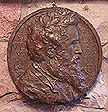 William
Morris (1834-96)
was an English poet, artist, and socialist reformer, who rejected the opulence on
the Victorian era and urged a return to medieval traditions of design, craftsmanship,
and community. He was inspired by the writings of John
Ruskin and Augustus Pugin
who championed the return of Gothic architecture (the last true architectural movement in their opinion.)
William
Morris (1834-96)
was an English poet, artist, and socialist reformer, who rejected the opulence on
the Victorian era and urged a return to medieval traditions of design, craftsmanship,
and community. He was inspired by the writings of John
Ruskin and Augustus Pugin
who championed the return of Gothic architecture (the last true architectural movement in their opinion.)
In his political
writings, Morris attempted to correct the dehumanizing effects of the Industrial
Revolution by proposing a form of society in which people could enjoy craftsmanship
and simplicity of expression. (This was the inspiration for Elbert Hubbard to establish
the Roycroft community
in East Aurora, NY.)
While at Oxford University he met a circle of artists which became known as the Pre-Raphaelite Brotherhood, and included Dante Gabriel Rossetti and Sir Edward Burne-Jones.
In 1861 Morris and others formed Morris, Marshall, Faulkner & Co. His partners:
- Philip Webb (architect)
- Edward Burne-Jones (painter)
- Ford Madox Brown (painter)
- Dante Gabriel Rossetti (poet, painter)
- Charles Faulkner (architect)
- P. P. Marshall (surveyor and sanitary engineer)
The company was formed to manufacture wallpaper, stained glass, chintzes, and later also carpets, tapestries, and woven furnishing materials.
Its aims were to promote the appreciation of better design standards amongst the middle and artisan classes, and to offer them honestly made domestic artifacts The work of Morris is characterized by an emphasis on decorative elements, especially on those that he thought to be characteristic of the art of the Middle Ages. His designs for books and wallpaper resembled precise, elegant illuminated manuscripts, and his poems and epics read like the ancient epics and sagas.
In 1874 the firm changed to Morris & Company.
Paintings:
- Sir Edward Burne-Jones, Wheel of Fortune painting - Musée
d'Orsay, Paris, France
- Sir Edward Burne-Jones, Princesse Sabre, ou La Fille du rois painting - Musée d'Orsay, Paris, France
- William Morris & William Frend de Morgan mural panes - Musée d'Orsay, Paris, France
|
For several years after his marriage [to Jane Burden], Morris was absorbed
in two intimately connected occupations: the building and decoration of a house for
himself and Jane, and the foundation of a firm of decorators who were also artists,
with the view of reinstating decoration, down to its smallest details, as one of
the fine arts. .. Red House featured ceiling paintings by Morris, wall-hangings designed by Morris and worked by himself and Jane; furniture painted by Morris and Rossetti, and wall-paintings and stained- and painted glass designed by Burne-Jones
|
As far as is known, William Morris never designed any furniture but devoted his attention to other crafts, particularly printing, fabrics and book production; furniture design was the province of Philip Webb.
|
Morris chair
Introduced about 1865 by Morris & Co., the chair's adjustable
design - based on a Sussex carpenter's pattern - was designed for cozy
comfort. Gustav Stickley later took William Morris' concept and refined the chair's styling: his slats-to-the-floor design is now considered
an Arts & Crafts classic.With their turned spindles and claw feet, pre-Stickley era Morris chairs are usually deemed too fussy by collectors. But even among the pared-down Stickley-designed chairs, there is variety. An open air chair (no side slats) is the most affordable, and is still robust and attractive.... Next in desirability comes the side-slats-to-the-seat model; the aforementioned slats-to-the-floor model is at the top of the desirability scale. From there, even more rarified designs by Stickley can be found, including the bent-arm Morris chair, bow-arm Morris chair, and the design that incorporates spindles rather than broad slats. [All the Morris chairs feature wide paddle arms.] - Barbara Rhines, The Essential Six," in Old-House Journal, February-March 201, p. 35
|
- "Sussex" Armchair - Montreal Museum of Fine Arts
- Philip Webb buffet - Musée d'Orsay, Paris, France
- See also Mission furniture
Stained glass
- Minstrel Figures - Montreal Museum of Fine Arts
- Morris Co. stained glass windows at the Albert & Victoria Museum, London
- See also: Stained Glass Photography: William Morris Windows (online Dec. 2016)). Features over 100 images of mostly 19th century stained glass windows by William Morris Company.
Wallpaper
Morris & Company began to sell their wallpapers in Boston in 1873, and by the mid 1870s had representatives for their growing line of wallpaper, fabric and carpet in many major American cities.
Morris's chief contribution to the arts was as a designer of repeating patterns for wallpapers and textiles, many based on a close observation of nature.
Morris style wallpaper is being manufactured by Bradbury & Bradbury
- "Grape vine," "Compton," and "Honeysuckle" patterns,
- Beau Fleuve
B & B, 242 Linwood Ave.
- "Honeysuckle"pattern - Edward
Harvey House. 91 Jewett Parkway
- "Pimpernel" pattern - Edward
Harvey House. 91 Jewett Parkway
- "Woodland" pattern - Edward Harvey House. 91 Jewett Parkway
Printing
Morris established the Kelmscott Press
in 1890, and, using his own designs for the type and ornamental letters, he issued
editions of the classics and of his own works, notably The Kelmscott Chaucer (1896).
- See Kelmscott
Press (Glasgow U.) for photos (online Dec. 2016)
Carpets
- Morris style rug - Edward
Harvey House. 91 Jewett Parkway
- See also: J. R. Burrows
& Company: William Morris Carpet Designs (online Dec. 2016)
Post-Morris: Voysey
| When
William Morris died in 1896, a new generation of British designers
continued in the Arts & Crafts tradition. Most notable was C.F.A.
Voysey, an architect and designer who created a large archive of animal
and foliate patterns for fabrics and wallpapers. His designs are
playful and often based on fairytales - with cats, birds, and rabbits
scampering about - and they are more stylized and less detailed than
Morris's work, bridging the eras between Victorian and Modernism. - Dan Cooper, "Arts & Crafts Walls," in Old-House Journal, February-March 2011
|
Illustration above: Modeled by Jerome Connor and later cast in bronze. On display at the ScheideMantel House Click on photo for larger size.
See also: Morris Exhibit At The Foreign Fair - Boston, 1883-84 (G. Wardle) (online Dec. 2016)