Guaranty Building - Table of Contents............Louis Sullivan - Table of Contents
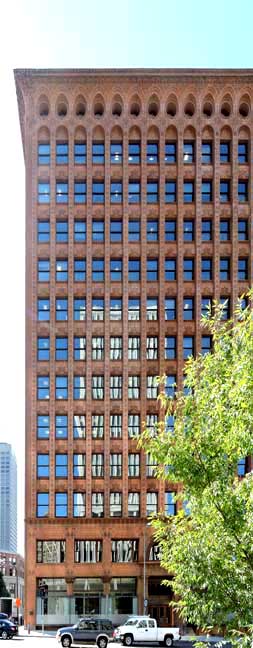
2006 Exterior Photos - Guaranty
Building
Formerly known as the
Prudential Building
28 Church Street, Buffalo, NY
TEXT Found Beneath Illustrations
|
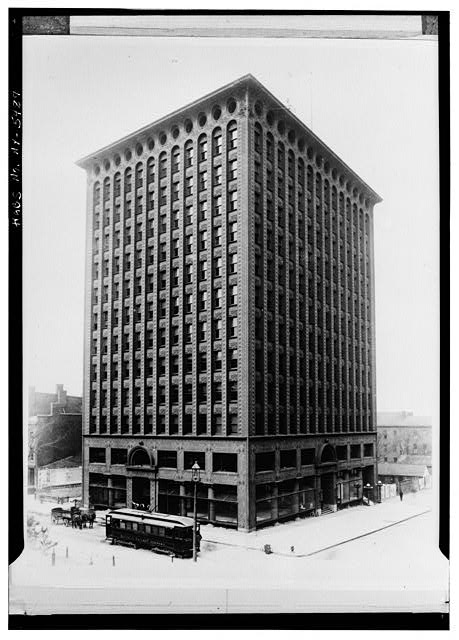
C. 1900 photograph |
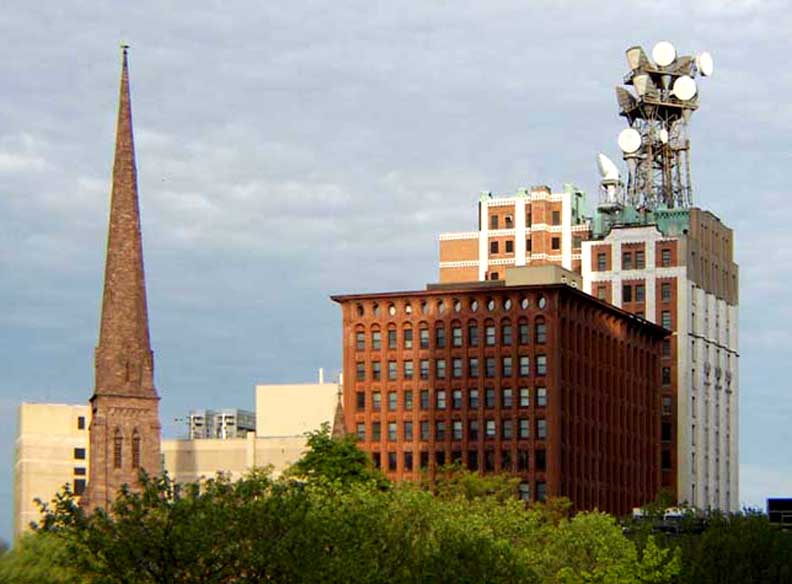
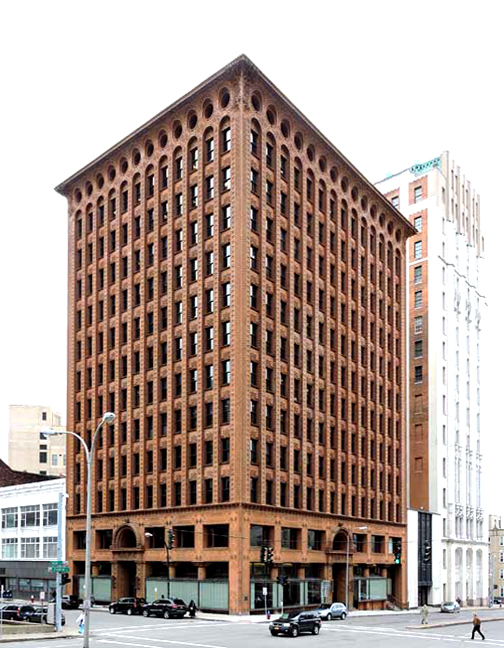
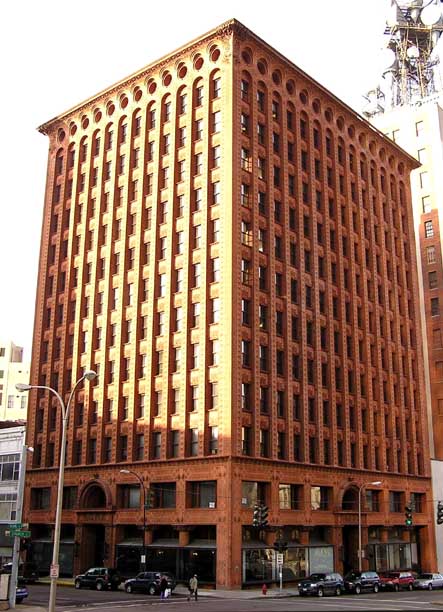
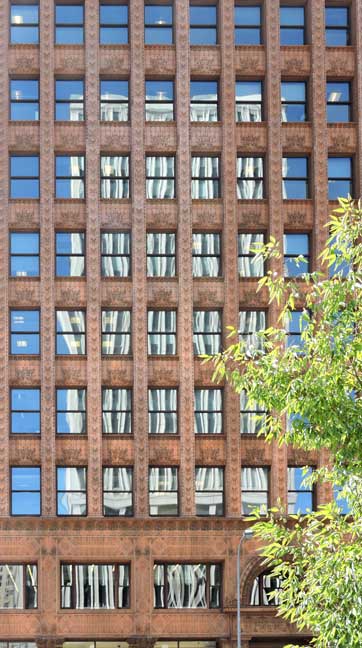
Terra cotta and glass exterior |
Overhanging cornice ornamented with terra cotta tree branches |
|
Geometric and nature motifs |
Terra cotta and glass "skin" made possible by a steel skeleton |
Top: overhanging cornice |
|
|
Top: overhanging cornice |
|
|
|
|
Botanical and geometric forms |
|
One interpretation: caterpillars (at right) and plant pods (at left) where the insects enter to eventually emerge as butterflies |
Supporting evidence for the interpretation of the preceding photo: Book of Kells detail illustrating moth |
|
|
|
|
|
|
Light standards no longer standing |
1980 restoration uncovered the original glass and metal that had been covered over in the 1970 remodeling |
Note "Prudential," added after the refinancing by the Prudential Insurance Company in 1898 |
|
|
|
|
|
Art Nouveau capital emphasizing a nature motif with vines, etc. |
This building is world famous because of two reasons:
1 - It has great historical value because it is an early skyscraper (the last building designed by Adler and Sullivan), and
2 - The interior and exterior Art Nouveau ornamentation is aesthetically exquisite.Constructed by the Guaranty Construction Company of Chicago in 1895-96, the building was refinanced by the Buffalo Prudential Insurance Company in 1898, and the new owners altered the façade by adding its name.
Excerpts from
Chicago Ceramics and Glass
by Sharon S. Darling
Chicago Historical Society, Chicago, IL, 1979Terra cotta (Latin for "burnt earth") had been used as a building material in other parts of the world since ancient times, but it was not employed for architectural purposes in America until the early 1870s, when the country's first architectural terra cotta factory was established in Chicago. Here rapid rebuilding after the Great Fire, technological progress, and architectural innovations - the same combination of factors that encouraged the widespread use of ornamental glass in private and public buildings - also stimulated experimentation and, in time, extensive use of architectural terra cotta in the city.
Taking advantage of steam-powered machinery, nearby clay deposits, and Chicago's excellent transportation network, local terra cotta manufacturers quickly created a thriving industry.Adler & Sullivan
During a productive fifteen-year association, lasting from 1880 through 1895, Dankmar Adler became known for his technical ingenuity while Louis H. Sullivan earned praise for his imaginative decorative designs. During the mid-1880s when Adler & Sullivan were establishing their architectural practice, the buildings they designed often featured terra cotta ornament.
Sullivan, who was primarily responsible for the ornamentation, favored conventionalized motifs derived from botanical forms. For example ... the Troescher Building on South Market Street (demolished 1978), and ... the Ruben house on South Ashland Avenue - both designed in 1884 - displayed angular floral abstractions, incorporating shells and snake-like spirals.
But in the course of the next few years Sullivan's botanical motifs gradually became more natural and luxuriant, taking the form of elongated buds, sinuous tendrils, and sharply pointed leaves.
A further evolution of Sullivan's style of terra cotta ornamentation became evident in the early 1890s as geometrical forms began to supplement the botanical motifs. For example, the Schiller Theatre Building ... featured large geometrical forms intertwined with small clusters of curly leaves in light brown terra cotta ....
George Grant Elmslie
Adler & Sullivan's Guaranty Building's ruddy terra-cotta facade is embellished with Sullivan's rich foliage and geometric ornament, some of which (most of the exterior cladding except for the cornice) was detailed by George Grant Elmslie, Adler and Sullivan's chief draftsman. (The modeling was done by Christian Schneider)
Christian Schneider
A man of essential importance to the execution of the delicate terra cotta ornament incorporated in many Purcell & Elmslie buildings was not employed directly by the firm but by the American Terra Cotta and Ceramics Company owned by W. D. Gates.
Sculptor Christian Schneider had modeled much of the terra cotta and iron work designed by Louis Sullivan and George Elmslie since 1892, and he excelled as no other person in translating their delicate, two dimensional drawings into the three dimensional forms of clay and metal. Almost all of the best terra cotta ornament designed by the Purcell firms passed through his gifted hands. The distinction between his abilities and those of other sculptors can be seen by comparing his work with that done after Schneider left the terra cotta company, when the modeling became visibly less sensitive.
.................................Cannon Design architects who headed the restoration were Ronald J. Battaglia and Peter Flynn
................2004-05:.. New owners, Hodgson Russ law firm, restore exterior. Work done by Flynn Battaglia Architects.
................2005-06:.. Hodgson Russ law firm restore interior
Special thanks to the owners of the Guaranty Building,
the Hodgson Russ
law firm, and especially Harry
G. Meyer, for their assistance