Illustrated FURNITURE Glossary............. Illustrated Dictionaries - Table of Contents
Illustrated Art Glass / Lighting Dictionary
A ..... B ..... C ..... D ..... E ..... F ..... G ..... H ..... I ..... J ..... K ..... L ..... M ..... N ..... O ..... P ..... Q ..... R ..... S ..... T ..... U ..... V ..... W ..... X ..... Y ..... Z
Acid Etching
See Etching below
Applied border
Many of the finest shades made by Steuben have an applied border of either platinum or gold Aurene (below). These are high workmanship items because the border was made separate and then applied or welded to the main portion of the shade.
Argand
The burner type designed by Ami Argand which employs a circular wick held between to concentric metal tubes and uses a chimney and improved air flow design to produce a brighter, more efficient flame. Also refers to the early style of lamp using the Argand principle with a centrally located oil fount feeding the burner that is mounted on an arm away from the fount. The more recent student lamp is a revival of this early design.
Art Deco style
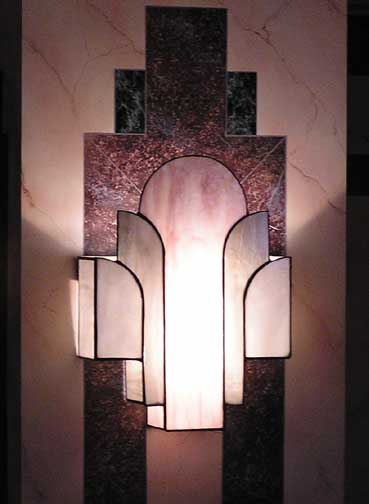
The name "Art Deco" comes from the 1925 Exposition Internationale des Arts Decoratifs Industriels et Modernes, held in Paris, which celebrated living in the modern world.Art Deco was essentially a style of decoration and was applied to jewelry, clothing, furniture and handicrafts as well as buildings. Industrial designers created Art Deco motifs (patterns) to adorn their streamlined cars, trains and kitchen appliances. Art Deco ornamentation consists largely of low relief geometrical designs, often in the form of parallel straight lines, zigzags, chevrons and stylized floral motifs.
See also: Art Deco architecture and Art Deco furniture
- Illustration: Carl Slone Antique Lighting and Windows
- Chandelier, pendant, table lamp, sconce - Hotchkiss-Sidway House
- 6 hanging light fixtures - Carl Slone Antique Lighting and Windows
- Ceiling light fixture - Kelly Schultz Antiques
- Pendants, sconces - Pierce-Arrow Showroom
- Outdoor wall sconce - Buffalo Industrial Bank
- Illuminated men's room sign - North Park Theatre
- Pendant, sconce - Norton Memorial Hall, Chautauqua, NY
- Pendants - Café Americain, American Hotel, Amsterdam, Netherlands
- Sconce - Grand Hotel, Amsterdam, Netherlands
Art Nouveau style
The French "new art" that took bold in Europe and America in the 1890's. The style used flat patterns of twisting plant forms based on nature, sometimes tortured. It was characterized by its use of fluid, sinuous lines and organic, elongated forms. The movement's signature motif was the S-curve, which might be found in a flower's stem on a brooch or the trail of smoke from a cigarette depicted in a theater poster.Sinuous lines, "whiplash" curves, and organic motifs, such as plants and flowers, characterized the Art Nouveau style.
The style, which means "new art," gets its name from a design shop, La Maison de l'Art Nouveau, which German entrepreneur Siegfried Bing opened in Paris in 1895. The shop was one of the major outlets for the glass of Emile Galle, the art glass of Louis Tiffany, the jewelry of Rene Lalique, and the furniture of Eugene Gaillard and George DeFeure.
In the United States, Louis Comfort Tiffany was a major proponent of the movement.
Art Nouveau shade patterns: Aurene / Drape / Feather, Pulled feather, Peacock feather / Fishnet / Heart and vine / Leaf and vine / Ribbing / Spider web / Stalactite / Threading
See also: Art Nouveau - Architecture and Art Nouveau - Furniture
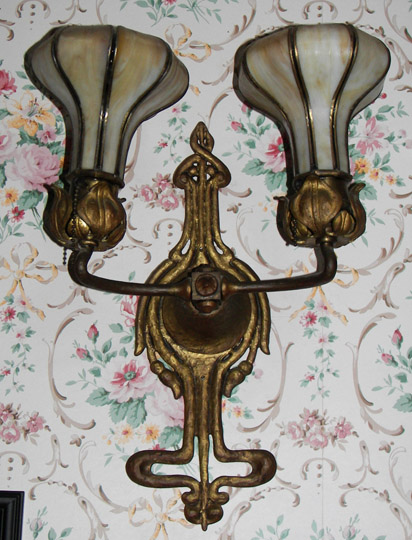
- Illustration: Green pulled feather - Statler House
- Sheffield - Carl Slone Antique Lighting and Windows
- Sheffield - Carl Slone Antique Lighting and Windows
- Pulled feather - Carl Slone Antique Lighting and Windows
- Outdoor sconce - Guaranty Building
- Sconce, chandeliers - Guaranty Building
Arts and Crafts style 1900-1925
In 19th century England, the Arts and Crafts movement was an outraged response to the Industrial Revolution, which was threatening time-honored manual crafts with extinction. The movement was also one of social and political reform.In America, the Arts and Crafts movement, 1890-1920 is often referred to as the Craftsman movement.
See also: Arts and Crafts - Architecture and Arts and Crafts - Furniture and Art Nouveau (above)
The primary legacy of the Arts and Crafts movement in lighting is that it brought together two rich and romantic materials - brass and opalescent art glass - in fresh and original ways. Opalescent art glass radiated the glowing warmth of hearth and home, while brass was easy to work and took finishes readily (popular ones included brushed, sanded and mottled brass or copper).
Best known of the Arts and Crafts lighting styles was Mission, which emerged about 1905 to become lighting's equivalent of the bungalow - simple, honest, accessible and unpretentious. Defined by square forms and lack of ornamentation, Mission fixtures were found in homes of many different styles.More elaborate Arts and Crafts designs might include leaded mosaic glass work, unusual square-link chain or hand-hammered brass lanterns. Even the most basic and straightforward fixtures possessed a progressive and modern sensibility that challenged the Victorian and Colonial Revival status quo.
Lighting styles of this era included Arts and Crafts and Old English, Mission and Craftsman.
- Bo Sulllivan, Illuminating the Past
- Illustration: Wright-designed ceiling pendant - Barton House
- Pendant, sconces - Barton House
- Sconce - Davidson House
- Wright-designed floor lamp - Graycliff, Derby, NY
- Buffalo Sconce
- Statler House
- Henry Hudson's Ship, Half-Moon, sconces - Carl Slone Antique Lighting and Windows
- Pendants, table lamp - Roycroft Inn, East Aurora, NY
- Table lamp, Steuben ceiling fixture - Elbert Hubbard Roycroft Museum, East Aurora, NY
- Table lamps, sconce - Elbert Hubbard Roycroft Museum, East Aurora, NY
- Outdoor hanging fixture - Gamble House, Pasadena, California
- Outdoor lamp - Paris Métro
Aurene
The name "Aurene" was derived form the Latin word for gold, "aurum," and the old English word for sheen or luster, "schene."Glassmaker Frederick Carder (Steuben founder) invented this brand of ornamental glass in 1904. To produce a murky translucent glass with an iridescent surface, the glass was sprayed with stannous chloride or lead chloride, and then reheated. It was the first iridescent glass Steuben made, and both the gold and the blue colors are very similar to glass that was being made by Tiffany and called "Favrile."
Steuben (below) Aurene colors: variations of deep ruby red, pink or salmon, green, brown
Steuben green Aurene decorations: leaf and vine, broken thread, peacock feather, diamond optic, applied border with zig zag, Murano type wave, copper wheel engraved designs
Steuben brown Aurene shades: from light tan through orange brown to a dark chocolate brown, many with zig zag decorated border. Some decorated with other Aurene colors such as r, blue, green, gold, or white. Most lined with either white Calcite or alabaster
- Illustration: Signed Steuben shades - Carl Slone Antique Lighting and Windows
- C. 1900 brass ceiling fixture - Carl Slone Antique Lighting and Windows
- Sheffield - Carl Slone Antique Lighting and Windows
- Craven/Bassett House - Example #1
- Craven/Bassett House - Example #2
Blowpipe, blow iron
An iron or steel tube, usually about five feet long, for blowing glass. Blowpipes have a mouthpiece at one end and are usually fitted at the other end with a metal ring that helps to retain a gather (below).The Romans discovered glassblowing in about 50 B.C.
For more inforamtion, see Illustrated Stained Glass Dictionary: Glassblowing
- Illustration: artwork at Corning Museum of Glass
Blown glass / Hand blown glass
Glass that is made on a blowpipe, formed and shaped by hand.To produce glass, a gaffer (below) gathers a glob of molten glass on the end of a blowpipe. The gaffer inflates the glob slightly by blowing, and then manipulates it by swinging, rolling or shaping it with tools. Then the gaffer inflates the piece to its proper size, possibly within a mold in order to achieve a specific shape.
For more inforamtion, see Illustrated Stained Glass Dictionary: Glassblowing
- Tiffany Flower-form Vase - Corning Glass Museum
- Roman Egyptian Glassware - Corning Glass Museum
Bracket lamp -- Any variation of lamp designed to be mounted on a vertical surface and extend outward. Many are adjustable side-to-side and swing outward. Brackets can be made of brass, bronze, cast iron, etc. Founts can be either metal or glass. Many bracket lamps feature reflectors mounted behind the lamp to increase the light output.
Broken Thread
See Zipper below
Calcite glass
Colorless or white mineral used in the manufacture of glassPerfected about 1915. It has a white tone with ivory translucency.
Used for the outside of cased glass such as "Aurene on calcite."
Canopy
The part of a lighting fixture the mounts to the ceiling. In a pull-down hall lamp fixture, the part that hangs from the ceiling and contains the pulleys.
- 1933 Lincoln Manufacturing Co. flashed glass chandelier - Carl Slone Antique Lighting and Windows
Carnival glass
This inexpensive glass with vivid gold, orange, and purple iridescence was made in the United States between about 1895 and 1924. It is so called because it was frequently offered as fairground prizes.Carnival glass is an inexpensive pressed glass, made as both functional and ornamental objects, always iridescent and found in a wide spectrum of colors.
It was produced in the U.S., Britain, Australia, and several European and Asian countries from the early 20th century until the present.
Carnival glass gets its iridescent sheen from the application of metallic salts while the glass is still hot from the pressing, then re-firing the glass
Chandelier
A ceiling mounted light fixture that has at least one arm branching out from a central support
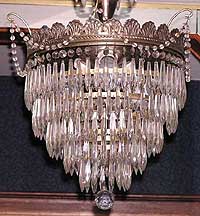
- 4 chandeliers - Carl Slone Antique Lighting and Windows
- Hagia Sophia, Istanbul, Turkey
- St. Stephen Walbrook
- Courier Express Building
- C. 1800 cut glass, brass chandelier
Chimney
Usually a glass (sometimes mica or even metal) enclosure that helps control the flow of air to and around a lamp burner.
Chipped glass
See Glue-chipped glass below
Classical Revival/Beaux Arts style 1895-1935
The 1893 World's Columbian Exposition in Chicago introduced many things to the American public, including Cracker Jack candy and the Ferris wheel, but perhaps its most lasting influence was on architecture. Constructed almost entirely in the Classical Revival (or Beaux Arts) style, the "White City" signaled the end of colorful and exotic buildings. Within just a few years, the artful, picturesque, asymmetrical designs of the VictorianGreek and Roman architecture.
Classical Revival fixtures were heavy and substantial looking, projecting an aura of permanence and power. These fixtures, as well as the shades that adorn them, can usually be distinguished by boldly detailed Classical motifs such as egg and dart, ribbon and bay, acanthus leaf and Greek key. era were being replaced by columns, capitals, coffers and pediments inspired byIn addition, the introduction of the tungsten-filament light bulb around 1910 made more opaque forms of glass viable, and large indirect and semi-indirect bowl fixtures become popular in dining rooms and other large spaces.
The brass and bronze parts found in Classical Revival fixtures are often solidly cast and meticulously detailed. Common finishes included polished and brushed brass, as well as the blue-green patina known as verde gris or verde antique.
Lighting styles of this era included Classical Revival, Beaux Arts, Baroque/Rococo and French/ Italian Renaissance.- Bo Sulllivan, Illuminating the Past
Colonial Revival style 1905-1940
Colonial Revival lighting also has a bit of a split personality. On the one hand, we find the elegant and sophisticated polished-brass or silver-plated fixtures enhanced by sparkling crystals and wheel-cut shades, while on the other are the rustic and "hand-forged" designs that celebrate wrought iron and the blacksmith's hammer.
Either way, frequent features include chains, dangling finials and sockets that evoke the memory of candles or oil-burning lamps of the earlier period.
Lighting styles of this era included Colonial Revival, Sheffield (see below), Georgian/Adam and Late Colonial Revival.
- Bo Sulllivan, Illuminating the Past
See Sheffield below
Core-forming glass
3 basic ways of forming glass:Core-formed (ancient systm before glassblowing)
Glassblowing (above)
Rolling (Cathedral glass)In the 16th century B.C., western Asian craftsmen made glass vessels by core forming. This process was introduced in Egypt around 1450 B.C.
Core-formed glass was usually opaque (allowing little or no light to pass through).
[The Egyptian glassmaker] first made a core of clay combined with dung. He then wound hot glass around the core. The glass was reheated and smoothed by rolling it on a flat surface. Next, the glassmaker trailed glass thread of brilliant colors - turquoise, blue, yellow, red, white - around the surface and dragged them up and down to form waves or feathery patterns. When the vessel was finished, he picked out the clay core with a pointed instrument.
- Chloe Zerwick, "Glass in Pre-Roman Times"in A Short History of Glass, 1980, pp. 15-16
- Illustration: Core-formed Egyptian Jars - Corning Glass Museum
- Jar, Eastern Mediterranean, possibly Cyprus - Corning Museum of Glass
Custard glass
First produced in England around 1880, novelties, salt dips, small baskets, etc., were created in creamy custard glass but it was not made in America for nearly five more years. The first American company said to produce custard glass was the Dithridge Company in Pittsburgh, Penn.
With all the cream-colored glass on the market, how can you tell if you've found a piece of genuine custard glass? Buy a small, portable black light and shine black light on the piece so you'll know for sure whether or not it's custard glass because the genuine article will take on an unearthly, luminous glow.
In custard glass, uranium is what gives the glass its deep cream color. In fact, if you have a Geiger counter handy, you will also get a positive reading on custard and any other form of uranium glass.- Source: Tammy Springer
One of the popular patterns used at Steuben was called Drag Loop. It is found on many shades and vases and is occasionally found on other pieces also.
The pattern is often mistakenly called a feather; however it differs from the feather in that the hook used in pulling the hot glass went in one direction only. This leaves no center spine which is formed on the regular feather as a result of the hook being pulled one way and then the opposite. The Drag Loop design is nothing more than a loop or festoon.- Darrah L. Roberts, Collecting Art Nouveau Shades, 1972, p. 31
Drape pattern
"This motif is actually a variation of the pulled feather decoration. The drape is different, however, because it adorns the bottom portion of the shade. The undecorated portion is toward the fitter rim. Also, the drape pattern usually repeated only four times, while the feather was duplicated five times. The gaffer sometimes pulled the glass threads the entire length of the shade." - Darrah L. Roberts, Collecting Art Nouveau Shades, 1972
Electrolier
[Formed from electric in imitation of chandelier.] A branching frame, often of ornamental design, to support electric illuminating lamps.
- Art Deco electrolier - Carl Slone Antique Lighting and Windows
Enameled
Engraving
The surface of the glass is decorated by scratching the surface with a rotating copper wheel or a diamond.
Etching
Glass decorated by biting out designs or motifs by means of acid applied to unprotected surfaces. The he glass surface is covered with wax, the desired design is inscribed in the wax, and then hydrofluoric acid is applied. The acid will only corrode the areas that are not covered by wax. This process produces a flatter design than engraving.A method of producing designs/patterns on glass whereby acids are used to remove part of the glass and make the design.
Traditionally this was done after the glass was blown or cast.
In the 1920s a new mould-etch process was invented, in which art was etched directly into the mould, so that each cast piece emerged from the mould with the image already on the surface of the glass. This reduced manufacturing costs and, combined with a wider use of colored glass, led to cheap glassware in the 1930s, which later became known as Depression glass.
- C. 1880 newel post gas light - Carl Slone Antique Lighting and Windows
- Rococo Revival lighting fixture - Carl Slone Antique Lighting and Windows
- Art Nouveau amber scallop edge shade - Carl Slone Antique Lighting and Windows
- Art Nouveau shade - Carl Slone Antique Lighting and Windows
- Carl Slone Antique Lighting and Windows
- Carl Slone Antique Lighting and Windows
- 216 Metcalfe Street
Feather, Pulled feather, Peacock feather pattern
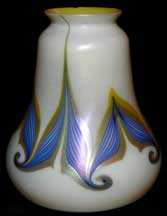
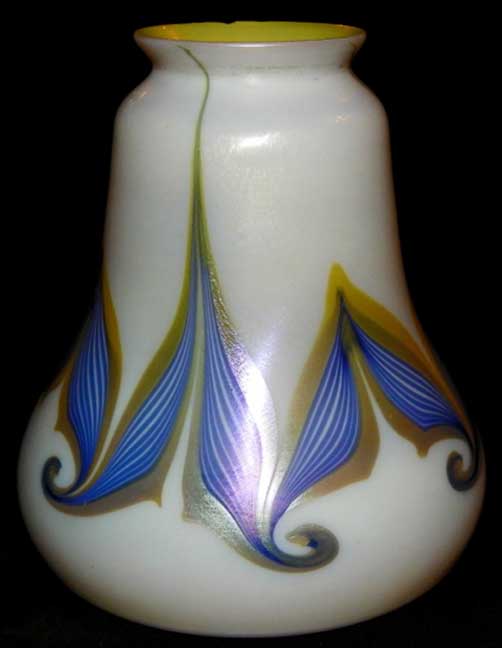
Colored canes of glass are wound around the body while red hot and molten. and then been combed or "pulled" to create the feather-like appearance. The center spine is formed on the regular feather as a result of the hook being pulled one way and then the opposite.
The pattern most often seen as a decoration on shades is the feather pattern. Thousands of shades were so adorned. This pattern was used by all six of the firms known to have made high quality iridescent shades. A wide range of colors were used, with either green, yellow, or gold being the most common. Red is least often seen. The names listed above all describe the same decoration.
The feather decoration was formed by first spinning a fine thread of colored glass on the partially blown parison [see Shades below]. The threads were spun around and around the piece to be decorated. They were always separated, however slight this separation may have been in some cases, The parison was reheated at the glory hole of the furnace, and then by using a steel hook the gaffer pulled the threads of hot plastic glass into the desired pattern.The piece was returned many times to be reheated so it could be kept in a plastic state and workable. Temperatures were vital for the gaffer [above] because the shade would break if an attempt was made to work it while it was too cool. Other serious handling problems arose if the shade was overheated.
After the feather was formed the piece was rolled on the steel marvering board which pushed the threads into the main body of the shade.
On some shades a contrasting border was formed first, and then the feather was pulled inside this frame.
Shirt Hooked Feather and Short Feather: We call it a short feather because it is short and does not cover as much of the outside area of the shade as the regular feather pattern does. - p, 40
- Darrah L. Roberts, Collecting Art Nouveau Shades, 1972, p. 31
- Illustration: Pulled feather with peacock eye - Carl Slone Antique Lighting and Windows
- Craven/Bassett House - Example #1
- Craven/Bassett House - Example #2
- Tiffany Flower-form Vase - Corning Glass Museum
Fishnet pattern
The fishnet pattern is actually nothing more than a double feather (above) pattern, one over the other. One of the feather patterns was pulled in one direction while the other was pulled in the opposite way. This can be seen on close inspection of the marks left by the gaffer's (below) hook as the hook traveled both directions in each track.
To make the fishnet shade the threads for the underneath half of the decoration were spun on the parison (below). They were reheated until the gaffer could pull the threads into the coarse feather pattern. The parison and threads were again reheated and marvered (below) into the body of the shade. The last half of the decoration was then spun on over the marvered-in threads. These threads were free enough so that the gaffer could pull them into the pattern desired without disturbing the marvered in threads underneath., which left a fishnet pattern on the piece.- Darrah L. Roberts, Collecting Art Nouveau Shades, 1972, p. 90
Fitter
Generally the lower rim (or lip) of a chimney, globe or shade that that fits into a metal ring, burner or holder. A hall lamp shade, for example, would have a fitter on both ends.
Flashed glass
The process of a glass item being dipped into hot glass of another color in such a manner to cause only a thin layer of it to adhere. This is a less expensive method for making a piece of glass appear to have been made in a solid color. This is a blown glass method and is not to be confused with staining used on pressed glass.
Also known as plating, flashed glass is sometimes cut through to the thicker layer beneath the flashing. The flashing is probably about as thick as a sheet of paper and can still be scratched through, but not as easily as staining.
- Art Deco electrolier - Carl Slone Antique Lighting and Windows
Gaffer
"The gaffer was most skilled and usually in charge of a shop. He was the worker who pulled the hot plastic glass into the various shapes such as King Tut, feather (below) and other pulled decorations and who did the final shaping of the piece." - Darrah L. Roberts, Collecting Art Nouveau Shades, 1972
Gasolier / Gasolier (gas a LEER)
[Formed from gas, in imitation of chandelier.] A chandelier arranged to burn gas.
- Illustration: Carl Slone Antique Lighting and Windows
- Electrified gasolier
Gather/gob
(Noun) A mass of molten glass (sometimes called a gob) collected on the end of a blowpipe [above] or gathering iron;
(verb) to collect molten glass on the end of a tool.
- Illustration: 2009 demonstration at Corning Glass Museum
Glass
Glass is a hard material with non-crystalline, random structure like a liquid. It is commonly made by combining materials such as silica, potash, and lead oxide at a high temperature in order to allow the materials to melt and fuse together. When cooled rapidly, the substance becomes rigid . Glass is often classified as a supercooled liquid rather than a regular solid.Glass is made with very basic ingredients. Sand is the main ingredient, and then added to that are ashes from trees or plants which help the sand to melt. Something like lime is also added which is a stabilizing ingredient, and it protects the glass from moisture.
Virtually the same recipe as that given on a cuneiform tablet of the seventh century B.C. is in use today.
No one really knows how glass came to be made. it is older than the Ten Commandments and probably originated somewhere in the Middle East. it was adopted by the Romans, who contributed significantly to its development; it flowered under the Islamic empire; and it reached new heights in Renaissance Venice, whence it spread throughout Europe and eventually to America.
- Chloe Zerwick, A Short History of Glass, 1980, Introduction
3 basic ways of forming glass:
Core-formed (ancient systm before glassblowing; above)
Glassblowing (above)
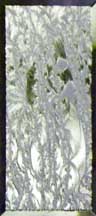
"Glue chipped glass is glass that has been etched and covered in warm, wet hide glue. As the glue cools, it attaches to the rough glass. As it dries, it shrinks and rips thin shards off the surface in a fern-like random pattern." - AngelGilding.com (June 2011)
"...surface of the glass is chipped by the controlled action of a particular type of hide glue. The texture looks like ice crystals on glass in winter and is used as a striking decorative effect as well as to block the view through a piece of glass without blocking out light." - Etch Master (June 2011)
"A unique surface texture created by applying a thin layer of animal hide glue to a cathedral glass and then heated in an oven. As the glue dries it pulls away from the glass surface and chips it. Different patterns created include single, double, and oceanic. The texture is often described as feathered or like frost on a window pane." - The Store Finder (June 2011)
Illustration: Temple Beth Zzedek
Gone With The Wind Lamp
Generally a vase or parlor lamp with a removable fount and matching painted or embossed decoration on both the lamp base and shade.
Gothic /Gothic Revival
Illustration: Episcopal Church of the Ascension
St. John's United Evangelical Church / St. John's United Church of Christ
Heart and vine motif
Hob nail
Some people identify hobnails as large-headed nails used to protect the sole of a heavy boot or shoe. But in the world of glass, the word "hobnail," sometimes spelled "hob nail," has a very different meaning. "People refer to the hobnail pattern as 'the little things that stick out on a piece of glass,'" says Kathleen Bailey, an ANTIQUES ROADSHOW appraiser and dealer based in Seattle and Issaquah, Washington. "The easiest way to describe it is as glass that has little bumps over most of its surface."
The word hobnail probably comes from the first surname in Hobbs, Brockunier & Company, from South Wheeling, West Virginia, the company that first patented the raised bumps. Their hobnail pieces are the most famous ones from the late 19th century. The company would sometimes advertise the pattern with other names, such as nodule, dewdrop, or pineapple, but hobnail has become the popular term for the glass.
The pattern went out of fashion in the first half of the 20th century, but was revived from the 1940s to the 1970s by companies such as Duncan Miller and the Fenton Glass Company; the latter is still in business today. Other companies that have offered hobnail patterns were Millersburg, West Moreland, L.G. Wright Company, and Imperial.One popular type of hob nail style on lamp shades is found on milk glass.
- Illustration: Hand blown canary yellow - Carl Slone Antique Lighting and Windows
- Hand blown red - Carl Slone Antique Lighting and Wind
- Illustration: Tiffany blue hooked feather shade - Private collector, Buffalo
Iridescent
Showing a changeable rainbow of colors.Not a surface texture, but a special surface finish. Finish produces a metallic sheen creating a colorful, shimmering, rainbow effect.
Glass with a colorful shimmering effect created when a layer of metallic oxide is bonded to hot glass.Tiffany had his "Favrile" glass and Carder developed a similar line he called "Aurene," but other glassmakers followed their lead and also produced iridized glasswares.
- Illustration: Sconce - Barton House
- Another sconce - Barton House
- Tiffany shade - Private collector, Buffalo
- Tiffany Flower-form Vase - Corning Glass Museum
Jeweled
Any lamp or component part (such as a hanging lamp frame) that is adorned with cut or faceted colored glass cabochons.
- Ceiling fixture - Carl Slone Antique Lighting and Windows
King Tut pattern
The King Tut decoration is certainly one of the most popular and sought-after motifs to be found on fine art glass today.
The design consists of threads of glass, usually of a contrasting color, being hooked or pulled in a swirl pattern on the outside of the piece. Usually the motif was repeated twenty to forty times until it covered the entire outside of the shade. However, in some cases it was restricted to two-thirds or three-fourths of the area, with the remaining portion either left plain or adorned with a Broken Thread or zipper (below) design.
The threads of glass used must have, at times, been quite fine, where as many as twelve green threads in a quarter inch area can be counted and still show separation when viewed with a magnifying glass. This would suggest that at the time the thread of glass was applied, it must not have been much larger in diameter than a human hair. The threads would naturally be further broadened when flattened out during the marvering (below) process.In addition the shade may have been decorated while it was smaller and this would tend to expand the thread more when it was blown to its final size.
The King Tut decoration demanded a physical dexterity that only a few gaffers were able to really master well. It was executed at its finest by Emil J. Larson who made his version of the design famous while working as a gaffer at Durand.- Darrah L. Roberts, Collecting Art Nouveau Shades, 1972, p. 29
- Illustration: Tiffany shade - Private collector, Buffalo
Lantern
A lighting device, commonly used outdoors, that utilizes a globe to protect the flame from wind and the elements. Most often carried from place to place, thus of fairly rugged construction.
Leaded glass
Glass objects in which lead is used to solder together separate pieces of glass together into a larger whole. Most early stained glass is leaded.
Leaf and vine decor, Clinging vine (Durand Co. name)
If one company were to be singled out as the one producing the finest commonly seen Leaf and Vine decoration, it would be Steuben and by an overwhelming margin... Characteristically, the Steuben Leaf and Vine is a one-color motif. If the leaf is gold the vine is also gold. This rule is good for all of the other colors in which Steuben's Leaf and Vine is known, such as blue, platinum, green, and white...
Before the decorating of a leaf and vine shade could begin, a rod of glass of the color to be used was prepared for the gaffer. Several thin slices were cut from this glass rod and applied to the body of the shade in random positions. The shade was reheated often during this process, with the gaffer pulling down through each leaf with his steel hook to form the heart-shaped leaves. The completed leaves were then rolled in flush, or they might be left largely unmarvered, if that was desired. The fine thread of glass intended as the vine portion of the decorations was then spun on over the leaves and this was either marvered in or left as it was spun on. This is one thing Steuben did consistently when making Leaf and Vine decorated shades; the leaf was applied first and then the vine was applied over the leaf.- Darrah L. Roberts, Collecting Art Nouveau Shades, 1972
Loetz Glass Co.
See Shiffer Books: Loetz Glass Information and History
- Illustration: C. 1900 hand-blown shade - Carl Slone Antique Lighting and Windows
- Hexagonal shade with red/green drizzle - Carl Slone Antique Lighting and Windows
- C. 1900 green pulled feather opalescent shade - Carl Slone Antique Lighting and Windows
Mantle
A specially made 'tube' or cone of treated material that produces an incandescent glow when heated by a kerosene or gas flame.
Marvering, Marvering board
Marvering is the pre-shaping of the glass gathered on the preheated end of the blowing iron (above). This pre-shaping is carried out by rolling the glass backwards and forwards across a marvering table (or marver plate), adjusting the angle of the blowing iron to give the approximate shape desired.Marvering board: A metal or wooden table or slab - which was wax or oil coated for lubrication - on which the gob or gather (above) glass at the end of the blowpipe could be rolled to give the approximate shape desired.
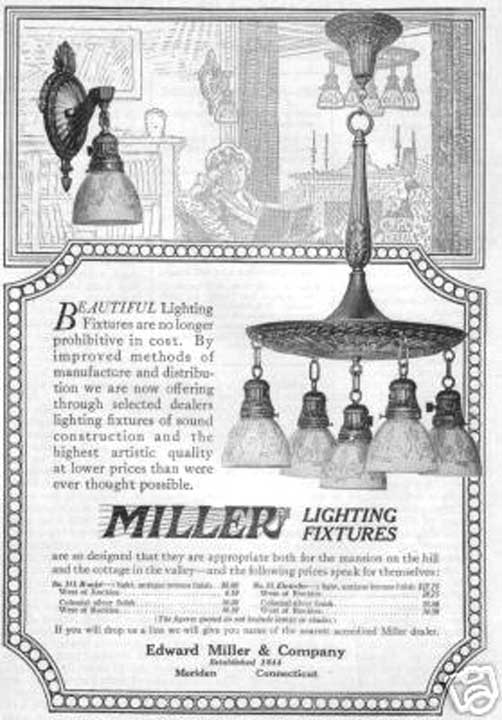
Edward Miller started his business in Meriden, Connecticut, in the 1840's making and selling camphene and burning fluid burners.
When Colonel Edwin L. Drake struck oil in Titusville in 1859, kerosene quickly became a safe and affordable lamp fuel. Miller envisioned an immediate need for burners for the new fuel and seized the opportunity.
In 1868, Miller constructed a brass rolling mill to keep up with his company's demand for brass
As gas became a viable fuel source for cooking, heating and illumination, Miller entered into the manufacture of gas lighting fixtures and stoves. As the age of electricity beckoned, Miller followed the trend, or more appropriately, blazed new trails. He improved upon Thomas Edison's carbon filament lamp by designing a tungsten filament lamp. Miller pioneered mercury vapor and fluorescent lighting systems in the late 1930's as well.
Starting around 1884 through 1892, Edward Miller & Company manufactured the "ROCHESTER" line of lamps for The Rochester Lamp Company, located in New York City. They billed themselves as "The largest wholesale and retail lamp store in the world," with branch stores in London, Paris and Chicago. Edward Miller produced, according to the catalog, 2000 designs and of variations of the Rochester, and in every manner of lamp - table, hanging store lamp, hanging library lamp, pull-down hall lamps, bracket lamps, night lamps, and more.
Edward Miller died in 1909 at the age of 82. The Miller Company is still in existence today.
- Illustration: Bent panel table lamp - Carl Slone Antique Lighting and Windows
- Four table lamps - Carl Slone Antique Lighting and Windows
- Poster
Mold blown glass
Glass that is formed by being blown into a shape or pattern mold, not free-formed.Mold Marks :Seam lines that remain on the body of the glass after it is removed from the mold.
- Illustration: 2009 demonstration at Corning Glass Museum
Mushroom shade
- Art Deco electrolier - Carl Slone Antique Lighting and Windows
Newel post light
Opalescent
Exhibiting a milky or pearly iridescence like that of an opal.See American opalescent glass - LaFarge and Tiffany
Parison
The gather [above] of hot glass after it has been partly or wholly inflated by the glass blower.
Patina
The sheen on any surface, produced by age and use.
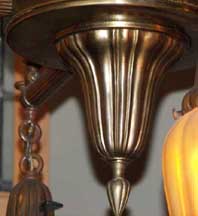
- C. 1900 brass ceiling fixture - Carl Slone Antique Lighting and Windows
- C. 1880 newel post gas light - Carl Slone Antique Lighting and Windows
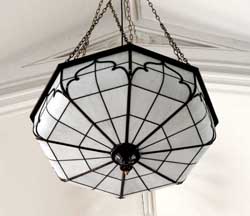
Pendant lights are any lights that hang from a ceiling, whether they hang over a kitchen island or a dining room table.
Pendant lights can cast direct light or diffuse light, and can be decorative or utilitarian.
Many pendant lights, such as chandeliers, have several branches.
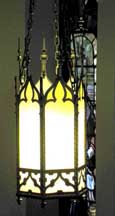
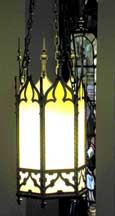
- Episcopal Church of the Ascension Gothic Revival style
Pot
A fired clay container placed in the furnace in which the batch of glass ingredients is fused, and kept molten. The glass worker gathers directly from the pot.
Pressed glass
Glassware formed by placing a blob of molten glass in a metal mold, then pressing it with a metal plunger to form the inside shape. The resulting piece, termed "mold-pressed," has an interior form independent of the exterior, in contrast to mold-blown glass, whose interior corresponds to the outer form.
Prisms
Dangling glass pendants used to embellish a lamp. Often of high quality glass, cut and faceted, to reflect and refract the light. Found on many hanging library/parlor lamps, on girandoles, and overlay lamps, to name a few.
Pulled feather shade
See Feather above
Quezal Art Glass Company
The Quezal Art Glass and Decorating Company was established in Brooklyn, New York, in 1901, and was in operation until about 1924.
The chief officer was Martin Each who had learned how to make iridescent (above) glass while working at the Tiffany glass works. The company was successful in creating excellent examples of Art Nouveau (above) glassware and probably produced more shades than any other firm.
The Quezal company took their name from the colorful South American Quezal bird. The name was chosen because of the similarity in coloration between the bird and the glass made by Quezal.
The production of shades at Quezal was large. Shades are known to have been made in every color and in nearly every known decoration, shape, and size. Sizes range from the smallest lily and similar miniatures up to large ornate ceiling fixtures which hold very large shades.
The workmanship shown on most Quezal shades is excellent. This is especially true of those which have an engraved signature. Many shades are adorned with hard-to-make motifs such as King Tut, hooked feather, zipper, fishnet, applied flowers, and some "pulled" decors which were especially pleasing. Quezal also made shades which had the decoration embedded in clear glass.- Darrah L. Roberts, Collecting Art Nouveau Shades, 1972
Quezal was considered to be a major rival of Louis Comfort Tiffany's glass as they produced iridescent glass which was widely regarded to be of the same high quality as Tiffany's glass.See also:
- Malcolm Neil MacNeil, Quezal art glass, part 1
- QUEZAL GLASS INFORMATION & HISTORY
- Illustration: Sheffield chandelier detail - Carl Slone Antique Lighting and Windows
Rococo / Rococo Revival styles
Rococo: Ornate style originating in France in the 18th century and evolving from the Baroque styleRococo Revival: Introduced to America around 1840 and remained dominant throughout the 1860s. Although it is based on the 18th-century European Rococo style, it is much bolder than its model. Ornament is carved in higher relief, and decorative detail is usually far more realistic.
See also: Rococo / Rococo Revival - Furniture
- 1850 brass four-arm - Carl Slone Antique Lighting and Windows
Shades
The Making of an Art Nouveau Shade
All hand blown, iridescent, Art Nouveau style glass was made by a group of workers in what was called a "shop." The larger operations, such as Tiffany Glass Company, may have had two or three shops in operation at the same time while small firms such as Lustre Art and Durand only operated one shop. The crew needed for making shades or vases consisted of the following glass workers:
The gaffer [A master craftsman in charge of a team of hot-glass workers, probably coming from "grandfather"]
The decorator or servitor
The blower and sometimes an assistant
The gatherer
The carry-in boy or boysThe gaffer was most skilled and usually in charge of a shop. He was the worker who pulled the hot plastic glass into the various shapes such as King Tut, feather (below) and other pulled decorations and who did the final shaping of the piece.
[Start:] A shade began as a gather (above) of glass on the end of the blow iron (above). If a cased shade was planned, the gatherer started with a lining, dipping this into the different pots of colored metal (molten glass), in succession, to form the base glass and overcoat. Sometimes the baseglass or overcoat was prepared in advance in cup shape, and the glass used for the lining was blown into this, making the cased parison [partially blown].
[Decoration:] If the shade was to be decorated, it was done at this time. The decoration consisted of a thread of hot glass, usually of a contrasting color, applied to the outside of the partially blown shade, which was probably in bullet shape at this stage. The threads of glass were then pulled with a steel hook into various decorations .... Certain decorations, such as Spider Webbing, were not done until the shade was blown to its full size.
After the decoration was complete the shade was reheated at the glory hole of the furnace and blown to its full size. Sometimes the shade was blown first into a mold which formed it into the desired shape. Then it was removed and blown further to its final size.[Fitter rim:] Forming the fitter rim was the next step. This was done by trimming the outer end and forming a flange by the use of the usual glassworking tools. (This had to be 2 1/4, inches in diameter, give or take an eighth inch, if the shade was to have a standard size fitter rim.) No standard tool was used in doing this job, so each shade was likely to have a fitter rim of slightly different size and shape.
[Shade bottom:] The piece was then transferred to the pontil rod by sticking the recently completed fitter rim on a small gather of molten glass attached to the end of the rod. The blow iron end of the piece was then cut off or trimmed to form the bottom rim of the shade. This end was then often notched or ruffled by pushing the hot shade in a crimping die of the proper- shape and size. The crimping on some shades, especially some Quezals, appears to have been done one crimp at a time since they are unevenly spaced. This left each shade slightly different.
[Iridescence:] The shade was now ready to receive its iridescence (above). It is our honest belief that no one knows exactly how this was accomplished at that time. We do know that the matrix of which much high quality glass was made is the main difference between it and the cheaper imitations. The metallic properties placed in the matrix came to the surface of the glass and were seen for the first time when the piece was held in a reducing flame, It is also known that the shade or vase was sprayed with some substance (possibly metallic chloride) which fractured the surface of the glass into millions of small, light-reflecting facets which we see as iridescence. This was done while the shade was hot. In addition, it is known that some shades were given a fuming treatment of specially formulated gases or vapors which give them a particular iridescence. Other methods may have been used as well. If the exact method of making this glass was common knowledge, we would probably be plagued with reproductions today. Such manufactures, however, would become most time consuming and costly. Wages and other costs now aren't what they were in 1910.
The shade was finally held by asbestos-lined tongs, snapped off of the pontil rod and carried into the tempering lehr [a special type of oven or kiln used specifically for annealing glass] where it was cooled slowly to relieve the internal stresses in the glass. When the shade was cool, the fitter rim was ground down to remove any roughness left by the pontil rod or to remove any other unevenness. Some shades were then given an acid finish which had the effect of satinizing the glass. After a final inspection the shade was ready to be placed in inventory and offered for sale.- Darrah L. Roberts, Collecting Art Nouveau Shades, 1972, pp. 29-30
Slip fit shades
- Art Deco chandelier - Carl Slone Antique Lighting and Windows (second row)
Snake-thread decoration
In the Roman era, glass objects were sometimes decorated with trails of molten glass. These trails were applied in curved, snakelike designs. They were then worked with tools to produce notches or crisscross patterns.
Later trailed vessels included objects that were decorated before they were blown to their full size and shape. The trails were dragged up and down with a too l. The objects were then rolled on a smooth surface until the trails were flat.
- Illustration: Egyptian Glassware - Corning Glass Museum
Spider Webbing
This method of decorating a piece of art glass was used by at least three of the firms that made high quality iridescent shades and vases.
Although the design was used years before by both Quezal (above) and Lustre Art, it was left to Durand to name it. They called it Spider Webbing.
The Spider Webbing motif consists of a fine thread of glass which was spun around and around the piece until it covered most of the area on the outside of the shade or vase. The threads of glass were usually quite fine and were often placed over a leaf (above) or feather (above) design of some kind. The fine threads were left as they were spun on and were not marvered in.
Spinner motion lamp
A spinner bearing is a small piece that fits in the center top of the inner spinner in the motion lamp. It is smaller than a dime. It sits on the needle-like spinner post, just over the light bulb. The inner-spinner bearing is usually present, but on many older lamps it is missing. With No Bearing, the lamp simply will not spin. Bearings can be replaced.
- Colonial Fountain - Carl Slone Antique Lighting and Windows
Stained glass
A process of coating a piece of glass with a chemical whose true color is developed by heat. This is the least expensive way of coloring glass.The staining material is painted on the annealed [cooled] article with a brush wherever the decorative effect is desired. It is then fired on for permanency at which time the glass assumes the desired color.
Stalactite shades, globes, bulbs
Shape imitates cave stalactites.
Art Nouveau (above) or Art Deco (above)This design is blown and formed directly into the glass and is not painted on.
Tiffany Studios was one of the companies that made some Stalactite chandeliers.
The company was acquired by Corning Glass Works (now Corning Incorporated) in 1918, and in 1933, Arthur A. Houghton, Jr. was appointed Steuben's president. Soon after, he revolutionized the art glass industry with the introduction of clear Steuben crystal -- a new optical glass of unparalleled brilliance and purity formulated by Corning Glass Works scientists.
Tiffany had his "Favrile" glass and Carder developed a similar line he called "Aurene," but other glassmakers followed their lead and also produced iridized (above) glasswares.
- Illustration: Signed aurene shades - Carl Slone Antique Lighting and Windows
- Ceiling fixture - Elbert Hubbard Roycroft Museum, East Aurora, NY
Threading
See Zipper, Broken Thread above
- Illustration: Gold threads on calcite - Carl Slone Antique Lighting and Windows
Tudor Revival style
Victorian styles 1880-1910
Victorian lighting was defined by the two leading trends of the day - technology and a taste for ornamentation. As the primary light sources were dim gas burners and carbon-filament bulbs, fixtures were often multi-arm affairs with numerous sockets or jets to maximize light output. Until about 1910, electricity was expensive and poorly distributed, so "combination" fixtures that used both gas and electricity were common. Most fixtures were turned on or off directly at the fixture and hung quite low relative to today's standards
.
Like the houses in which they hung, Victorian fixtures tended toward elaborate and graceful designs that aspired to be "artistic and beautiful" - the highest compliment of the day. Most utilized finely detailed decorative-glass shades that enhanced the light without obscuring it. Fixtures were constructed of polished brass or bronze, often finished in gilt, silver-plate or rich antiqued treatments.. Lighting styles of this era included Renaissance Revival, Romanesque (Medieval), Aesthetic/Anglo-Japanese, Empire, Exotic, Art Nouveau and Victorian Vernacular.
- Bo Sulllivan, Illuminating the Past
- Illustration: Stella Lowry House
- Carl Slone Antique Lighting and Windows
Most of the decorations found on shades are "pulled," but the Broken Thread or "zipper" pattern is one of the few that differs from this technique.
The Broken Thread design was made in the following way: The partially blown parison was blown or pushed into a mold (above) which formed vertical ribs (above) on the piece. Thus formed, the parison was removed from the mold, and a fine thread of glass was spun on it which went around and around the piece horizontally. This thread touched and adhered to the high part of the ribs. It did not touch down in the valleys between each rib.
The partially completed shade was then reheated, causing the fine threads to break and draw up on each rib; somewhat as taffy or sugar frosting will break and draw up when pulled or tested.
The shade was then rolled on the marvering board (above) until the decoration was rolled in smooth and most of the ribs erased.
The decorating process was then complete, and the gaffer could reheat the piece and continue on with the further blowing, shaping, trimming, and forming of the shade.
A wide rib would result in a broad zipper line, and a sharp rib would result in a fine line of broken threads. If you study a zipper shade carefully you can see where the glass thread drew up after breaking, resulting in a ball at one end of each zipper.
Sometimes the zipper decoration was placed over another decoration. This was more difficult because the ribs had to be formed in over the marvered-in threads.
- Illustration: Carl Slone Antique Lighting and Windows