Bricks - Table of Contents ............ Illustrated Architecture Dictionary.................Frank and Jane Clement Brick Museum
Bricks
- Table
of Contents
............ Illustrated
Architecture
Dictionary.................Frank
and Jane Clement
Brick Museum
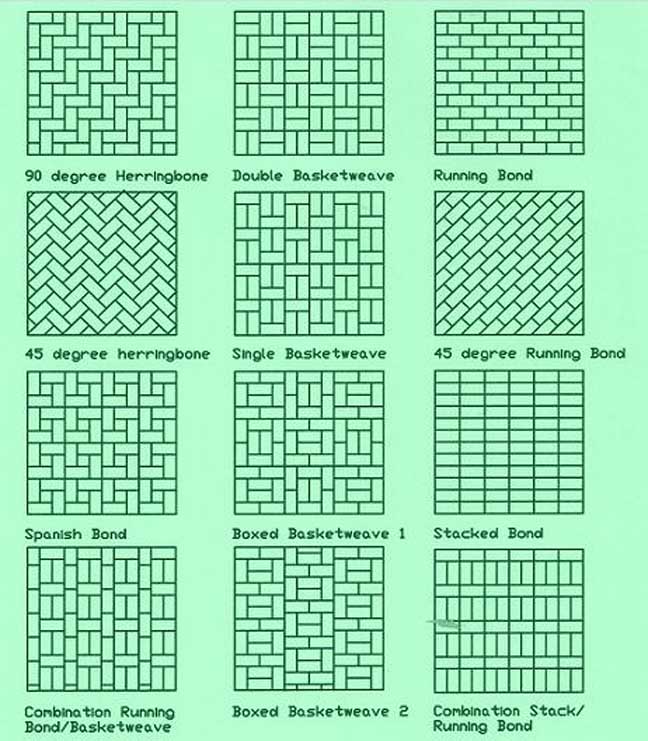
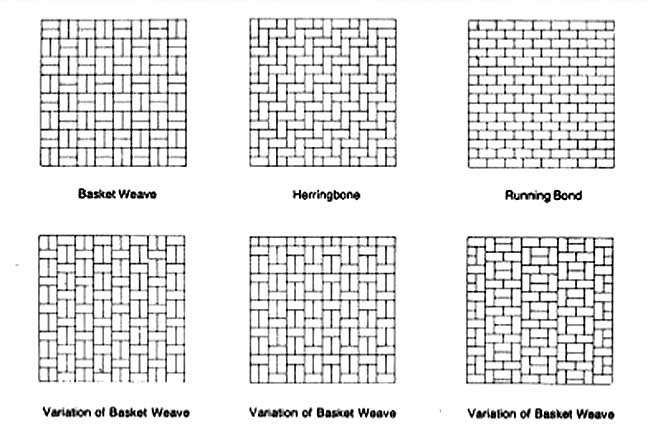
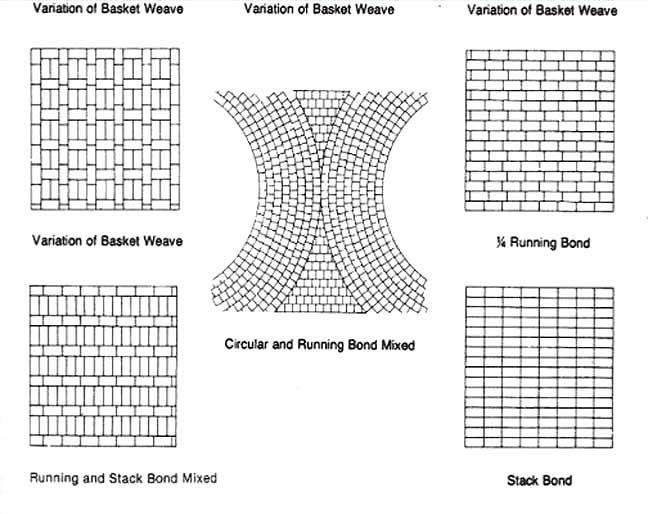
Bond
A patterned arrangement of masonry units to provide strength, stability, and in some cases, beauty.
Course: A row of bricks, when laid in a wall, is called a course. . Each horizontal layer of brick in a masonry structure is called a course.
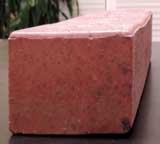
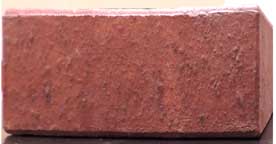
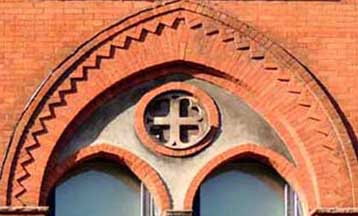
Soldier: A soldier course is one in which brick are laid standing on end with the narrow edge facing out. This type of course is sometimes used for decorative effects over door and window openings and in fireplace facings (vertical, long, narrow).
Sailor: A sailor course is similar to the soldier course but with the wide edge facing out. It is used for decorative effects (vertical, long, wide).
Morter: Pasty building material composed of sand, lime and cement mixed with water. This mixture gradually hardens when exposed to the air. Mortar is used as a joining medium in brick and stone construction.
Joint: A joint is the mortar bond placed between individual masonry units such as brick, block or stone.
Weeping joints: Mortar is left to ooze and drip down from the joints between the brick courses.
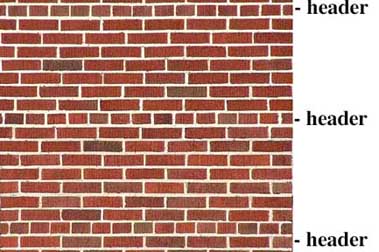
Header: short side of the brick faces out. During Colonial times, the silver color of the headers occurred on bricks placed close to the wall of the kiln. In effect, these were overbaked.
A header course consists entirely of headers (horizontal, short, narrow side laid on wide edge).
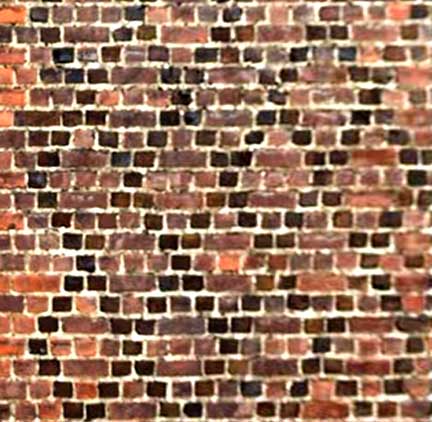
Flare header: A brick having a darker end exposed as a header in patterned brickwork
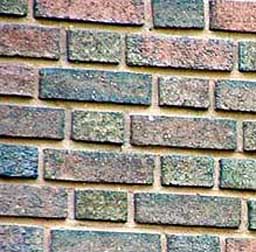
Stretcher: Long side of the brick faces out
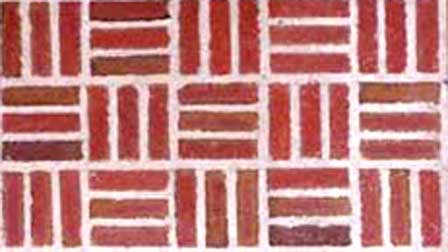
Basket weave
Source: Oregonbrick.com (online August 2016)
Source: Oregonbrick.com (online August 2016)
Source: Oregonbrick.com (online August 2016)
Della Robbia Weave bond ... Source: Walton & Sons Masonry, Inc. (online August 2016)
Example: Bemis/Ransom House
Basket weave
Common bond /American bond
Flemish bond
English bond
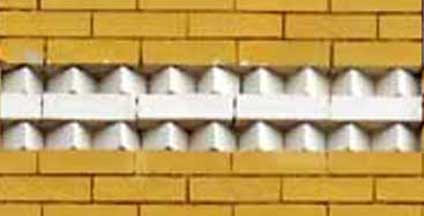
Saw tooth
Saw tooth
Diamond
|
Flemish
Bond
Virginia
Glazing results from the way the bricks were stacked in kilns (or temporary kilns called clamps) for firing. The headers were positioned closest to the heat source and were thusly glazed or vitrified just as a piece of clay pottery would be glazed. A brick, after all, is a ceramic. In colonial Virginia and neighboring colonies, brick kilns were normally fueled with oak. The potassium in oak produced a chemical reaction with the clay resulting in the clear blue-gray glazes on the headers, which provided a rich contrast to the red stretchers. By the mid-18th century, the stands of oak in eastern Virginia were being depleted. Hence, softer woods, such as pine, were used to fire brick kilns. Pine does not produce the light blue glazes that oak does but instead turns out smutty black headers. Black headers were not considered attractive, thus when a wall was laid up in Flemish bond, the black glazed headers were laid facing inward and the unglazed headers were exposed on the wall surface. This gave the walls an overall even color ... Rubbed bricks continued to be used at jambs and corners but the color contrast was not as strong. ---- Philadelphia Glazed-header Flemish bond continued to be used in well into the 18th century. However, Philadelphia headers tend to be black rather than the light blue-grays of Virginia and Maryland. This is probably the result of firing bricks with wood other than oak. The black headers are a dominant element of Philadelphia’s Carpenters’ Hall, built 1770-73. Regrettably, much of Philadelphia’s 18th-century brickwork was irreparably damaged by sandblasting during the city’s extensive restorations of the 1960s and ‘70s. Carpenters’ Hall fortunately was spared this misguided disfiguring; its brick surfaces and mortar joints remain in good condition. ---- The use of Flemish bond experienced resurgence in the late 19th and 20th centuries, brought on by the popularity of the Colonial Revival and Georgian Revival styles. - Calder Loth, Classical Comments: Flemish Bond: A Hallmark of Traditional Architecture (Online Dec. 2012) |
Examples:
English bond - Statler Hotel
English bond - Ullmann House, 260 Middlesex Rd Several examples
Herringbone bond - Lafayette Presbyterian Church Fireplace hearth
Herringbone bond - David Wallace House Floor
Herringbone bond - 27 University Avenue
Herringbone bond - Medieval Fortified Town of Carcassonne, France
Saw tooth - Hellriegel House
Running bond - 36 Capen Blvd
Stretcher bond / running bond - Williams-Butler House
Stretcher bond / running bond - Engine #15 Fire Station
Common/American bond - Ullmann House, 260 Middlesex Rd.
Medley of bonds - Stratford Arms