Modern
Style
FURNITURE
................Modern
Style
Architecture
International
Style
1920s
- Middle 1970s
Buffalo: 1950s-1960s
 |
 |
| Barcelona Pavilion | Main
Place Tower and
Mall ,
Buffalo |
The International Style blossomed in 1920s Western Europe: the Dutch de Stijl movement, the work of visionary French/Swiss architect Le Corbusier and the German Bauhaus.
The term International Style came from the 1932 exhibition at the Museum of Modern Art, organized by Philip Johnson, and from the title of the exhibition catalog for that exhibit, written by Johnson and Henry Russell Hitchcock.
In a broader view, the international style is part of late 19th and early 20th century Modernism - the conviction that the traditional forms of art, architecture, literature, religious faith, social organization and daily life were becoming outdated in the new economic, social, and political conditions of an emerging fully industrialized world.
Bauhaus in the US
The Bauhaus lasted from 1919-1933, at which time the faculty fled to escape Nazi Germany. (School building photo) When Walter Gropius and Marcel Breuer fled, they both arrived at the Harvard Graduate School of Design, in an excellent position to extend their influence and promote the Bauhaus as the primary source of architectural modernism. When Ludwig Mies van der Rohe fled in 1938, he came to Chicago, founded the Second School of Chicago at IIT and solidified his reputation as the prototypical modern architect.
After World War II, the International Style matured, HOK and SOM perfected the corporate practice, and it became the dominant approach for decades.
Features:
See also: Mid Century Modern
- Radical simplification of form
- Rejection of ornament
- Open interior spaces
- Adoption of glass, steel and reinforced concrete as preferred materials
- Ribbon windows
- Smooth and undecorated wall surfaces
- Flat roofs
- Cantilevers
- Curtain walls: In a framed building, an exterior wall having no structural function
In architecture, the term "International Style" describes a type of design that developed mainly in Germany, Holland and France, during the 1920s, before spreading to America in the 1930s, where it became the dominant tendency in American architecture during the middle decades of the 20th century.
Although it never became fashionable for single-family residential buildings in the United States - despite the efforts of William Lescaze (1896-1969), Edward Durrell Stone (1902-78), Richard Neutra (1892-1970) - the International Style was especially suited to skyscraper architecture, where its sleek "modern" look, absence of decoration and use of steel and glass, became synonymous with corporate modernism during the period 1955-70. It also became the dominant style of 20th century architecture for institutional and commercial buildings, and even superceded the traditional historical styles for schools and churches.
Origins and Development
The International Style emerged largely as a result of four factors that confronted architects at the beginning of the 20th century:
(1) Increasing dissatisfaction with building designs that incorporated a mixture of decorative features from different architectural periods, especially where the resulting design bore little or no relation to the function of the building;
(2) The need to build large numbers of commercial and civic buildings that served a rapidly industrializing society;
(3) The successful development of new construction techniques involving the use of steel, reinforced concrete, and glass; and
4) A strong desire to create a "modern" style of architecture for "modern man". This underlined the need for a neutral, functional style, without any of the decorative features of (say) Romanesque, Gothic, or Renaissance architecture, all of which were old-fashioned, if not obsolete.
- Encyclopedia of Art and Design: International Style of Modern Architecture (online May 2016)
A curtain wall is defined as thin, usually aluminum-framed wall, containing in-fills of glass, metal panels, or thin stone.
The framing is attached to the building structure and does not carry the floor or roof loads of the building. The wind and gravity loads of the curtain wall are transferred to the building structure, typically at the floor line.
Aluminum framed wall systems date back to the 1930's, and developed rapidly after World War II when the supply of aluminum became available for non-military use.
- Excerpts: Nik Vigener, PE and Mark A. Brown, Building Envelope Design Guide - Curtain Walls (online May 2016)
HousesIn the decades separating World Wars I and II, Americans tended to prefer period houses that reflected past traditions, while European architects emphasized radically new designs that came to be known as International style architecture. Le Corbusier had stressed the idea of the house as a "machine for living."
During the 1930s these ideas were introduced into the United States by several distinguished practitioners, like Walter Gropius and Mies van der Rohe, Richard Neutra and Marcel Breurer who emigrated to escape the developing chaos in Europe.
Defining features:
- Simple geometric forms, often rectilinear
- Asymmetrical
- Form characterized by a series of volumes
- Reinforced-concrete and steel construction with a nonstructural skin
- Occasionally, cylindrical surfaces
- Unadorned, smooth wall surfaces, typically of glass,steel, or stucco painted white
- Complete absence of ornamentation and decoration; often, an entire blank wall
- Often, a cantilevered upper floor or balcony
- Houses in this style are characterized by open interior spaces and are commonly asymmetrical
- Commercial buildings are not only symmetrical but appear as a series of repetitive elements
- Flat roof, without a ledge, eaves, or coping, that terminates at the plane of the wall
- Large areas of floor-to-ceiling glass or curtain walls of glass
- Metal window frames set flush with the exterior walls, often in horizontal bands
- Casement windows; sliding windows
- Doorway treatments conspicuously plain, lacking decorative detailing
Furniture
Examples from Buffalo architecture:
- Central Library 1964
- M&T Bank 1966
- Right illustration above: Main Place Tower and Mall 1969
- 371 Linwood Avenue House 1930
- Bethlehem Steel Office Building 1958
Other examples:
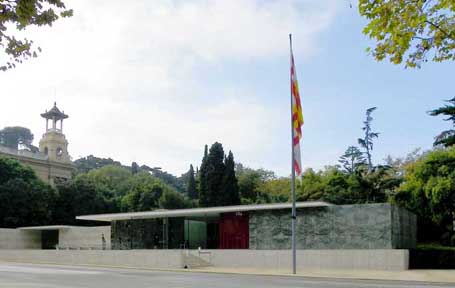
- Left illustration above: Barcelona Pavilion 1929
- IBM Building, Seattle, by Minoru Yamasaki 1964
- Rainier Tower, Seattle, by Minoru Yamasaki 1977
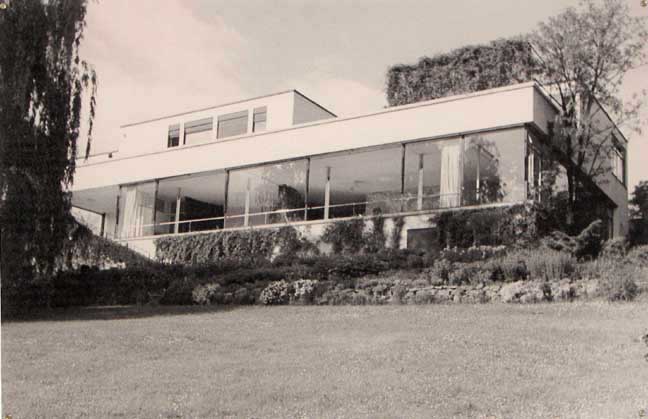
- Villa Tugendhat, by Mies van der Rohe - Hofmobileliendepot Imperial Furniture Collection,Vienna, Austria On display in 2005
- Villa Tugendhat, by Mies van der Rohe (Great Buildings)
- The Seagram Building, by Mies van der Rohe (Great Buildings)
- The Farnsworth House, by Mies van der Rohe (Great Buildings)
- Garden Grove Church, by Philip Johnson (Great Buildings)
- United Nations Headquarters, by Le Corbusier (Great Buildings)
- Kaufmann Desert House, by Richard Neutra (Great Buildings)
- The Lovell House, by Richard Neutra (Great Buildings)