Renaissance and Reformation Stained Glass Windows .................. Stained Glass - Table of Contents
Munich Pictorial Style Stained Glass Windows in Western New York
In General
Mayer of Munich
F. X. Zettler
Tyrol Art Glass
Josef Scherer
Other firms
In GeneralThe Munich Pictorial Style style developed out of the Royal Bavarian Stained Glass Establishment in 1827 under Ludwig I of Bavaria (1786-1868) who sought to turn his capital into an unrivaled center of German art and culture. Ludwig I sent German art and German artists to the United States.
"Although Munich windows were made of traditional hand-blown antique glass, both Munich windows and American opalescent windows typically eschew the flatness and emphatic leading of medieval windows in favor of an idealized naturalism and spatial realism. - Leo Thomas ...
Broadly speaking, the artistic style is Romantic. The artistic language of Munich glass owed much to the revival of religious painting - especially fresco painting in the tradition of the Italian Renaissance masters, especially Masaccio, Raphael, and Michelangelo - in Germany early in the 19th-century.
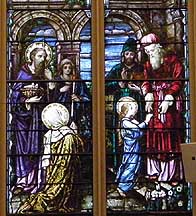
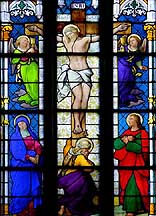
Munich style windows are recognizable and respected for their elaborate, finely executed painting. The style was composed of painting on relatively large glass panels (as opposed to the medieval technique of smaller pieces of colored glass) held in a leaded framework. Each window was made up of small colored glass pieces that were coated with overlay color and tracing lines before being fired and leaded.
"Christ, saints, heavenly hosts, and ordinary people are attired in jeweled tone and richly embroidered fabrics. Backgrounds contain intricately woven tapestries and finely laced cloths. Throughout the narrative scenes are lush plantings and a multitude of flowers each so well rendered that botanical identity is possible. The abundant landscaping is reflective of the Romanticist's belief that nature can be the source for the spiritual experience." - Gail Tiemey, Franz Mayer and Company and Zettler Studios
1847 Joseph Gabriel Mayer (1808 - 1883) founded the “Institute for Christian Art“. He visualized a company that was “…a combination of fine arts, architecture, sculpture and painting…“ to revitalize the medieval building trades.
Around 1860 a stained glass department was created.
In 1865 the first overseas branch was opened in London.
In 1882 the company was awarded the status of “Royal Bavarian Art Establishment“ by King Ludwig the II.
Following this, the studio moved into an rich and active period with over 500 employees and world-wide business connections. This was achieved during the management of Franz Borgias Mayer (1848 - 1926) who was the founder’s son.
In 1888 a new branch in New York City was opened bringing the company to full international status and in 1892, Pope Leo XIII named the company a “Pontifical Institute of Christian Art“.
Franz Mayer and Company
1848-
25 Seidl Street
Munich, West GermanyIn 1848 Joseph Gabriel Mayer founded the Establishment for Architecture, Sculpture, and Painting under the probable patronage of King Ludwig I of Bavaria. Royal commissions for the Cologne and Regensburg cathedrals and the Maris Helf Kirche in Au soon prompted J. G. Mayer, his son Franz Borgias, and his son-in-law F. X. Zettler, to expand the establishment by including a division for stained glass.
In 1882 King Ludwig II conferred on the firm the title of "Royal Bavarian Court Institution." Under the direction of Franz Borgias Mayer, the firm (now known as Franz Mayer and Company) attained its highest international fame for art glass.
Still in the family today, the company is now headed by Gabriel Mayer, a direct descendant of the founder, and continues to design and execute windows in all styles and techniques - medieval, contemporary, and also naturalistic.
The thousands of stained glass windows executed by Franz Mayer and Company for cathedrals, churches, and chapels all over the world include: by order of Pope Pius X in 1912, a stained glass window for St. Peter's Church in Rome, Italy, representing the dove, symbol of the Holy Ghost, surrounded by golden rays; a number of windows in four chapels of the North American College in Vatican City; and many of the stained glass windows in Roman Catholic cathedrals in cities of the United States, such as Buffalo, Cleveland, Covington, Los Angeles, San Francisco, St. Augustine, and Spokane.
Mayer windows in churches and chapels are represented in the Detroit area at Duns Scotus Seminary, St. Boniface Roman Catholic, St. Florian, St. Cecelia, Our Lady of Lourdes Church, Cathedral Church of St. Paul, Church of the Messiah, Christ Church-Detroit, and Trinity Episcopal.
- Discovering Stained Glass in Detroit, by Nola Huse Tutag. Detroit: Wayne State U. Press, 1987, p. 151 (Table of Contents at the bottom of the page)
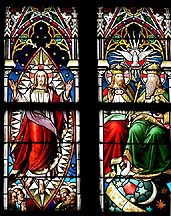
"Stylistically, Mayer's windows tend to contain richly colored scenes bordered by architectural frames consisting of pilasters, columns, architrave and elaborate canopies. The frame treatments within the windows vary according to the structure and tastes of each church. Commonly, the lower portions of the windows have richly bordered panels.
These architectural frames and panels are derived from directly from medieval stained glass models. Within the frames are narrative scenes based on the life of Christ or Old Testament stories. Frequently, many parishes ordered individual windows portraying Saints, Apostles, and Old Testament figures. - Gail Tiemey, Franz Mayer and Company and Zettler Studios
We should note that the Munich pictorial style is not to everyone's taste, and it certainly has had its detractors over the years. Frueh remarks that some find the subject matter overly sentimental, while James Sturm notes that critics of the style find it overly embellished and sometimes poorly executed on a technical level. ... we can see the hand of different painters at work and, consequently, the variation in skill between them.
Whatever our individual tastes may be, or the technical merits or flaws of particular windows, the fact remains that this work is found in many fine churches and cathedrals around the world for a reason. It represents an aesthetic that was evidently prized in its time for its craftsmanship and opulence as well as for its ability to engage the viewer emotionally and spiritually.
Wealthy Protestants might prefer opalescent windows, which were complicated and expensive to make, but Munich glass windows could be imported as art, i.e., glass 'paintings' and - exempt from a high tariff on imported 'raw' glass - cost less than opalescent windows and windows made in America using imported glass. Although often derided by English glass artists as too pictorial, and viewed as an economic threat by American glass firms, the broad aesthetic appeal, economic advantage, and papal approval made Munich glass windows the overwhelming choice among Roman Catholics in the United States.
The relationship of Munich and Austrian studios to glazing in the United States was profound. Catholic patronage gravitated to these firms, which were not only adept in high quality work but also familiar with Catholic traditions and piety.
Most of the larger studios set up American business offices. The Tiroler Glasmalerei was known as the Tyrolese Art Glass Company at 50-61 Park Place, New York.
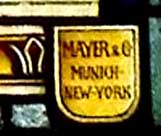
Mayer signed the studio's windows in America as "Mayer and Co., Munich, New York," and Zettler also had an American branch. Foreign studios also associated with American firms; for example, the Daprato Statuary Company of Chicago and New York advertised itself in 1910 as the sole representative for Zettler in the United States and Canada.
A reflection of these years can be found in publications by the studios themselves, such as the 1894 volume by Josef Fischer commemorating forty years of business by the Tiroler Glasmalerei Anstalt. The text reveals the studio's ideas of which were its flagship commissions, and a section was devoted to windows installed in the United States.
Mayer's windows and those by Franz Xavier Zettler (1841-1916), son-in-law of Joseph Gabriel Mayer (1808-83), founder of the Mayer firm, whose businesses ultimately intertwined, are ubiquitous in American Catholic churches. Mayer's commissions include over seventy-six cathedrals, twenty-six of them in the United States. The studio often incorporated imagery from Great Master paintings as well as compositions of the nineteenth century, a standard practice in public decorative work of the era. For example, a window in the cathedral of St. John the Baptist, Charleston, South Carolina, installed in 1907 or 1925-26, shows the Transfiguration of Christ modeled after the 1517 painting by Raphael in the Vatican.
- Virginia Chieffo Raguin, Stained Glass: From Its Origins to the Present, 2003, pp. 205-210 EXCERPTS
Excerpts from
German and Austrian Stained Glass Windows in Chicago
Spurensuche (online 2009)
Chicago has been a great center of German and Austrian made stained glass.
Since the Great Fire of 1871 the studios of Franz Mayer and F.X. Zettler, both of Munich, Germany, and the studios of the Tyroler Glasmalerei Anstalt (TGA) in Innsbruck, Austria began to send representatives to sell their new decorative patterns for churches. These three studios often worked together and their style is interchangeable.
From the 1870s to the 1920s, Chicago became the most influential center of Catholic culture in the United States. Unlike that of any other period of history, its state of- the-art church design included brightly colored windows, often displaying action packed scenes from biblical events or episodes from the life of a patron saint.
Today superb examples of windows made in Munich by F.X. Zettler or Franz Mayer can be seen in churches such as Saint Vincent de Paul ... A set of windows depicting the Mysteries of the Rosary and dedicated to Mary, Mother of God, were made by the Tiroler Glasmalerei Anstalt (signed TGA) of Innsbruck, Austria for St. Stanislaus Kostka.The Munich style lost much of its appeal in the 1920s. Today it is appreciated as a fine expression of German aesthetics and artistic sensitivity in the face of an almost overpowering American competition led by Louis Comfort Tiffany.
|
"F.
X.
Zettler, Munich, Bavaria. Franz Xavier Zettler
originally
worked for his father-in-law Joseph Gabriel Mayer and
founded the
stained glass department within Mayer’s 'Institute of
Christian Art' in
1862. He struck out on his own in 1870 and his fledgling
company
achieved its first success with award-winning windows
displayed at the
1873 International Exhibition in Vienna. By the end of the
decade,
Zettler’s firm had 150 employees and its success continued
to be
confirmed with additional honors and awards. In the 1893
World’s
Columbian Exposition in Chicago, a Zettler window won top
prize over a
Tiffany. 'Professor Franz,' as students and admirers knew
Zettler, died
in 1916 at the age of 75. The F. X. Zettler Studio was
reunited with
the Mayer Studio in 1939." - King
Richard's
Liturgical Design & Contracting (online April
2021) |
"Tyrol Art Glass Company, Innsbruck, Austria. Beginning in the 1870s after The Great Fire, Chicago became a great epicenter for German and Austrian stained glass. The Munich studios of Franz Mayer and F.X. Zettler and the studios of the Tyroler Glasmalerei Anstalt (Tyrol Art Glass Company) in Innsbruck began to send representatives to sell their new patterns for churches. These three studios often worked together and their style is interchangeable. From the 1870s to the 1920s, Chicago became the most influential center of Catholic culture in the United States. Unlike that of any other period of history, its state-of- the-art church design included brightly colored windows, often displaying action packed scenes from biblical events or episodes from the life of a patron saint. The appeal of Munich and Austrian style glass declined greatly after the 1920s in the face of almost overpowering American competition led by Louis Comfort Tiffany." - King Richard's Liturgical Design & Contracting (online April 2021) |
|
Other Munich or Munich-style firms of the time included the following:
- van Treeck (Munich),
- Fred Müller (Quinlinberg),
- Gassen & Blaschke (Düsseldorf)
- George Boos (Munich)
The style's popularity led to its adoption by many non-German studios as well.

 ...
...
 ...
...