Daylight
Factory Style
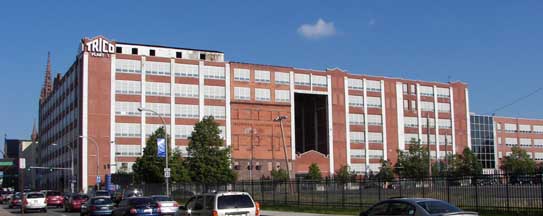
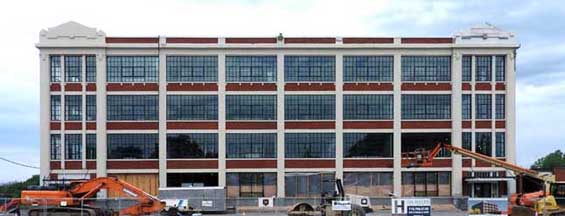
| The bulk of the chapter is an
account of the development of the daylight factory between 1898
and 1917. Mr. Banham sees the total evolution in three stages:
preliminary (late 1890's to 1906), classic (1906 to 1913) and decadent
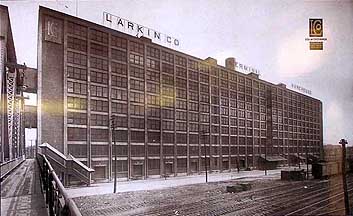
(1914 to early 1920's). As St. Denis announced a coming architectural revolution ... As Amiens represented the climax, so did the Terminal Warehouse of the Larkin Company in Buffalo. Mr. Banham's first, and perhaps most interesting, chapter describes the development of daylight factories, that is, ''multi-story American industrial buildings with exposed concrete frames, filled in only by transparent glazing.'' - John Coolidge, "From Grain to Gropius." A review of "A Concrete Atlantis U.S. Industrial Building and European Modern Architecture." By Reyner Banham. Illustrated. 266 pp. Cambridge, Mass.: The MIT Press. $25. (online may 2016) |
|
The Transition From 19th to 20th Century in Industrial Design National Register of Historic Place - Nomination, pp. 6-7 (online July 2013) In the last quarter of the 19th Century, the influence of engineering upon architecture resulted in a new approach to traditional and historic materiality. Roebling's American bridges and those in France by Eiffel, were not only truly elegant in style but they employed the use of iron and steel to solve structural problems. As the century ended, the use of concrete would take on a new form and was being used by being reinforced with steel. By the beginning of the 20th Century, reinforced concrete was being used in European residential commercial structures. American architect Albert Kahn played a significant role in expanding the applications for reinforced concrete after 1903. Some have argued that Kahn was more of an engineer than an architect, but it is this disciplinary marriage that produced the reinforced concrete frame that Kahn employed to allow broad, clear spaces for the operation of production lines in American automobile factories. This form reached a high point in Kahn's Building #10 done for the Packard Motor Car Company on East Grand Boulevard in Detroit. There the reinforced concrete frame held the loads so that the perimeter walls of the factory could be filled with glass to allow natural light to penetrate into the interior workspaces, thus giving birth to the "Daylight Factory." This building type was particularly suited to manufacturing because of its open floor space, with fewer and less obtrusive support columns allowed for the reconfiguration of assembly lines. Additionally, the floor to ceiling window walls that were a consequence of the concrete framing system allowed these workspaces to be light and air filled. Banham, in A Concrete Atlantis, refers to Packard #10 as an "innovative structure [that would] bridge the gap between the older tradition and the stunningly new type of factory (Banham 237)." There were additional benefits to the reinforced concrete frame that also made it suitable for warehouse use. Not only were the columns of reinforced concrete, but so were the floor and roof plates, producing a highly rigid structure that could carry extreme weight loads. Add to this the inherent fireproofing produced by the concrete itself, and there appears the ideal form for the storage of combustible materials. Thus, the Daylight Factory could be used where light and air were not necessary or desirable for the building's use, and the spans between the piers along the exterior walls would be filled with brick or other opaque materials produced by minimal fest ration. |
|
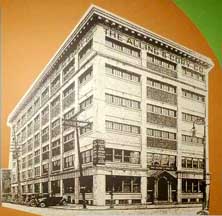
Daylight Factory
... "Daylight Factory"
design, which utilized steel reinforced concrete
to create strong, fireproof structural systems that supported concrete
slab floors. The design featured large unobstructed floor spaces and
exposed concrete exterior frames that could be filled with large
windows to admit light and air. - N.Y.
State Office of Parks, Recreation, & Historic Preservation: Alling
& Cory Warehouse (online July
2013)-
|
|
The Daylight Factory
During the third quarter of the nineteenth century, Ernest Ransome, working first in California and later in New York City, developed a system of embedding steel rods in concrete to create a strong, fireproof structural system that supported concrete slab floors. This system proved especially suited to multistoried industrial architecture, for it allowed for the creation of layer upon layer of virtually unobstructed floor space. On the exterior walls, large windows filled the spaces between the exposed concrete frame, admitting abundant light and fresh air to each floor. Elevators and hoists linked the various work levels. Reinforced concrete construction was also inexpensive, easily standardized, and fire proof. "Around 1900, then," wrote architectural historian Peter Reyner Banham in his book Concrete Atlantis, "the action and the excitement were not in iron and steel but in concrete, which was about to take off into the most spectacular stage of its development in the United States. The new men, headed by Ransome, were above all specialists in concrete, and their subject matter -- the Daylight factory and the grain elevator -- was to be (along with bridge building) concrete's primary province. The evidence of this is overwhelming, on the ground and in the professional literature" (p. 106). As Banham further argued in Concrete Atlantis, functional buildings like these came to influence significantly the course of high style modern architecture. On the exterior of his buildings Ransome, and other pioneers of this method of construction such as Buffalo's [sic?] Lockwood, Greene and Company, left the skeletal structure of vertical supports and horizontal floor slabs exposed to view. These simple, repetitive exteriors were thus composed of a concrete frame filled in with banks of simple, steel sash windows. Only a modest spandrel was sometimes present beneath the windows to provide space for radiators. By 1924, this revolutionary system, which Banham called the "daylight factory," was fully developed. There were several major examples in Buffalo prior to the M. Wile Building by Lockwood, Greene and Company, notably the huge Larkin R/S/T Block of 1911, the Buffalo Meter Building of 1915, and the Pierce Arrow Factory of 1907. The unadorned beauty of structure and proportions that these elementary exteriors portrayed deeply impressed architects such as Walter Gropius, Le Corbusier and Mies Van Der Rohe. Indeed, the M. Wile Building is contemporary with Gropius' Bauhaus in Dessau, Germany, the icon of the International Style. The Buffalo factory was of the same type that, says Banham, "Le Corbusier had used to exemplify his arguments [for a new architecture]; multistoried American industrial buildings with exposed concrete frames, filled in only by transparent glazing; buildings like X-ray images, their bones on public display" (Banham, 23-26). |
|
John Coolidge, From Grain to Gropius (online July 2013) New York Times review of A
Concrete Atlantis, by Reyner Banham. Alling and Cory Buffalo Warehouse - Nomination for Listing on the National Register of Historic Places, p. 6 (online July 2013) |
|
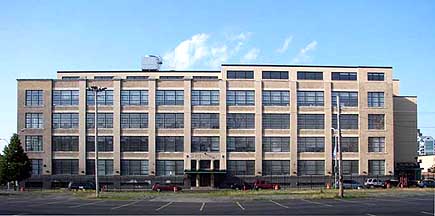
Larkin Co. Terminal Warehouse / Larkin at Exchange ... Lockwood, Greene's system for the "R, S, T" warehouse (otherwise the terminal warehouse) at the back of the complex, between Van Rensselaer and Hydraulic Streets. Designed in 1911, built by the Aberthaw Construction Co. in just over six months in spite of its great size, a brilliantly conceived packaging and shipping facility, "R, S,T" has long been recognized as a masterpiece of functional design and rational detailing. It has been commendably maintained by its present owners, Graphic Controls, who also added the"Wrightian" entrance on Exchange Street in 1969, by Arthur Carrara.
|
|
Lockwood, Greene & Co. Lockwood, Greene & Company of Boston, Massachusetts (later Lockwood, Greene, Engineers, of New York and Spartanburg), was an all-round engineering and factory-design office with roots that go back to the middle of the nineteenth century. Originally specializing in textile mills, it expanded its business southward instep with the textile industry and, at the same time, moved into reinforced concrete construction, following the lead established by Ernest L. Ransome's United Shoe Machinery plant of 1906 at Beverly, Massachusetts. Buffalo is fortunate that its golden age of industrial building coincided with the very best period of Lockwood, Greene's work in concrete: Graphic Controls (formerly Larkin Company), dating from 1911, is their first masterpiece in concrete. Bethune Hall (formerly Buffalo Meter Company), of 1915, already shows their design on the edge of self-conscious stylishness and decadence.
|
|
Lockwood, Greene
& Co., Inc Lockwood Greene is the oldest
professional services firm in the United States, specializing in
industrial engineering and construction. |
|
United Shoe Machinery Corp, Beverly, MA Beyond its sheer magnitude, the plant was internationally known because it was the first successful application of reinforced concrete, pre-dating architect Albert Kahn's Detroit automobile factories. Built by construction innovator Ernest Ransome, the plant was created by a revolutionary method of embedding twisted square iron rods into the concrete. This incredibly sturdy design permitted large glass window panes to make up 85 percent of the wall area. ... More than 2,000 5-foot by 10-foot windows flooded this factory's pre-electricity interiors with natural light. |