|
Amen /Amun/ Amon/
Amen-Re/ Amon-Ra/ Amon-Re
Alternate
spellings:
Amen /Amun/ Amon
Alternate spellings: Re/ Ra
Alternate spellings: Amen-Re/ Amen-Ra/ Amun-Re/
Amun-Ra/ Amon-Re/ Amon-Ra
Amun (pronounced AM
mun)
Amun did not physically engender the universe. His
position as King of gods developed to the point of
virtual monotheism where other gods became
manifestations of him. With Osiris,
Amun-Ra is the most widely recorded of the Egyptian
gods.
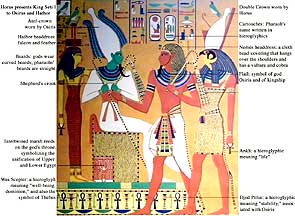
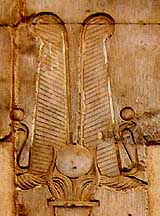
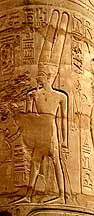
Amun became depicted in human form, seated on a
throne, wearing on his head a plain, deep circlet from
which rise two straight parallel ostrich plumes, but
it can also be worn by a king. It appears to associate
the ruler with Amun and to legitimate his rule under
the god's protection. The plumes were
symbolic of the spirit of duality. The Amun crown
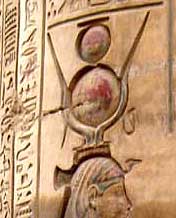
can be adorned with horns, disks and uraei.
Chief
consort was Mut.
|
 When the army of the founder of
the Eighteenth dynasty expelled the Hyksos
rulers from Egypt, the victor's city of
origin, Thebes, became the most important
city in Egypt, the capital of a new dynasty.
The local patron deity of Thebes, Amun,
therefore became nationally important. The
pharaohs of that new dynasty attributed all
their successful enterprises to Amun and
they lavished much of their wealth and
captured spoil on the construction of temples
dedicated to Amun. When the army of the founder of
the Eighteenth dynasty expelled the Hyksos
rulers from Egypt, the victor's city of
origin, Thebes, became the most important
city in Egypt, the capital of a new dynasty.
The local patron deity of Thebes, Amun,
therefore became nationally important. The
pharaohs of that new dynasty attributed all
their successful enterprises to Amun and
they lavished much of their wealth and
captured spoil on the construction of temples
dedicated to Amun.
Subsequently,
when
Egypt conquered Kush,
they identified the chief deity of the
Kushites as Amun. This Kush deity was
depicted as ram-headed, more
specifically a woolly ram with curved horns
- so Amun became associated with the ram.
Indeed, due to the aged appearance of
the Kush ram deity, the Egyptians came to
believe that this image had been the
original form of Amun and, that Kush was
where he had been born. [See Karnak
Temple Complex: Sphinxes]
As
the cult of Amun grew in importance, Amun
became identified
with the chief deity who was worshipped in
other areas during that period, Ra-Herakhty,
the merged identities of Ra, and Horus. This
identification led to another merger of
identities, with Amun becoming Amun-Ra.
.Ra-Herakhty had been a solar deity and
this nature became ascribed to Amun-Ra as
well,
Several words derive from Amun
via the Greek form, Ammon: ammonia
and ammonite.
- Wikipedia:
Amun
|
The Temple
Complex at Karank honors him.
The word Amen in Christianity is not derived
from the Egyptian god.
|
| . |
|
Animals
Cat-headed
- Bastel
Cow-headed - Hathor
Cow-headed - Isis
Cobra -
Wadjet
Falcon-headed - Horus
Falcon-headed - Ra
Ibis-headed
-Thoth
Jackel-headed - Anubis
Lion-bodied
- Sphinx
Lion-headed - Sekhmet
Vulture's wings - Nephthys
James
Stevens
Curl: "... the ancient Egyptians seem to
have regarded animals as possessing the archetypal
qualities of their deities (e.g. bull = power and
regeneration; cow = mother; and ram = sexual power and
fecundity ... the reverence shown to animals at certain
cult-centres did not mean that the creatures themselves
were worshipped: what was important was what the animals
represented. The main cult centres were as follows:
|
Animal
|
Temples |
|
Bull:
|
Heliopolis,
Hermonthis, and Memphis |
|
Cat:
|
Bubastis |
|
Cow:
|
Aphroditopolis and
Dendera |
|
Crocodile:
|
Crocodilopolis and
Kom
Ombo |
|
Falcon:
|
Edfu
and Philae |
|
Ibis:
|
Abydos and
Hermopolis |
|
Ram:
|
Elephantine, Esna,
Herakleopolis, and Mendes |
See also:
Caroline Seawright, Animals
and
the Gods of Ancient Egypt and Toby A.
H. Wilkinson, Early
Dynastic
Egypt: The bull's tail
|
| . |
|
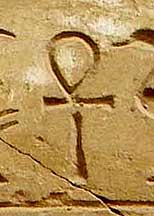 Ankh (Pron. ANGK
or ONK; Plural ankhs) Ankh (Pron. ANGK
or ONK; Plural ankhs)
AKA
ansate cross, crux ansata ("handle-shaped cross")
Ancient Egyptian hieroglyph - a
cross shaped like a T with a loop at the top.
Symbol
of eternal life,
It is found in ancient tomb inscriptions, including
those of the King Tutankhamen. Egyptian gods are often
portrayed
carrying it by its loop, or bearing one in each hand,
arms crossed over their chest.
Ra is usually represented with the
body of a man and the head of a hawk,
holding an ankh & scepter.
In ancient
Egypt, only kings, queens and gods were allowed to
carry the ankh, indicating that only the king or god
holding it had the power to give life or take it away
from lesser mortals.
Possible origins:
- A sandal strap, with
the loop going around the ankle
- Belt-buckle
of the mother goddess Isis
- Sun
crowning over the horizon
- The
path of the sun from east to west (with the loop
representing the Nile
- Combination
of the male and female symbols of Osiris (the cross) and Isis (the
oval) respectively, and therefore signifies the
union of heaven and earth
- The
oval head represents the Nile delta, the vertical
mark represents the path of the river, while the
East and West arms represent the two sides of the
country and their unification
- Illustration:
Karnak
Temple
Complex
- Daniel
Good
Mausoleum
- Kom
Ombo
Temple
- Karnak
Temple
Complex
- Display
Sign
in the Valley of Kings
|
| . |
|
Anubis (a NOOB is)
Jackel-headed god of embalming
(responsible for embalming)
Son of Osiris and Isis
His head is black.
Jackals
used to haunt cemeteries, so they were linked with
funerals - the idea being that a jackal god would
protect the domain of the dead.
|
| . |
|
Apedemak
|
In Ancient Nubian religion,
lion-god.
Apedemak was called "The Lord of Royal
Power." In Nubia, with the kingdoms of Cush,
the royal throne was always depicted as a
lion...
Apedemak originated in Meroë region, and had
his main cult centres near the 6th cataract
of the Nile river. The main temples were at
the lion temples at Musawwarat al-Sufra and
Naqa. There was also a temple at Meroë
itself, and perhaps even at Basa.
Interestingly, inscriptions at Musawwarat
al-Sufra are in hieroglyphs, not in Meroitic
script, indicating a close link with
Egyptian religion, although Apedemak was
uniqe to Nubia.
At Naqa, walls are filled with reliefs of
Apedemak together with Egyptian deities,
forming a triad with Isis, with Horus as their son. Apedemak is
also represented together with Hathor and Amon.
There are great similarities between
Apedemak and the obscure Egyptian god,
Maahes, who also represented a specific
religious dimension in the oases of the
Western Desert. Also, it is possible that
the cult of Sekhmet, Egypt's lion goddess, was
introduced from Nubia, and related to that
of Apedemak.
- Looklex
Encyclopdia: Apedemak
|
In Nubian
mythology, Isis was his wife.
|
|
|
Beard
From the Old Kingdom onward, the king
often wears a long, square-ended artificial (or false)
beard, fastened by a strap along the jawbone.
Gods wear curved beards
Kings
wear straight beards
|
| . |
|
Crook
and flail
Scepters
Most
commonly represented together, held across the chest
of the kings,
Osiris
identified with them.
See
illustration on The
Virtual
Egyptian Museum
|
| . |
Crowns/Headdresses
|
| . |
Eye of
Horus / Wedjat / Wadjet / Eye of Ra / Eye of the Moon
/ Udjat
An ancient Egyptian symbol of protection
and royal power from deities, in this case from Horus or
Ra.
The symbol is seen on images of Horus' mother, Isis,
and on other deities associated with her.
In the Egyptian language, the word for this symbol was "Wedjat,"
a solar deity and this symbol began as her eye, an all
seeing eye. The Wedjat "was intended to protect the king
in the afterlife" and to ward off evil.
The Eyes of Horus: Horus fought
with Seth (his uncle) for the throne of
Egypt. In this battle one of his eyes was injured and later it was
healed by Isis (his mother). His
right eye represented the sun; his left eye the moon.
In early artwork, Hathor is
also depicted with this eye.
Funerary amulets were often made in the shape of the Eye
of Horus.
Ancient Egyptian and Near Eastern sailors would
frequently paint the symbol on the bow of their vessel
to ensure safe sea travel. |
| . |
|
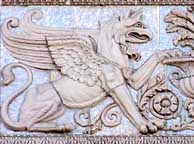 Griffin: Griffin:
Head
and wings of an eagle and the body of a lion.
The griffin
was known in Egypt before 3300 BC and is possibly more
ancient still.
Emanated protective power.
Middle
Ages: Griffins not only mated for life, but also, if
either partner died, then the other would continue
throughout the rest of its life alone, never to search
for a new mate. The griffin was thus made an emblem of
the Catholic Church's views on remarriage.
|
| . |
|
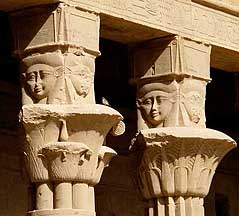 Hathor (HATH
er) Hathor (HATH
er)
Hathor is commonly depicted as a cow goddess with
head horns in which is set a sun disk with Uraeus.
Hathor is at times the mother, daughter and wife of Ra and, like Isis,
is
at times described as the mother of Horus
Depicted as "Mistress of the West" welcoming the dead
into the next life.
The Anc ient Greeks identified Hathor
with the goddess Aphrodite and the Romans as Venus.
For more information, see Wikipedia:
Hathor
The Smaller
Temple
at Abu Simbel was dedicated to Hathor.
|
| . |
|
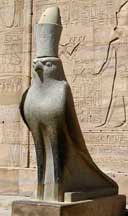 Horus (HOR us) Horus (HOR us)
God
of the sky, depicted as a falcon, or as a
hawk/falcon-headed man.
Since Horus
was said to be the sky, he was considered to also
contain the sun and moon. It became said that the sun
was his right eye and the moon his left, and that they
traversed the sky when he, a falcon, flew across it.
Thus he became known as Harmerty - Horus of two eyes.
Myth of Osiris, Isis and Horus:
Osiris
was a king who taught the Egyptians how to live,
worship and grow corn. He was murdered by his jealous
brother, Seth,
who cut up the body, scattering it over Egypt.
Osiris's beloved wife, Isis,
and her sister collected all the pieces. Isis used her
medical skills first to impregnate herself with the
last drop of semen in her consort's penis, and then to
reassemble the corpse as the first mummy and
bring it back to life. The first magic worked, and she
became pregnant with Horus.
But the gods refused to let Osiris return to the world
of mortals, and he went to rule in the Underworld, the
lord and judge of the dead.
Myth
of Horus and Seth:
Horus would avenge his
father at Edfu
and Horus became known as the Egyptian god of the sky.
In that Horus was the son of Osiris, he became closely
associated with the Pharaoh of Lower Egypt (where
Horus was worshipped), and became their patron. Seth
was the patron of Upper Egypt. Horus united Egypt and
bestowed divinity upon the pharaohs who were viewed as
incarnations of Horus in life. On the other hand, , once
the two lands were united, Seth and Horus were often
shown together crowning the new pharaohs, as a symbol of
their power over both Lower and Upper Egypt.
For a detailed account, see The
Sacred Temple Island of Philae: The Great
Quarrel
Later
Egyptians interpreted the myth of the conflict between
Set and Osiris/Horus as an analogy for the struggle
between the desert (represented by Seth) and the
fertilizing floods of the Nile (Osiris/Horus).
The
Eyes of Horus:
Horus fought with Seth (his
uncle) for the throne of Egypt. In this battle one of
his eyes was injured and later it was healed by Isis
(his mother). His right eye represented the sun;
his left eye the moon.
Forms
of Horus:
Mythologically, the god was imagined as a celestial
falcon, whose right eye was the sun and left eye the
moon. The speckled feathers of his breast were
probably considered to be the stars, while his wings
were the sky that created the wind.
The most
familiar form of Horus is as a full
falcon, probably the lanner (Falco biarmicus) or
peregrine (Falco peregrinus).
It is as a
falcon-headed man that the god most frequently
appears, often wearing one the following crowns:
Double Crown (Pschent)
signifying his kingship over all Egypt.
Atef
(white crown with a plume on either side and a
small disc at the top),
Triple atef
Disk with two plumes
Horus
is also depicted with wings in a solar disk flanked by 2 cobras and
vulture with outspread wings
See also: Jimmy Dunn, Horus,
The God of Kings
See also
illustration on The
Virtual
Egyptian Museum
|
| . |
|
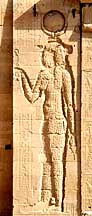 Isis (EYE
sis) Isis (EYE
sis)
The principal goddess worshiped by the
Egyptians. She was regarded as the mother of Horus,
the sister and wife of Osiris,
and the sister of Set
and Nebthet.
The Egyptians adored her as the goddess of fecundity,
and as the great benefactress of their country, who
instructed their ancestors in the art of agriculture.
Isis, Osiris
and Horus are sometimes referred to as a "trinity."
"Her cult
continued to grow in importance until it ultimately
absorbed that of nearly all the other goddesses. ...
It was not until the middle of the sixth century, in
the reign of Justinian, that the temple
of
Philae - her chief sanctuary in the
extreme south of the country - was closed to her cult
and turned into a church." - New
Larousse
Encyclopedia of Mythology, Prometheus
Press, 1972 edition, p.19
Myth of Osiris Isis and Horus:
Osiris
was a king who taught the Egyptians how to live,
worship and grow corn. He was murdered by his jealous
brother, Seth,
who cut up the body, scattering it over Egypt.
Osiris's beloved wife, Isis,
and her sister collected all the pieces. Isis used her
medical skills first to impregnate herself with the
last drop of semen in her consort's penis, and then to
reassemble the corpse as the first mummy and
bring it back to life. The first magic worked, and she
became pregnant with Horus.
But the gods refused to let Osiris return to the world
of mortals, and he went to rule in the Underworld, the
lord and judge of the dead.
Isis became known as the Egyptian goddess of the
children. Horus
would avenge his father and Horus became known as the
Egyptian god of the sky. In that Horus was the son of
Osiris, he became closely associated with the Pharaoh
of Lower Egypt (where Horus was worshipped), and
became their patron. Set(h) was the patron of Upper
Egypt. Horus united Egypt and bestowed divinity upon
the pharaohs who were viewed as incarnations of Horus
in life.
The Temple
at Dendur and the Temple
at
Philae were dedicated
to Isis.
|
Depictions
Normally
represented as a woman who bears on her
head a throne, the ideogram of her
name.
Occasionally, but
later, her head-dress is a disk,
set between cow's horns,
occasionally flanked with two
feathers.
Finally we sometimes
find her represented with a cow's head
set on a human body. These horns and
the cow's head merely prove that Isis was
by then identified with Hathor.
Sculpture and
painting often represent her beside Osiris, whom she helps or protects
- as she does the dead - with her winged
arms.
She may be seen mourning at the foot of
sarcophagi or watching over canopic jars.
She also frequently
appears in the role of mother suckling
the infant Horus or joining him in
his struggles with Set.
- New
Larousse Encyclopedia of Mythology,
Prometheus Press, 1972 edition, p.19
|
|
| . |
| Lotus |
| . |
|
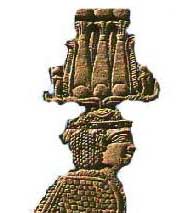
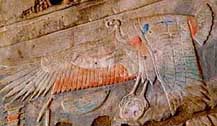 Nekhbet (Nechbet,
Nekhebit), Vulture
Goddess Nekhbet (Nechbet,
Nekhebit), Vulture
Goddess
Patron of Upper Egypt
Depicted
as the Egyptian white vulture:
Depicted
as the Egyptian white vulture - the griffon
vulture (Gyps fulvus). The
priestesses of Nekhbet wore robes of vulture
feathers.
Nekhbet
usually was depicted hovering, with her wings spread
above the royal image, clutching a shen
symbol, frequently in both of her claws.
A shen ring is a circle with a line
at a tangent to it, which was used in hieroglyphics
as a stylized loop of a rope. In particular, the
circle represented eternity, as circles did in many
ancient cultures (e.g.,. the wedding ring). In
numerical use, a circle represented infinity, all,
or everything.
Nekhbet is the protectress of the king and of the
non-royal deceased. As such, she is represented as a
vulture extending one wing to the front, the other
to the ground, flying above the person she is
protecting."
Depicted
as one of the twin Uraei:
From the
18th Dynasty onwards, she began to be represented as
protecting the royal women in the form of one of the
twin Uraei (spitting cobras)
on the headdresses of the queens
In
art, Nekhbet was depicted as the white vulture,
always seen on the front of pharaoh’s double crown along with Wadjet
(cobra).
Depicted
as woman wearing the Atef-crown
See
illustration on Echoes:
The Egyptian Vulture Goddess Nekhbet
See also: Horus
who is depicted with wings in a solar
disk flanked by 2 cobras and vulture with outspread
wings
See Wikipedia:
Nekhbet
|
| . |
|
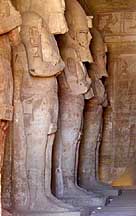 Osiris (oh
SIRE is) Osiris (oh
SIRE is)
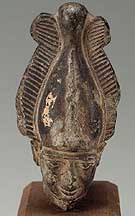
God of the Underworld.
Osiris was usually depicted as a green-skinned
(green was the color of rebirth) pharaoh wearing the Atef
crown , a crown worn by
the god Osiris, and by the king. It is composed of a
central miter mounted upon two ram's horns, surmounted
by a sun disk and flanked by two ostrich feathers.
Typically he was also depicted holding the crook
and flail which signified divine authority in
Egyptian pharaohs and his feet and lower body were
wrapped, as though already partly mummified.
Myth of Osiris Isis and Horus:
Osiris
was a king who taught the Egyptians how to live,
worship and grow corn. He was murdered by his jealous
brother, Seth,
who cut up the body, scattering it over Egypt.
Osiris's beloved wife, Isis,
and her sister collected all the pieces. Isis used her
medical skills first to impregnate herself with the
last drop of semen in her consort's penis, and then to
reassemble the corpse as the first mummy and
bring it back to life. The first magic worked, and she
became pregnant with Horus.
But the gods refused to let Osiris return to the world
of mortals, and he went to rule in the Underworld, the
lord and judge of the dead.
Isis became known as the Egyptian goddess of the
children. Horus
would avenge his father and Horus became known as the
Egyptian god of the sky. In that Horus was the son of
Osiris, he became closely associated with the Pharaoh
of Lower Egypt (where Horus was worshipped), and
became their patron. Set(h) was the patron of Upper
Egypt. Horus united Egypt and bestowed divinity upon
the pharaohs who were viewed as incarnations of Horus
in life.
In the
Serapeum at Saqqara, archaeologists
found the mummies of one and a half million ibises and
hundreds of thousands of falcons.
|
| . |
|
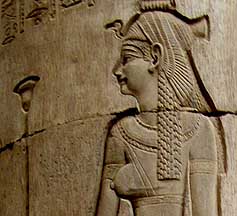 Papyrus
scepter Papyrus
scepter
Long, thin
shaft surmounted by a triangular umbel
Papyrus
|
| . |
|
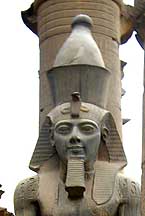 Pharaoh Pharaoh
"Pharaoh is a title used in many modern
discussions of the ancient Egyptian rulers
of all periods. In antiquity this title began to be
used for the ruler who was the religious and political
leader of united ancient Egypt. This was true only
during the New Kingdom, specifically during the middle
of the eighteenth dynasty. For simplification
however, there is a general acceptance amongst modern
writers to use the term to relate to all periods." -
Wikipedia:
Pharaoh
The
pharaoh, or king of Egypt, was viewed as both human
and divine, and thus acted as intermediary between
Egypt's people and the gods.
The king was also associated with several specific
deities. While alive, a pharaoh was identified with Horus,
and given the title "Son of Ra."
The goddesses Isis,
Hathor, and Mut were all seen as the mother of the
pharaoh.
A deceased king was viewed as fully divine, and
identified with Osiris
(the father of Horus) and with Ra.
A common depiction of the king is his holding a group
of enemies of Egypt by the hair and raising his club
to smite them.
Crowns
/ Nemes
Ptolemaic
dynasty
The pharaoh
often was depicted as wearing a false beard
made of goat hair during rituals and
ceremonies
|
| . |
| Ram's horns |
| . |
|
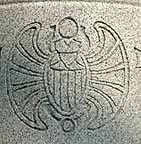 Scarab / dung beetle Scarab / dung beetle
Dung
beetles are beetles that feed partly or exclusively on
feces. Many dung beetles, known as rollers,
are noted for rolling dung into spherical balls, which
are used as a food source or brooding chambers.
Scarab dung
beetles lay eggs in a pellet which they roll along and
the Egyptians regarded this action as an image of the
sun and its course through the heavens, rolled by a
gigantic beetle. Scarabs are associated with the
Egyptian god, Khepri. It was Khepri
that pushed the sun across the sky. The scarab beetle
became an ancient Egyptian symbol for rebirth, the
ability to be reborn. Each day the sun disappeared,
always to rise again and be reborn the following day.
The god Khepri, which literally means "He who
is Coming into Being", was a creator god and a solar
deity. He was represented as a scarab or dung beetle,
or as a man with a beetle head. Often represented as a
beetle within the sun-disk.
The scarab
beetle was observed to roll its eggs in a ball of dung
along the ground, and the ball was identified with the
sun. The baby beetles were seen to emerge from the
primeval mound and so dung beetles were thought
capable of spontaneous creation. Hence, the scarab
became an important symbol of creation, resurrection
and everlasting life in the religious mythology of
ancient Egypt. Alternate myth: Isis
Small jars
and coffins containing dried (mummified) scarabs were
often placed in Egyptian tombs as part of their
ancient funeral rites to ensure eternal resurrection.
Winged
scarab / heart scarab:
So-called heart scarabs, usually flanked with falcon's
wings, were funerary talismans. The stone heart scarab
was laid upon the breast of the mummy, and this
indicated that the guilty soul must stand in the
judgment hall in the presence of Osiris.
The scarab thus used was to secure exemption from the
possible performance of an evil life. Perhaps the most
famous example of such "heart scarabs" is the
yellow-green pectoral scarab found among the entombed
provisions of Tutankhamen.
Ra was also
pictured as scarab that has the body of a scarab with
outstretched falcon wings, scarab forelegs, and falcon
back legs.
|
| . |
|
Scepter
A rod or wand borne in the hand as an emblem of
regal or imperial power.
The hieroglyph
for "nobleman" or "official" shows a man carrying a
long staff of office in front of him.
See alsoAncient
Egypt
Online: mks, Heqa, Was, Flail
See also: Toby A. H. Wilkinson,
Early
Dynastic
Egypt: mks, Heqa, Was, Flail
See also:
Toby A. H. Wilkinson, Early
Dynastic
Egypt: Mace and long staff
See also: Wiklipedia:
Sekmen scepter
|
| . |
|
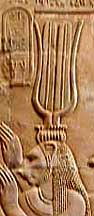 Sekhmet,
Sachmet,
Sakhet, Sekmet, Sakhmet and Sekhet Sekhmet,
Sachmet,
Sakhet, Sekmet, Sakhmet and Sekhet
Appearance:
Woman with the head of a lioness. She was envisioned
as a fierce lioness, and in art, was depicted as such,
or as a woman with the head of a lioness, who was
dressed in red, the colour of blood.
Sekhmet was the goddess of war.
For more
information, see Wikipedia:
Sekhmet
See also a
poem by Margaret Atwood, Sekhmet,
the
Lion-headed Goddess of War
|
| . |
Set(h)
Osiris
was a king who taught the Egyptians how to live, worship
and grow corn. He was murdered by his jealous brother, Seth,
who cut up the body, scattering it over Egypt. Osiris's
beloved wife, Isis,
and her sister collected all the pieces. Isis used her
medical skills first to impregnate herself with the last
drop of semen in her consort's penis, and then to
reassemble the corpse as the first mummy and
bring it back to life. The first magic worked, and she
became pregnant with Horus.
Seth and his followers changed themselves into
crocodiles to escape Horus. The ancient Egyptians
believed that by honoring the fearsome crocodile as a
god, they would be safe from attacks.
Horus would avenge his
father at Edfu
and Horus became known as the Egyptian god of the sky.
In that Horus was the son of Osiris, he became closely
associated with the Pharaoh of Lower Egypt (where Horus
was worshipped), and became their patron.
Seth was the patron of Upper Egypt. Horus united Egypt
and bestowed divinity upon the pharaohs who were viewed
as incarnations of Horus in life. On the other hand,
once the two lands were united, Seth and Horus were
often shown together crowning the new pharaohs, as a symbol of
their power over both Lower and Upper Egypt.
For a detailed account, see The
Sacred Temple Island of Philae: The Great Quarrel |
| . |
|
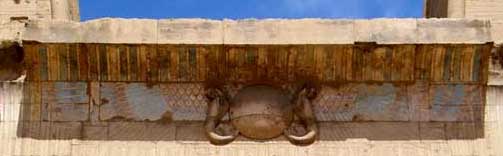
Solar
(Sun) disk flanked by 2 cobras and outspread wings:
Solar disk represents Ra,
the sun god.
Cobras represent the Uraeuses
(Wadjet
and Nekhbet)
Wings: Vulture wings represent Nekhbet
- OR Falcon wings represent Horus
A symbol of protection.
Often
occurring on a cavetto
cornice.
The Winged Sun Disc is thought to have
originated from the corona effect of a solar eclipse
which can give the appearance of wings.
|
| . |
|
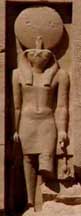 Sun
god Sun
god
Overall, the
sun god was the dominant deity in Egyptian religion,
although he could take different forms.. The earliest
deities associated with the sun
are Wadjet,
Sekhmet,
Hathor,
Nut, Bast, Bat, and Menhit. First Hathor, and then Isis,
give birth to and nurse Horus
and Ra.
In the
eighteenth dynasty, Akhenaten changed the polytheistic
religion of Egypt to a pseudo-monotheistic one,
Atenism. All other deities were replaced by the Aten,
including, Amun,
the reigning sun god of Akhenaten's own region. Unlike
other deities, the Aten did not have multiple forms.
His only image was a disk - a symbol of the sun.
Most
common forms:
- At dawn
- Khepri, the scarab beetle rolling
the sun disk above the eastern horizon
- In
evening - Atum, an old man - Atum-Ra
- Re-Harakhty,
the great hawk/falcon soaring in the sky,
responsible for all creation. Amalgamation of
Ra and Horus; Falcon-headed
Ra, sometimes crowned with a solar disk and Uraeus
(see illustration at left)
- Amun-Re,
king of the gods and protector of
the pharaoh when he was on military campaigns. he
handed the scimitar to great warrior pharaohs like
Tuthmosis III.
Other depictions:
- Atum
- A man wearing a
pharaoh's crown (a sign of his leadership
of the deities) and the wadjet (cobra with the wings of a vulture), with
sun disk above his head.
- Body of a man and the head of
a hawk, holding an
ankh & scepter.
"Re" is an alternate form of "Ra."
Sun boat: Ra was thought to travel in a
sun boat (The Boat of the Millions) to protect its
fires from the primordial waters of the underworld it
passed through during the night. Ra traveled in the
sun boat with various other deities including Set
and Mehen who defended against the monsters of the
underworld, and Ma'at who guided the boat's course.
The monsters included Apep, an enormous serpent who
tried to stop the sun boat's journey every night by
consuming it. The Ra myth saw the sunrise as the
rebirth of the sun by the goddess Nut and the
sky, thus attributing the concept of rebirth and
renewal to Ra and strengthening his role as a creator
god. Alternate myth: See "Scarab "
below.
The benu bird is Ra's bird and a symbol of
fire and rebirth (see Obelisk).
|
| . |
|
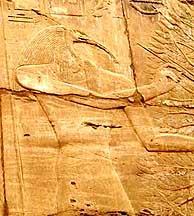 Thoth
(TOTE) Thoth
(TOTE)
Ibis-headed
(sometimes, however, a baboon) god of wisdom.
The Sacred Ibis (Threskiornis aethiopicus)
is now extinct.
The curved beak of the ibis was like the
crescent moon, so the bird became the symbol of the
moon god Thoth.
The ancient
Egyptians believed that Thoth gave them the gift of hieroglyphic
writing.
At the town
of Hermopolis, ibises were
reared specifically for sacrificial purposes and in
the Serapeum at Saqqara, archaeologists
found the mummies of one and a half million ibises and
hundreds of thousands of falcons.
|
| . |
|
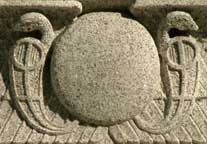 Uraeus (you REE us)
(plural: Uraei or Uraeuses) Uraeus (you REE us)
(plural: Uraei or Uraeuses)
Wadjet
(spitting cobra) and Sun disk. Nekhbet,
vulture wings added later.
Spitting cobra:
The
Uraeus is the stylized, upright form of an Egyptian
spitting cobra used as a symbol of sovereignty,
royalty, deity, and divine authority in ancient
Egypt.
The
Uraeus is a symbol for the goddess Wadjet
, one of the earliest of Egyptian deities, who often
was depicted as a cobra. The center of her
cult was in Per-Wadje. She became the patroness of
the Nile Delta and the protector of all of Lower
Egypt
Spitting
cobra plus white vulture:
At the time of the unification of Egypt, the
image of Nekhbet,
who was represented as a white vulture and
held the same position as the patron of Upper
Egypt, joined the image of Wadjet
on the Uraeus that would encircle the crown of the
pharaohs who ruled the unified Egypt. Together they
were known as, The Two Ladies, who became
the joint protectors and patrons of the unified
Egypt.
Worn by the Pharaoh as a golden emblem on the
forehead as a sort of crown; it was the symbol of
supreme rulers, and a symbol of Pharaoh's power.
Beside
the Uraeus being used as an ornament for statuary or
as an adornment on the pharaoh, it also was
used for jewelry and in amulets. However another
important use is as the hieroglyph.
In
that the Uraeus was seen as a royal symbol, Horus and Set
also were depicted wearing one.
|
| . |
Wadjet / Wadjit / Wedjet
/ Uadjet / Ua Zit
Cobra goddess; Patron of Lower Egypt.
AKA The
Green One
Depicted as a cobra in the Uraeus.
After unification of Egypt, joined by her sister Nekhbet
with the wings of a vulture in the Uraeus.
She came to be the patron and protector of Lower Egypt,
and upon unification with Upper Egypt, the joint
protector and patron of all of Egypt with the goddess of
Upper Egypt (Nekhbet).
The Two Ladies: The vulture-goddess
Nekhbet and the cobra-goddess Wadjet, representing the
Upper Egypt and Lower Egypt respectively.
See above: Uraeus
and Eye of Horus |
| . |
|
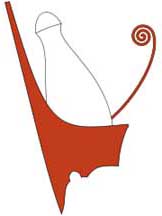
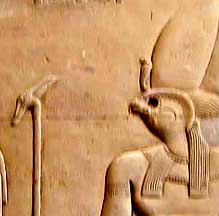 Was-scepter Was-scepter
Stood for
domination and power.
It was very common among gods/kings in all times.
Sometimes
depicted as a stylized animal head on top and a forked
end.
A staff made
from a dried bull's penis that was the symbol for the
goddess Wosret or Wasret.
Also used to
hold up roofs.
See also on
another website: 9
illustrations
|
| . |
Wings
Horus
Isis
Nekhbet
Re-Harakhty
Scarab |