Ely Parker
(pron. EE lee)
Ely Parker
(pron. EE lee)
BIOGRAPHY Beneath Illustrations
Source: Highland Lodge #835
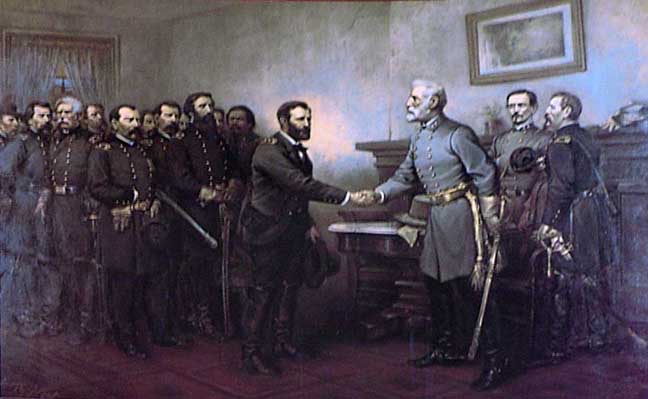
Lee's Ssurrender at Appomattox Court House
Parker is the person to the immediate left of Grant
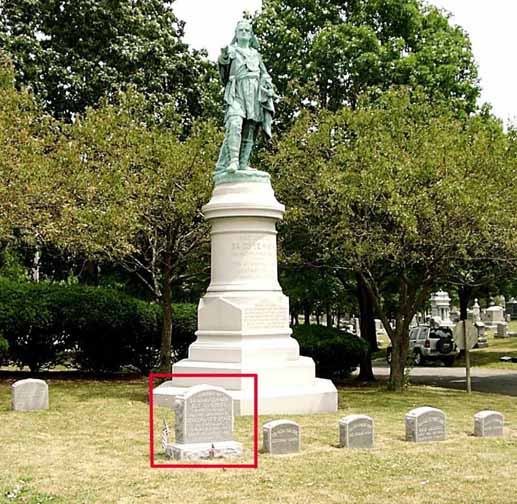
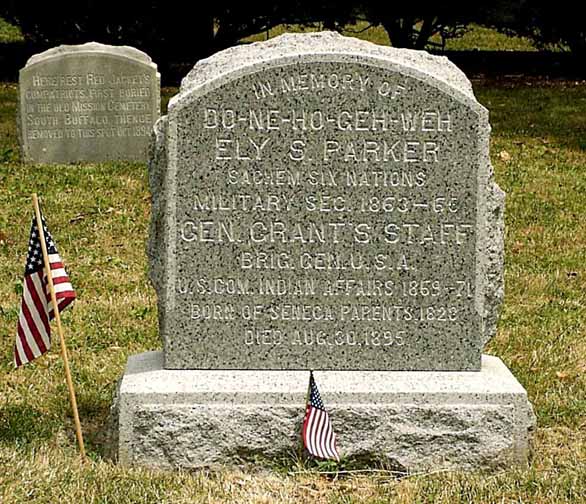
Red Jacket (statue) and Ely Parker memorials at Forest Lawn Cemetery
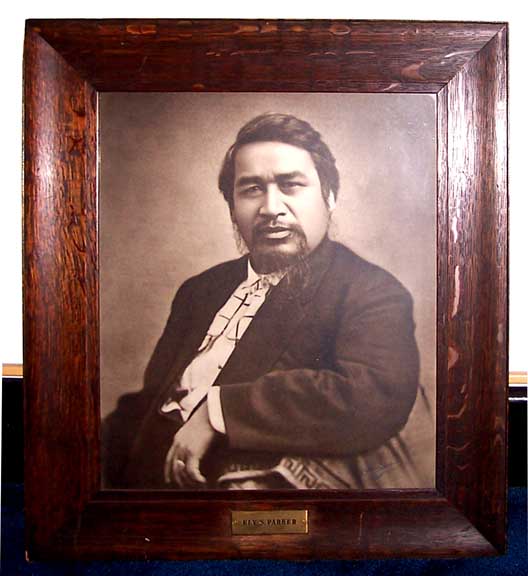
Ely Samuel Parker (1828 – August 31, 1895), (born Hasanoanda, later known as Donehogawa) was a Seneca attorney, engineer, and tribal diplomat. He was commissioned a lieutenant colonel during the American Civil War, when he served as adjutant to General Ulysses S. Grant. He wrote the final draft of the Confederate surrender terms at Appomattox. Later in his career, Parker rose to the rank of Brevet Brigadier General, one of only two Native Americans to earn a general's rank during the war (the other being Stand Watie, who fought for the Confederacy). President Grant appointed him as Commissioner of Indian Affairs, the first Native American to hold that post.
Parker was born in 1828 as the sixth of seven children to William and Elizabeth Parker, of prominent Seneca families, at Indian Falls, New York (then part of the Tonawanda Reservation). He was named Ha-sa-no-an-da and later baptized Ely Samuel Parker. His father was a miller and a Baptist minister. The Seneca were one of the Six Nations of the Haudenosaunee (Iroquois Confederacy). Ely had a classical education at a missionary school, was fully bilingual, and went on to college. He spent his life bridging his identities as Seneca and a resident of the United States.
Parker was present when Confederate general Robert E. Lee surrendered at Appomattox Courthouse in April 1865. He helped draft the surrender documents, which are in his handwriting.
- Wikipedia (June 2012)
Ely Parker was a Seneca chief, a legal scholar, an engineer, a Civil War hero, and a Cabinet-level commissioner -- all by the age of 40. At first glance, his story appears to be one of success and triumph.
Yet Parker died in poverty far from the land of his birth. In later life he was estranged from his people and dismissed by political leaders he once considered friends. Today, American history remembers him as a mere footnote, and inside the Seneca community, he is a controversial figure -- considered a hero by some, branded a traitor by others.
- WNED (June 2012)
When Robert E. Lee met with Ulysses S. Grant at Appomattox, Virginia, on the momentous morning of April 9, 1865, the Union commander insisted on introducing his staff members to Lee individually. The Rebel leader, ever courteous, shook each man's hand. Among the men in Grant's entourage was Lieutenant Colonel Ely Parker, a Seneca Indian. Lee hesitated upon meeting the swarthy Parker, apparently mistaking him for a freedman or mulatto; however, he quickly realized his error, extending his hand to Parker with the gracious comment, 'I am glad to see one real American here.' Parker accepted the proffered handshake, responding, 'We are all Americans.'
After exchanging small talk, the two commanders began the arduous business of drafting the articles of surrender for the Confederate Army. Among his other duties, the 37-year-old Parker served as one of Grant's military secretaries. Once the generals had agreed on conditions, Parker was directed to copy the articles of surrender into a manifold book, a bound pamphlet in which multiple copies could be produced through the use of carbon-paper inserts. This done, he passed the book to Colonel Theodore Bowers, another of Grant's aides, who was to prepare the final copy in ink for the commanding generals' signatures. Bowers, however, was so unnerved by the magnitude of the occasion that he was forced to leave the task to the unflappable Parker, who quickly produced the copy in his graceful hand.
- HistoryNet.com (June 2012)