Palladian window................. Palladian door................Illustrated Architecture Dictionary
Andrea Palladio
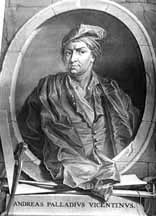
Frontispiece, Volume I, The Architecture of A. Palladio, third edition by Giacomo Leoni, London, 1742.
See also: Center for Palladian Studies in AmericaAndrea Palladio, 1508-1580, an Italian Renaissance architect.
Palladio was born in Padua in 1508, of humble family, but grew up in Vicenza. He was originally trained as a sculptor (a not unusual thing for Renaissance architects) and as a stone mason. A generous patron, Count Giangiorgio Trissino, took him to Rome in 1541 where he turned to the study of ancient buildings. He published the first scholarly guide book to classical Rome in 1554.
Most of his life he spent in Vicenza. He built churches, town and country houses, public buildings and bridges in Venice and on the Venetian mainland and in and around Vicenza. He died in Vicenza in 1580.
Palladio's work is indebted the Roman architect Vitruvius (The Ten Books on Architecture) and Leon Battista Alberti ( De Re Aedificatoria).
Palladio ranks among the most influential architects of all time, primarily because of his 4-volume book, The Architecture of A. Palladio, first published in 1570, ten years before his death. A second edition followed in 1581, a year after his death, another in 1601, and so on in remarkable succession.
Palladio was a High Renaissance architect. Palladian style-influenced architecture is classified as Neoclassical
Andrea Palladio, original name Andrea di Pietro della Gondola (born Nov. 30, 1508, Padua, Republic of Venice [Italy]—died August 1580, Vicenza)
Italian architect, regarded as the greatest architect of 16th-century northern Italy. His designs for palaces (palazzi) and villas, notably the Villa Rotonda (1550–51) near Vicenza, and his treatise I quattro libri dell’architettura (1570; The Four Books of Architecture) made him one of the most influential figures in Western architecture.
Palladio was born in the northern Italian region of the Veneto, where, as a youth, he was apprenticed to a sculptor in Padua until, at the age of 16, he moved to nearby Vicenza and enrolled in the guild of the bricklayers and stonemasons. He was employed as a mason in workshops specializing in monuments and decorative sculpture in the style of the Mannerist architect Michele Sanmicheli of Verona.
Between 1530 and 1538 Count Gian Giorgio Trissino, a Humanist poet and scholar, was rebuilding his villa at Cricoli outside Vicenza in the ancient Roman, or classical, style. Palladio, working there as a mason, was noticed by Trissino, who undertook to expand his practical experience with a Humanist education. Planned to house a learned academy for Trissino’s pupils, who lived a semimonastic life studying mathematics, music, philosophy, and classical authors, the villa represented Trissino’s interpretation of the ancient Roman architect and theorist Vitruvius (active 46–30 bc), whom Palladio was later to describe as his master and guide.
The name Palladio was given to Andrea, after a Humanist habit, as an allusion to the mythological figure Pallas Athena and to a character in Trissino’s poem “Italia liberata dai goti.” It indicates the hopes Trissino had for his protégé.
VISITS TO ROME AND WORK IN VICENZA
In 1541 and again in 1547 Palladio visited Rome with Trissino. These visits greatly affected his palace designs. On them, he saw the work of the greatest architects of the Roman High Renaissance style, Donato Bramante, Peruzzi, and Raphael, generally more remembered for his painting than for his architecture. He also measured ancient Roman antiquities, notably the baths. Palladio’s principal ideas on palace design were formed between his first works of 1540 and his visit to Rome in 1554–56.
During his stay in Rome, from 1554 to 1556, Palladio in 1554 published Le antichità di Roma (“The Antiquities of Rome”), which for 200 years remained the standard guidebook to Rome.
Palladio’s elevations have always a central emphasis that reflects the axial symmetry of the plan. This is developed in the Palazzo Valmarana, Vicenza, of 1565, along with an increasing use of stucco surface reliefs and giant orders, or columns, extending more than one story. The latter are both Mannerist elements, used particularly by Michelangelo.
Palladio’s villas were less affected by his visits to Rome. For practical reasons these buildings were always of stuccoed brickwork with a minimum of carved-stone detail. His aim was to recreate the Roman villa as he had come to understand it from Latin descriptions in the writings of Pliny and Vitruvius. His villas were built for a capitalist gentry who, during the period of Palladio’s maturity, gained in prosperity and found new economic outlets in agricultural improvement and land reclamation.
Palladio adapted the classical temple front to the facades of his villas because it had the dignity suitable for an entrance. He reasoned that, since ancient temples such as the Pantheon in Rome had pedimented porticoes, houses, which preceded temples, would also have had them.
At the end of 20 years of intensive building, Palladio in 1570 published I quattro libri dell’architettura. This work was a summary of his studies of classical architecture.
VENETIAN PERIOD
After 1570 Palladio’s life was centred on the building of churches in Venice. In the Veneto, because of a war with the papacy, few churches had been built in the first half of the century, and there are no church designs in his early drawings.
With the death of Sansovino in 1570, Palladio became the leading architect of the Veneto region. Until then he had failed to gain official state patronage, and his designs for palaces in Venice, known from the Quattro libri and from drawings, had never found patrons. His later civic work in Venice consisted of advice on fortifications, designs for decorations used on state occasions, and interiors for the Doges’ Palace. In 1572 his two sons died, and afterward he lived a secluded life, publishing only an illustrated edition of Julius Caesar’s Commentaries as a memorial.
Palladio’s last commission came in 1579–80—to build a theatre in Vicenza for the Accademia Olimpica for the performance of classical dramas. The design of the Teatro Olimpico was in the nature of an academic exercise, being based on the reconstruction of the ancient Roman theatre at Orange, in France.
ASSESSMENT
Palladio is one of the most influential figures in the whole development of Western architecture. The qualities that made him influential were numerous and varied. His palaces and villas were imitated for 400 years all over the Western world; he was the first architect to systematize the plan of a house and consistently to use the ancient Greco-Roman temple front as a portico, or roofed porch supported by columns (this was probably his most imitated architectural feature), and finally, in his I quattro libri dell’architettura, he produced a treatise on architecture that, in popularizing classical decorative details, was possibly the most influential architectural pattern book ever printed.
The influence of Palladio’s buildings and publications reached its climax in the architecture of the 18th century, particularly in England, Ireland, the United States, and Italy, creating a style known as Palladianism, which in turn spread to all quarters of the world.
- Palazzo Chiericati, Vicenza, Italy
- Vincenzo Gajassi, "Monument to Palladio" Statue, Vicenza, Italy
- Palladian Basilica, Vicenza, Italy
- Church of San Giorgio Maggiore, Venice, Italy
- Saints Gervasio and Protasio Church, Venice Italy Attributed to Palladio
- A Sampling of Drawings from Andrea Palladio's The Four Books of Architecture
- Two photos: Villa Rotunda (Villa Capra) Perhaps Palladio's most influential building. On "Great Buildings" website.
- Andrea Palladio (Great Buildings)
England
In England, Inigo Jones (1573-1652) imported Palladianism and helped usher in the Renaissance.Palladio's buildings ("Palladianism") were used as models in England in the early 18th century by Lord Burlington and Colen Campbell.
Palladio studied Roman ruins; In the 18th century, Robert Adam would study excavations at Pompeii and Herculaneum and be more influential than Palladio in the development of English Neoclassicism and American Federal style.
America
Palladio's books influenced American architecture in the late 18th century in America, as promoted by Thomas Jefferson. Jefferson owned five editions of Palladio's Four Books of Architecture. Jefferson's Monticello and the University of Virginia are two examples of Palladian influence. See Classical Revival/Jeffersonian Classicism/Roman ClassicismTwo examples of early Palladian Georgian buildings are the Governor's Palace (1706-1714) in Williamsburg, Virginia, and Drayton Hall (1738-42) near Charleston, S.C.
Palladio studied Roman ruins; In the 18th century, Robert Adam would study excavations at Pompeii and Herculaneum and be more influential than Palladio in the development of English Neoclassicism and American Federal style.
In Buffalo, an example of Georgian Revival patterned after Palladian models is Lockwood Library on the UB South (Buffalo) campus.