Three Italian Styles ..................... Renaissance Revival FURNITURE .......................Illustrated Architecture Dictionary
Renaissance / Renaissance Revival Architecture Styles
On this page below:
Mannerist Architecture
First Renaissance Revival - 1840-1890
Second Renaissance Revival - 1890-1920
See also:
Commercial Renaissance Revival
Renaissance Revival FURNITURE
Renaissance and Reformation Stained Glass Windows
Fifteenth-century Italy was unlike any other place in Europe. It was divided into independent city-states, each with a different form of government. Florence, where the Italian Renaissance began, was an independent republic. It was also a banking and commercial capital and, after London and Constantinople, the third-largest city in Europe. Wealthy Florentines flaunted their money and power by becoming patrons, or supporters, of artists and intellectuals. In this way, the city became the cultural center of Europe and of the Renaissance.
Thanks to the patronage of these wealthy elites, Renaissance-era writers and thinkers were able to spend their days doing just that. Instead of devoting themselves to ordinary jobs or to the asceticism of the monastery, they could enjoy worldly pleasures. They traveled around Italy, studying ancient ruins and rediscovering Greek and Roman texts.
To Renaissance scholars and philosophers, these classical sources from Ancient Greece and Ancient Rome held great wisdom. Their secularism, their appreciation of physical beauty and especially their emphasis on man’s achievements and expression formed the governing intellectual principle of the Italian Renaissance. This philosophy is known as “humanism.”
However, perhaps the most important technological development of the Renaissance happened not in Italy but in Germany, where Johannes Gutenberg invented the mechanical movable-type printing press in the middle of the 15th century. For the first time, it was possible to make books–and, by extension, knowledge–widely available.
By the end of the 15th century, Italy was being torn apart by one war after another. The kings of England, France and Spain, along with the Pope and the Holy Roman Emperor, battled for control of the wealthy peninsula. At the same time, the Catholic Church, which was itself wracked with scandal and corruption, had begun a violent crackdown on dissenters. In 1545, the Council of Trent officially established the Roman Inquisition. In this climate, humanism was akin to heresy. The Italian Renaissance was over.
- History.com (online February 2026)
- Italy: Basilica of San Lorenzo, Florence
- Italy: Sforza Castle, Milan, Italy
- Italy: Sienna Cathedral, Italy: Piccolomini Altar
- Italy: Palladian Basilica, Vicenza, Italy
- Italy: Palazzo Chiericati, Vicenza, Italy
- Italy: Ceiling - Capitoline Museums, Rome, Italy
Renaissance Palaces of Florence
- Unlike the villas which were set among the fountains and cypresses of the surrounding hills, these palaces arc fundamentally urban.
- Each fills a city block.
- Each is built right up to the street frontage, presenting a cliff of masonry to the outer world.
- Each has an internal courtyard of shaded and colonnaded charm.
- Each relegates to the ground floor such subordinate things as offices, stables, kitchens and guard rooms.
- The bottom floor was constructed of rusticated stone to suggest a firm foundation and impenetrable defenses. Higher floors were formed from smooth ashlar blocks, with the joints hardly perceptible, to represent the refinement of the living area. The overall effect emphasizes that the building appears progressively lighter as the eye moves upward.
- Ground floor rooms often have quite small windows to the street, covered with heavy grilles. The grilles themselves, as in the case of the Palazzo Pitti, were often fine works of art, their metallic quality being a foil to the rusticated stonework.
- Mullioned windows were popular.
What is more important than individual facades is the fact that here had been created a new urban type, which was to be found throughout the centuries in the Georgian square, the Pall Mall clubs, the Wall Street bank. The wealthy businessman, now neither a churchman nor a feudal lord, had found his architectural symbol. Moreover, the modern street, the "corridor" of stone frontages, had, for better or worse, been invented.
- Each palace has great suites of state apartments on the first floor - the piano nobile (second story in US) - with coved and painted ceilings. Externally this gives a splendid area of blank wall above each range of windows.
- Each palace has a crowning cornice; that of the Palazzo Strozzi overhangs the street by more than seven feet, casting a mighty shadow.
- The facades, while having scale and dignity, were austere.
- Often the greatest enrichment was the craggy character of the rusticated masonry or, as in the Alberti's Palazzo Rucellai, very flat pilasters.
- Florence, Italy: Pitti Palace Architecture plus art
- Florence, Italy: Palazzo Strozzi
- Florence, Italy: Palazzo Medici Riccardi
- Florence, Italy: Palazzo Fenzi
- Florence, Italy: Palazzo Vecchio
Comparing High Renaissance and Mannerist Architecture
High Renaissance Architecture
The High Renaissance is the height of the Renaissance in Italy, which occurred from roughly the 1490s to the 1520s. Architecture of the High Renaissance was seen as the finest example of Renaissance principles, including the use of symmetry, geometry, and mathematically-derived ideal proportions to create a sense of intellectual calm and harmony. High Renaissance architects strove to create a perfect, balanced space that would encourage personal balance and harmony. Remember that architecture is meant to support certain behaviors or lifestyles.
A lot of High Renaissance forms were derived from Classical architecture, meaning the styles of ancient Greece and Rome. This meant a heavy use of columns, arches, and domes to create smooth, balanced architecture.
The greatest achievement of High Renaissance architecture is generally recognized as the Tempietto, a small commemorative tomb in the Roman church San Pietro in Montorio. Designed in 1502 by the famed Renaissance architect Donato Bramate, this small tomb blends architectural styles of Roman temples, early Christian circular tombs, and Renaissance symmetry. The Tempietto is almost perfectly symmetrical, displaying an overwhelming sense of order, balance, and logic. It uses Doric columns, an early Greek style, and a dome roof to reflect the ideal proportions used by the ancient Romans for both a strong temple and the male figure, reflecting the dedication of this tomb to St. Peter.
Mannerist Architecture
As the High Renaissance began to wind down, another style emerged, representing a transition of artistic ideals. Mannerism is the reaction to High Renaissance perfection, encouraging the mixture of idealized and intentionally imbalanced compositions.
In other words, while the High Renaissance was focused on perfect symmetry, order, and balance, Mannerists added elements that were imperfect, more playful, and less logical. In architecture, this meant exploring new relationships between structures and people. Mannerist architects embraced more imaginative, geometrical patterns that occasionally embraced chaos over harmony. Mannerism, as an artistic style, thrived from the 1520s into the 1580s.
The most famous example of Mannerist architecture is the Piazza del Campidoglio, a public plaza on the Capitoline Hill in Rome. It was designed by the Renaissance sculptor Michelangelo, a reminder that Mannerism was a transition from the High Renaissance and often relied on shared artists.
Michelangelo's design re-oriented the Capitoline Hill, which traditionally faced the ruins of the ancient Roman Forum. Rather than emphasize this past, Michelangelo oriented the plaza so that it faced the Vatican, emphasizing the position of Rome as the center of Christianity. By doing this, Michelangelo literally turned away from the Classical traditions of the Renaissance. Literally, he turned the plaza to take emphasis off of the Classical past.
- Study.com (online Jan. 2016)
- Mannerist - Palazzo Vecchio, Florence, Italy Sculpture
- Mannerist - Loggia della Signoria, Florence, Italy Sculpture
- Mannerist - Palazzo Vecchio, Florence, Italy Arabesques
- Mannerist - Laurentian Library, Florence, Italy Architecture
- Mannerist - Laurentian Library, Florence, Italy Stained glass
Francis I and the French Renaissance
Paris, as the capital of the newly consolidated Kingdom of France and as the center of the brilliant court of Francis I, attained preeminence in art and literature. This resulted in the adoption of one national architectural style which emanated from Paris and the schools in the vicinity; while the valley of the Loire became a highway along which, in response to new social conditions, the famous chateaux of kings and courtiers sprang up and formed models for other parts of the country.
This influence was largely augmented by the presence, at the court and in the schools, of such Italian artists as Leonardo da Vinci, Cellini, Serlio, Vignola, Rosso, Primaticcio, and Cortona, and was further spread by Italian craftsmen who, traveling from place to place in the district south of the Loire, there erected many picturesque buildings.
The kingly power was gradually becoming absolute, owing largely to the policy of Cardinal Richelieu and his successor, Mazarin,in the reign of Louis XIII (1610-43).
- A History of Architecture on the Comparative Method, by Sir Banister-Fletcher, New York, 1950
- France: Place des Vosges, Paris, France
- France: Fontainebleau Palace, France
- France: Château de Bourdeilles, France
- France: Étienne de La Boétie House, Sarlat, France
Renaissance in England
In England, the Renaissance began in the reign of Elizabeth I, during which Inigo Jones introduced the Italian Palladian style into England.
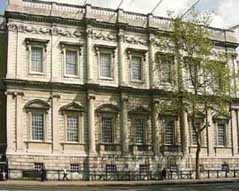
- Left illustration above: England: Banqueting House at Whitehall, London, England (1619)
- England: St. Paul's Cathedral, London, England
Other Examples
- Czech Republic: Schwarzenberg Palace, Prague, Czech Republic - Sgraffito
- Netherlands: Oost-Indisch Huis, 4 Oude Hoogstraat, Amsterdam, Netherlands
- Poland: Wawel Castle, Cracow (Krakow), Poland
- Poland: 15 Ulica Kanonicza, Cracow (Krakow), Poland
- Poland: Deanery, Cracow (Krakow), Poland
- Poland: Cupola - Church of St. Mary (Kosciol Mariacki), Cracow, Poland
- Spain: Catalonian National Art Museum, Barcelona, Spain
- Spain: Palau de Generalitat, Barcelona, Spain
Victorian substyle
Buildings in the Renaissance Revival style show a definite studied formalism. The tightly contained cube is a symmetrical composition of early sixteenth century Italian elements.
Characteristics include finely cut ashlar that may be accentuated with rusticated quoins, architrave framed windows, and doors supporting entablatures or pediments.Each sash may have several lights or just one.
A belt or string course may divide the ground or first floor from the upper floors.
Smaller square windows indicate the top or upper story.
- Identifying American Architecture, by John J.-G. Blumenson. New York: Norton. 1981
Example from Buffalo: 74th Regiment Armory
Second (Italian) Renaissance Revival 1890-1920
Beaux Arts substyleA later revival of Renaissance-inspired design in American houses occurred from about 1890-1930 and was the purest in its resemblance to the Italian originals. The period benefited from first hand familiarity with original models, improved printing technology for photographic documentation, and perfected masonry veneering techniques after W.W.I
At first, this style was relatively rare, found mostly in architect-designed landmark houses. By about 1920, the technique of veneering a single layer of brick or stone onto the outside of wood framed walls had been perfected leading to smaller and less costly Italian Renaissance designs that were popular in suburban neighborhoods.
One of the architects who popularized the style was Richard Morris Hunt (1827-1895), the first American to study at the prestigious L'Ecole des Beaux Arts in Paris. Hunt was one of the architects who designed buildings for the 1893 Columbian Exposition in Chicago where the style received great publicity.
The Italian Renaissance style was much less common than the more popular Tudor and Colonial Revival styles of the period. The style declined steadily in popularity through the 1930s, and post-1940 examples are rare.
Identifying features of the Second Italian Renaissance Revival:
- low-pitched hipped roofs covered with ceramic tiles
- widely overhanging eaves, often supported by decorative brackets
- upper-story windows smaller and less elaborate than windows below
- commonly with arches above doors, first-story windows, or porches
- symmetrical facade
Second Renaissance Revival 1890-1920
Architectural Style and Form
The Renaissance Revival was a style popular during several periods of the nineteenth and early twentieth century.
Drawing inspiration from the palazzos of Italy built in the 1400s through 1600s, the Renaissance Revival style was characterized by low-pitched hipped roofs often covered with ceramic tiles and broadly overhanging eaves often supported by decorative brackets.
Often with symmetrical facades, the elevations commonly feature distinct horizontal divisions, often marked by beltcourses. Each floor was treated differently, frequently with a more articulated lower level that often featured rusticated stone work with simplified, smaller-scaled detailing to upper floors, and upper-story windows that were smaller and less elaborate than windows below.
Arcades and arched openings frequently are present in Renaissance Revival style buildings.
- VILLAGE OF WILLIAMSVILLE, HISTORIC PRESERVATION COMMISSION (online October 2017)
Second Renaissance Revival 1890-1920
Scale and size distinguish the later Revival from the earlier Renaissance Revival.
Large buildings - usually three tall stories - are organized into distinct horizontal divisions by pronounced belt or string courses.
Each floor is articulated differently. If the Doric Order or rustication is used on the first floor then the upper floor will be treated with a different order and finish.
The window trim or surround also usually changes from floor to floor. Additional floors are seen in the small mezzanine or entresol windows.
Arcades and arched openings often are seen in the same building with straight-headed or pedimented openings. Enriched and projecting cornices are supported with large modillions or consoles. The roof often is highlighted with a balustrade.
In turning to larger Renaissance buildings for models, architects working in this style opened the door for greater size, textural richness, and variety in form. The style well suited the grandiosity required by a very rich client like Cornelius Vanderbilt, who commissioned The Breakers, in Newport, Rhode Island.
- Identifying American Architecture, by John J.-G. Blumenson. New York: Norton. 1981, p. 41
Second Renaissance Revival 1895-1920
Late-nineteenth- century revivals are larger, grander, and more elaborate than earlier nineteenth-century style revivals. They tend to be stately rather than exciting, "correct" rather than daring.
Characteristic of the Renaissance [Revival] are arched openings, rusticated masonry laid with deep joints to give the appearance of massiveness, and strong horizontal lines. Cornices are finely detailed and moldings are crisply drawn.
- A Field Guide to American Architecture, by Carole Rifkind. New York: New American Library, 1980, p.220
Second Renaissance Revival 1895-1920
The Italian Renaissance revival, directly inspired by the great Renaissance houses of Italy, was one of the most popular of the Beaux Arts design modes, lasting from the the 1800s until the 1920s.
While the Victorian Italianate was essentially a loose interpretation of Italian architecture, drawn primarily from pattern books, the Italian Renaissance revival took a much more academic approach, with design features often copied directly from actual Renaissance landmarks, Roman, Florentine, and Venetian prototypes - ducal palazzi or county villas - were translated into American "palaces," primarily in cities such as New York and fashionable resorts like Newport, Rhode Island.
- The Visual Dictionary of American Domestic Architecture, by Rachel Carley. New York: Henry Holt & Co., 1994, p. 179
- Right illustration at top of page: Lafayette High School - French Renaissance Revival.
- Putto
- Francis W. Tracy Monument
- Ellicott Square Building
- Park Lane Condominium
- Photo - John Strootman House
- Harlow C. Curtiss House, 479 Delaware Ave.
- St Vincent's School
- 70 Niagara Street
- Statler Hotel/Statler City
- Silverthorne House
- Forman-Cabana House
- St Gerard's RC Church
- Erlanger Theater Demolished
- Mayflower Apartments Second Renaissance Revival
- Lafayette Hotel - French Renaissance Revival
- Walbridge Building Second Renaissance Revival
- S. Douglas Cornell House - French Renaissance Revival
- Charles W. Goodyear House - French Renaissance Revival
- Bemis House - Flemish Renaissance Revival
- YMCA - English Flemish Renaissance Revival
- Riviera Theatre Italian Renaissance
- Liberty Bank Building Second Italian Renaissance
- Thomas J. McKinney House Second Italian Renaissance
- Fireplace - Thomas J. McKinney House
- Fireplace - Appleton House/Medaille College President's Residence
- Marble fireplace - Bush/Depew House
Examples outside of Buffalo:
- Albright Memorial Library, Scranton, Pa. - French Renaissance Revival
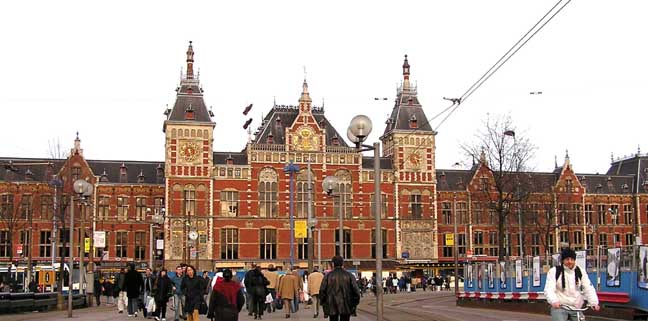
- Centraal Station, Amsterdam, Netherlands (1899) - Dutch Renaissance Revival
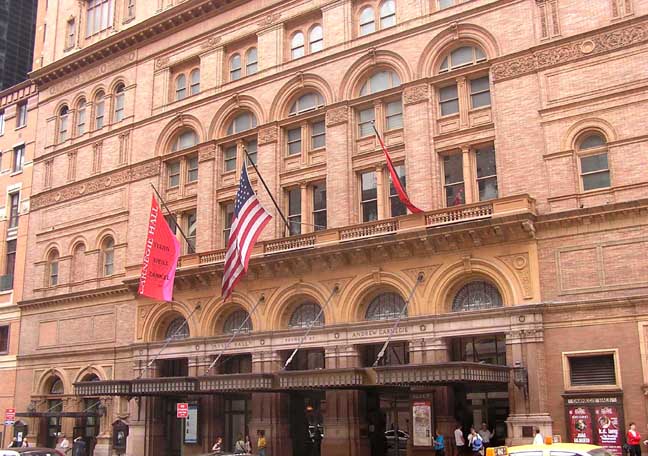
- Carnegie Hall, New York City - Italian Renaissance Revival
- Galleria Vittorio Emanuele II, Milan, Italy (1865-1877)
- Pierpont Morgan Library Complex, New York City - Italian Renaissance Revival