Cyrus Kinne Porter in Buffalo, NY
ILLUSTRATIONS Beneath essay
|
||||||||||
Illustrations - not part of Christopher Brown's essay 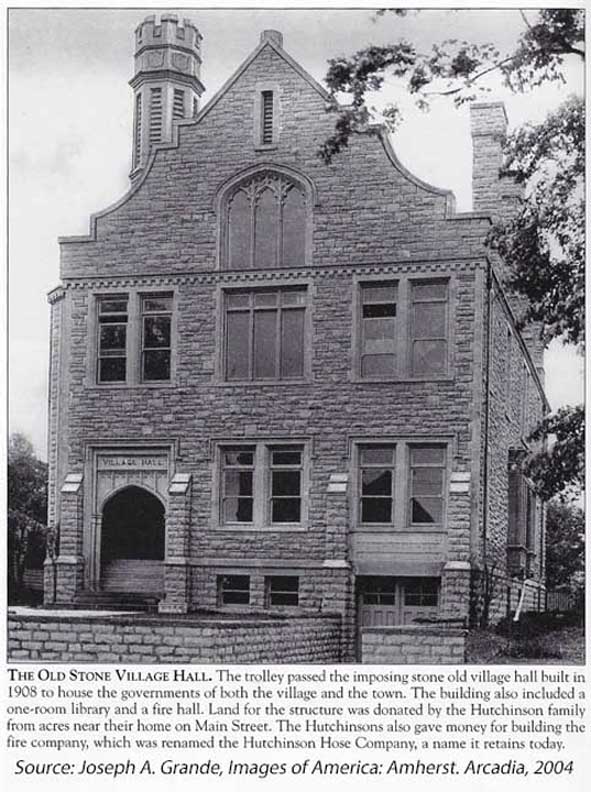 Williamsville Village Hall 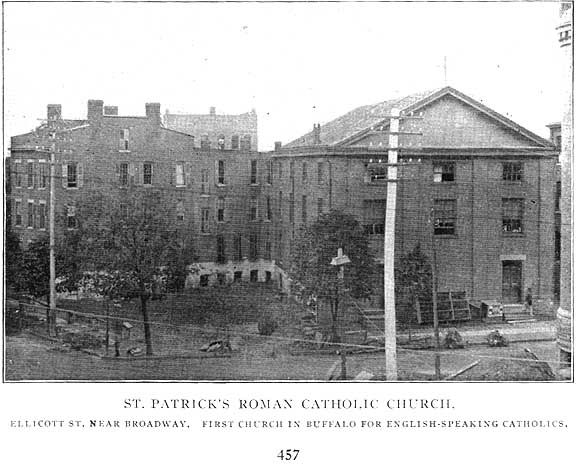 Source: "The Picture Book of Earlier Buffalo," Frank H. Severance, ed. Buffalo Historical Society Publications, Vol. 16, 1912, p. 457 (online) 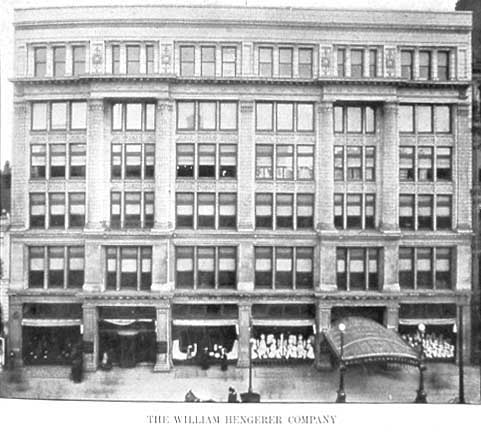 Source: "A History of the City of Buffalo and Niagara Falls," Moon, James C., ed.. Buffalo: The Times, p. 189 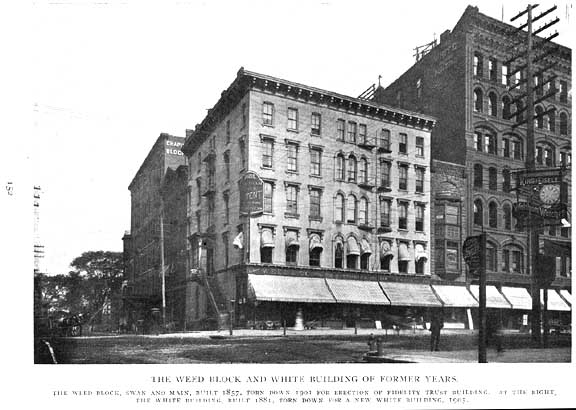 Caption: The Weed Block and White Building of former years. In
the early years Porter's office was in the Weed Block at Swan and Main
streets, in which Grover Cleveland's office was also located.
The Weed Block, Swan and Main, built 1857, torn down 1901 for erection of Fidelity Trust Building. At the right, the White Building, built 1881, torn down for a new White Building, 1905. Source: "The Picture Book of Earlier Buffalo," Frank H. Severance, ed. Buffalo Historical Society Publications, Vol. 16, 1912, p. 152 (online) |
||||||||||
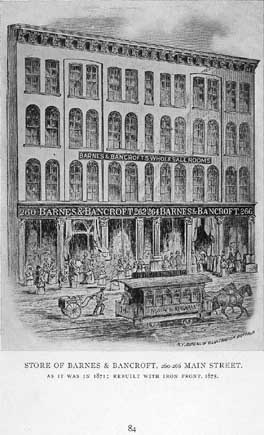 Barnes and Bancroft Store (1867) Caption: Store of Barnes and Bancroft Store, 260-266 Main Street, as it was in 1871; rebuilt with iron front, 1875 Source: "The Picture Book of Earlier Buffalo," Frank H. Severance, ed. Buffalo Historical Society Publications, Vol. 16, 1912, p. 84 (online) 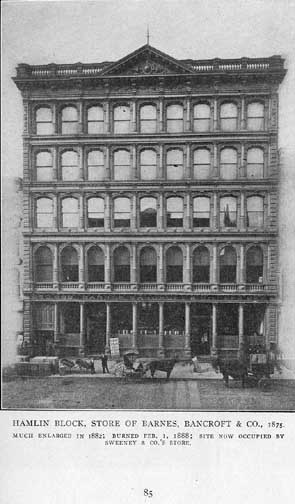 Barnes and Bancroft Store (1875) Caption: Hamlin Block, Store of Barnes, Bancroft & Co., 1875. Much enlarged in 1882; burned Feb. 1, 1888; site now occupied by Sweeney & Co.'s store Source: "The Picture Book of Earlier Buffalo," Frank H. Severance, ed. Buffalo Historical Society Publications, Vol. 16, 1912, p. 85 (online) 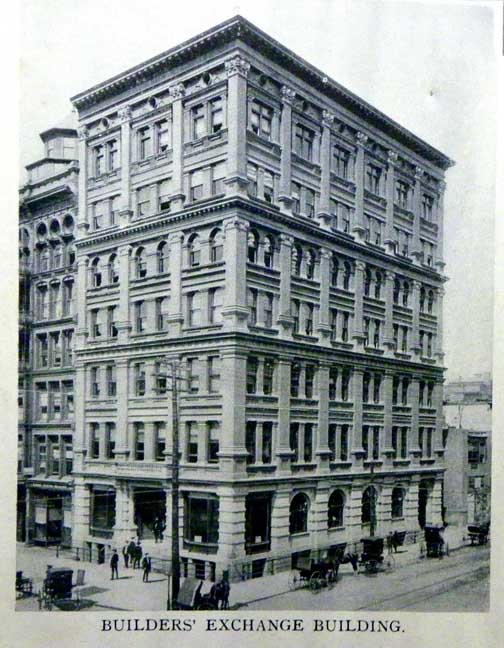 Source: 1905 Buffalo of Today: Domestic and Industrial |
||||||||||
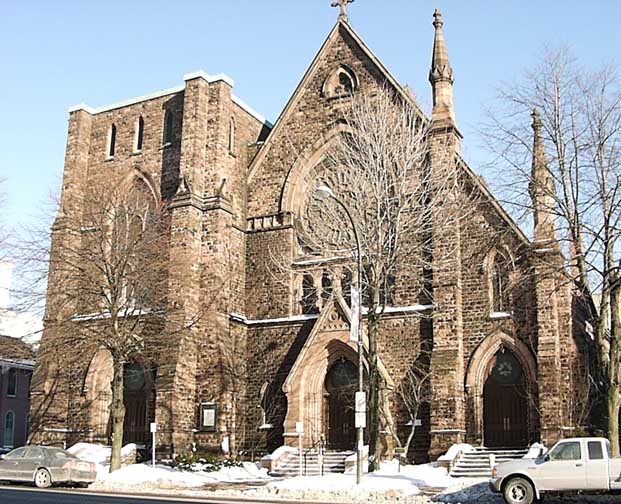 Trinity Episcopal Church 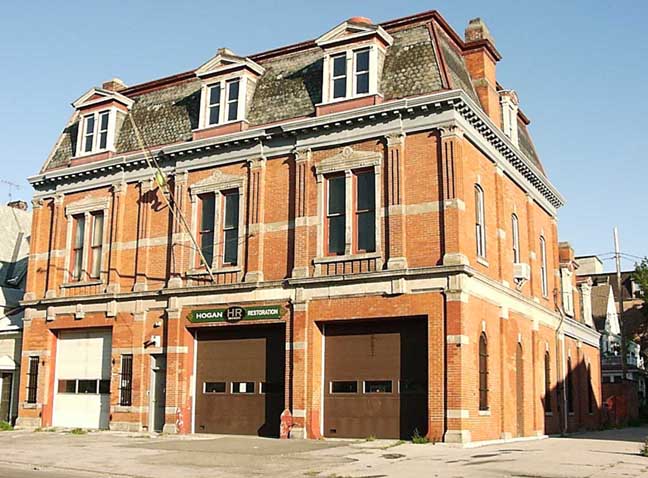 Firehouse #2 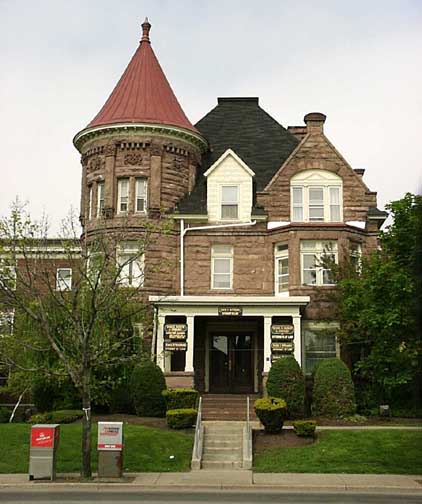 Eberhardt House 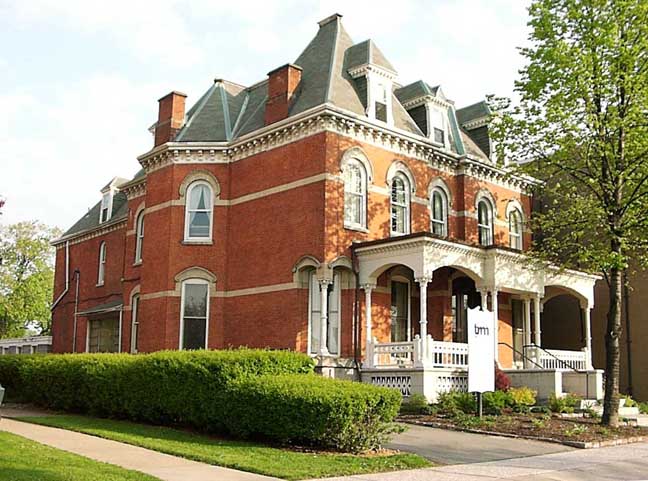 Robert B. Adam House 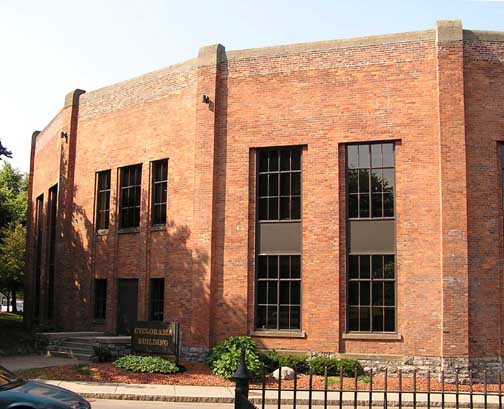 Cyclorama Building 369 Franklin St. |
||||||||||
341
Jersey Street, near Porter Ave.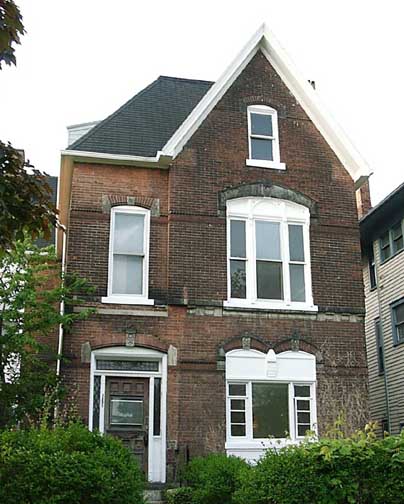 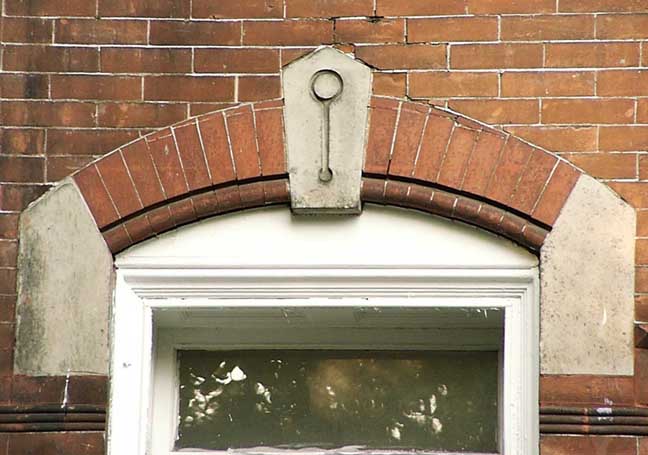 341 Jersey Street, near Porter Ave. Detail - keystone |
||||||||||
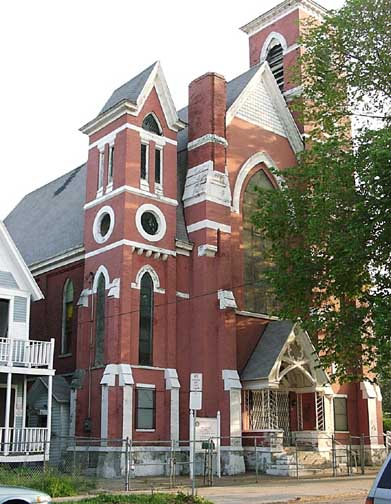 First Free Baptist Church, Hudson at Fargo Sts. Note entrance (detail in next photo) 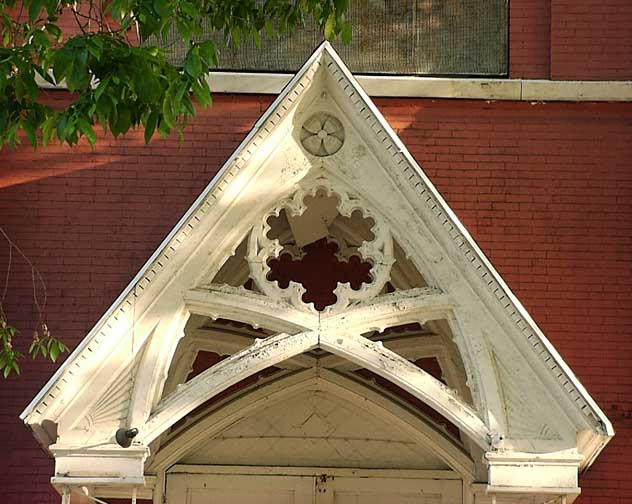 First Free Baptist Church Gable roof over front entrance: Dentils ..... Patera ..... Multifoil |
||||||||||
Plymouth Methodist Church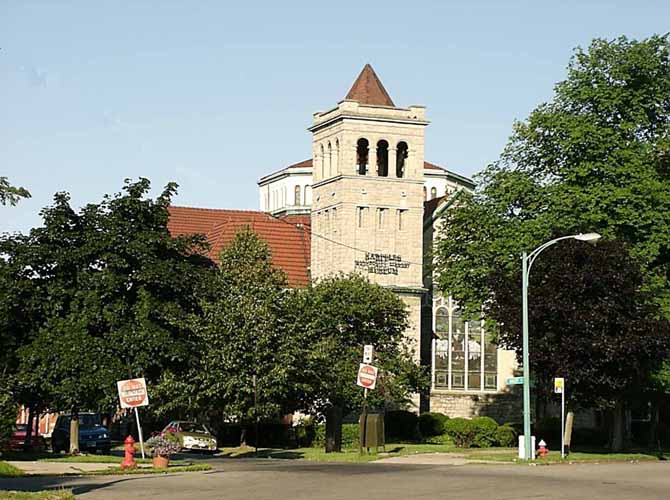 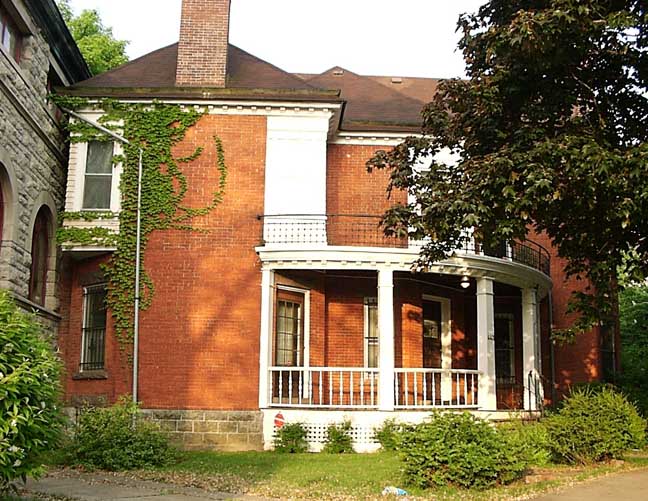 Plymouth Methodist Church Parsonage (1889) 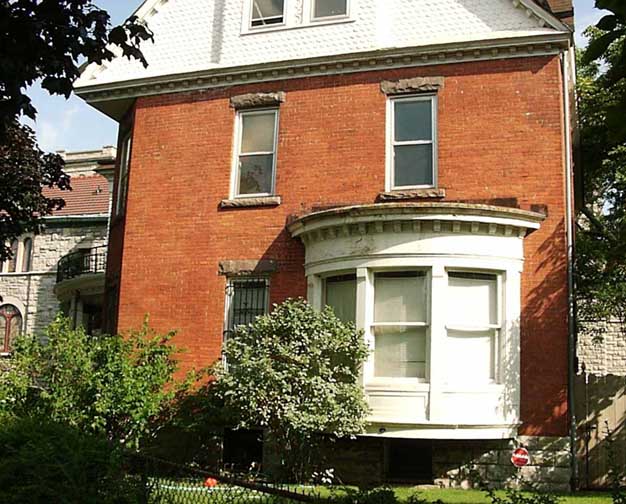 Plymouth Methodist Church Parsonage (1889) |
||||||||||
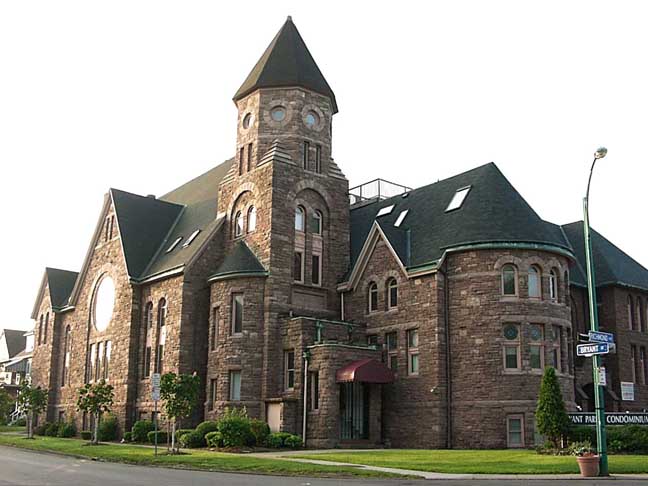 Disciples of Christ Church / Richmond Avenue Church of Christ / Bryant Parish Condominiums. Richmond Ave. at Bryant St. |
Cyrus Kinne Porter, (1828-1910) was one of the most well known and prolific architects in Buffalo during the Victorian era.
Porter had the following partnerships during his life:
A biography of Porter written at the time of his construction of the Plymouth Methodist Church parsonage at 443 Porter Avenue [Ed. note: Porter Avenue was named after Peter Porter] details his accomplishments to that time:
- 1855-1865
Porter and Turner (John), in Brantford, Ontario
- 1865
Wilcox (H.M.) and Porter
- 1874
Porter and Watkins
- 1880-1883
Porter and Percival (Charles R.)
- 1888-1910
Porter and Son (Jesse) One of the best known architects of the city is Cyrus Kinne Porter. Mr. Porter is of Puritan descent. The town of Cicero, Onondaga County, was his birthplace. At the age of seventeen Mr. Porter was left an orphan and thrown entirely upon his own resources.
As he was of a mechanical turn, he resolved to learn the trade of a joiner. While learning his trade, and subsequently while working at it for a livelihood, he began the study of architectural drawing. His first instructor was an itinerant teacher and architect, who was nominally located in Detroit. From this time forward the young man gave his entire attention to architecture. He soon mastered the principles of practical geometry and linear perspective, and developed into an accomplished draughtsman.
Porter and Turner: In 1853 he secured employment as a draughtsman for the Chicago Water Works, in which occupation he remained for some two years. He then, with a partner, opened an office in Brantford, Ontario. From March 1855 until at least April 1856 his partner in Brantford, Ontario was the talented and prolific architect John Turner (1807-1887).
Wilcox and Porter: In 1865 Mr. Porter came to Buffalo, and soon after entered into partnership with H. M. Wilcox. The firm of Wilcox & Porter designed several very important buildings, among which were the Ovid Insane Asylum and Normal schools at Fredonia, Cortland, and Potsdam. In 1867 Mr. Porter won the second prize of $2,000 in an open competition for the best design for the War Department Building at Washington.
Several pieces of successful work for the people of Bay City necessitated the opening of a branch office in that place. The Courthouse of Bay County and the Baptist Church of the city were both built from Mr. Porter's designs.
In Buffalo he has designed more business blocks and more dwellings than could be enumerated in a column. The Coal and Iron Exchange and the Brayley house at the corner of Main and Tupper streets are fair examples of his skill in these directions. Mr. Porter's greatest successes have been in ecclesiastical architecture. The new Trinity Church on Delaware Avenue [PHOTO ABOVE] is justly regarded as a specimen of his best work.
Porter & Son: Mr. Porter is now associated with his son under the firm name of Cyrus K. Porter & Son. The place of business is in the American Block at Room No. 43. (Source: Extra Number of the Buffalo Morning Express, Issued as a Souvenir of the International Industrial Fair, Sept. 4th to 14th, 1888. Buffalo, NY: Matthews, Northrup & Co., 1888, page 44.)
Family: Mr. Cyrus K. Porter certainly loved architecture. His son Jesse, who became his partner and designed the Plymouth Avenue Methodist Church at 453 Porter Avenue, had sibling competition. In 1889, the year that 443 Porter Avenue was being built, Cyrus' daughter, Edna M. Porter, was studying architecture at Cornell University. Edna had graduated from Buffalo High School in 1881.
Obituary: Cyrus Porter continued his own architectural practice until his death on January 30, 1910, just before the construction of the new Plymouth Methodist Church began. His obituary stated:Cyrus K. Porter, the oldest architect in Buffalo, died at Ransomville last night after an illness of many months. Mr. Porter had suffered two paralytic strokes and since the last one about four months ago he had been very feeble. Last spring he was removed to a farm near Ransomville, where he had remained since. Arrangements for the funeral will be announced later.
Mr. Porter was 82 years old. He was born in Cicero, N. Y. In 1865 he came to Buffalo, where he opened an office. He had the unusual record of 52 years of activity in his profession, and for many years was its undisputed leader in this vicinity. Many of the city's largest buildings of two decades were designed by him, including the American Block, the Coal and Iron Exchange, the Builders' Exchange, Trinity Church on Delaware avenue [PHOTO ABOVE], the Church of the Holy Name, St. Patrick's Church [PHOTO ABOVE] , and in recent years the William Hengerer Company [PHOTO ABOVE] store.
Offices: In the early years his office was in the Weed Block [PHOTO ABOVE] at Swan and Main streets, in which Grover Cleveland's office was also located. From there he moved to the American Block, in which he occupied offices for about 20 years, and moved with other tenants to the Brisbane Building 12 years ago when the offices in the American Block were given over to mercantile purposes. About four years ago the office was moved to the Hutchinson Building.
Surviving Family: Mr. Porter is survived by two sons, Jesse R. and Cyrus K., and three daughters, Edna M., Hermoine T. and Minnie K.
He was also active in promotion of temperance, being affiliated with many societies doing work along that line. He was a 33d degree Mason. (Source: "Designed Many of Buffalo's Largest Business Buildings. Trinity Church, Builders' Exchange and William Hengerer Store Among Many in Whose Erection Cyrus K. Porter Had a Hand." Buffalo Evening News, January 31, 1910.)In conclusion, Porter was an important local architect and contributed much to The Circle (now Symphony Circle) neighborhood. He had a hand in the design of the following buildings:
- Firehouse #2 (1875, corner of Jersey and Plymouth) PHOTO ABOVE
- Home for A. Reynolds at 213 North Street (1876). The home was obliterated when Elmwood Avenue was expanded north past North Street.
- House at 341 Jersey Street (1880) PHOTO ABOVE
- Plymouth ME church parsonage (1889, 443 Porter Avenue) PHOTO ABOVE
- Plymouth ME Church (1911, 453 Porter) His son designed the present church, but Cyrus may have had some influence in its design.
Although just out of range of The Circle neighborhood, Porter along with his partner Charles R. Percival in 1881 designed the First Free Baptist Church (PHOTO ABOVE) on Hudson Street near Fargo (the only known extant building from the period of his partnership with Charles R. Percival).
In addition, Porter also is credited with designing the following major Buffalo buildings:
- Barnes and Bancroft Store (1867, rebuilt in 1875, 260-268 Main St.) PHOTOS ABOVE
- Coal and Iron Exchange (pre-1883, 255-257 Washington St. [demolished])
- Trinity Episcopal Church (1886, 371 Delaware Ave.) PHOTO ABOVE
- In 1886, just a few years earlier than the reconstruction of the Plymouth Methodist Episcopal Church, he had just completed the design of the Disciples of Christ Church/ Richmond Avenue Church of Christ on Richmond & Bryant (now Bryant Parish Condominiums). (1886, SE corner of Richmond and Bryant) PHOTO ABOVE
- Municipal Building
- Interior and roof of St. Paul's Episcopal Cathedral after the fire of 1888
- Eberhardt House (1893-1894, 2746 Delaware Ave.)
- Holy Name of Jesus RC Church (1904)
- Wm. Hengerer Store (1904, with 2 story addition in 1910, 465-471 Main St.).
- Robert B. Adam House at 448 Delaware Ave. Adam was one of the founders of the Adam, Meldrum & Anderson department store on Main Street