H. H. Richardson - Table of Contents
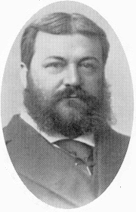
Henry Hobson Richardson -- Biography and Work
Henry
Hobson Richardson
(1838-86)Born at Priestly Plantation in Louisiana in 1838, Richardson learned early to speak French. He attended public and private schools in New Orleans before going to Harvard in 1854. At Harvard, he excelled in math, continued his study of drawing (an avocation he had started at age 10), and gave up civil engineering in favor of architecture. All would serve him will when he applied to be the second American student to enter the L'Ecole Des Beaux-Arts in Paris.
He remained in France throughout the Civil War (he had friends in the North and relatives in the South). After his return to the US in 1865, he settled in a house on Staten Island. His neighbor was the landscape architect Frederick Law Olmsted, with whom he later collaborated, for example in Buffalo for the Buffalo State Hospital.
His assistants Charles F. McKim and Stanford White developed their Shingle style from Richardson's fresh use of old materials in his domestic architecture. He also influenced such notable architects as Louis Sullivan, John Wellborn Root, and Frank Lloyd Wright.
Biographers have seen three Richardsons: the Romanesque revivalist, the Victorian designer, and the proto-modernist.Richardson's knowledge of the Queen Anne Olde English style of Richard Norman Shaw, transmitted through the pages of The Builder and other British journals to which Richardson subscribed, is clearly evident in Richardson's domestic architecture of the 1870s (Andrews House, Newport, 1872; James Cheney House Project, South Manchester, Connecticut, 1878; and especially the Watts Sherman House, built in Newport in 1874). The "free style" of Shaw encouraged a picturesqueness, textural richness and materially tectonic architecture that was rich, never academically dry, and conducive to a first decisive step out of the historicism of the midcentury.
When Richardson died prematurely in 1886, William LeBaron Jenney had just complete Chicago's first skyscraper and Frank Lloyd Wright was about to build his first house. Although he would not live to witness the rapid changes in both urban and suburban architectural design, in 20 short years Richardson had already made his mark. From his monumental masonry blocks of "Richardsonian Romanesque" to the landscape settings of North Easton, Richardson had established a lasting legacy for American architects of the following generation.
Henry Hobson Richardson (1838-1886), a great-grandson on his mother's side of Joseph Priestley (the discoverer of oxygen), was born in Louisiana on September 29, 1838. He spent his early life on the Priestley plantation and in New Orleans.
Because a speech impediment prevented him from entering West Point, he spent a year at the University of Louisiana and then entered Harvard College in February 1856. He spent four academically undistinguished but socially successful years at Harvard, where he was a member of the Hasty Pudding and Porcellian clubs and the Pierian Sodality. The friendships he made in these years would serve him well in his professional life. Although Richardson had initially intended to pursue a career in civil engineering, while at Harvard he chose architecture instead.
After graduation in 1859 he traveled to Paris, where he spent the next five years. He enrolled in the Ecole des Beaux-Arts in November 1860, but he attended only intermittently after the American Civil War cut off his family's support.
Richardson returned to the United States in 1865 and settled in New York. After some months working with a local builder and then as a designer of lamps, he entered practice on his own on May 1, 1866.
In 1867 Richardson entered a partnership with Charles Dexter Gambrill (1834- 1880). Gambrill served primarily as the business manager of the firm, Gambrill and Richardson, and was responsible for only a few designs over the next ten years. Richardson, in turn,was free to develop his design talents.
When Richardson entered architectural practice, American architecture was dominated by the Victorian Gothic (English) and Second Empire (French) styles. Richardson's earliest buildings follow the conventions of these styles and are generally indistinguishable from the works of his contemporaries. Only in the early 1870s did he begin his own approach to design; he did not achieve complete maturity as an architect until 1878.
Richardson won the competition for Trinity Church, Boston, in1872. With it he became one of the most sought after architects in the United States.
Richardson's professional maturity was marked by a series of projects beginning in 1878: Sever Hall, Cambridge; the Ames Monument, Wyoming; and the Crane Library, Quincy. In these projects Richardson began to simplify form and to eliminate archeological detail. He turned instead to basic shapes, continuous surfaces, and the innate qualities of brick, stone, and shingles to create the distinctive architectural quality of his buildings.
By 1882 Richardson was recognized as the leading architect in America; even in Europe he had few rivals. In the last years of his career he was besieged with commissions.
Richardson's health deteriorated markedly in the later years of his life. During his visit to Europe in the summer of 1882, he consulted with Sir William Gull concerning his illness, a chronic case of Bright's disease, a renal disorder. Although Gull warned Richardson to be careful, he continued his practice at the same pace on returning to Brookline. He died four year later on April 27, 1886, at the age of 47. His grave may be found in the Walnut Hill Cemetery in Brookline.
The practice of architecture in Richardson's office followed his experience in the Paris ateliers. For each project Richardson provided small sketches, which were given to his draftsmen to be developed in drawing form. A senior draftsman would know all aspects of each design and Richardson's intentions at each stage. When the project was ready for construction, this draftsman was fully prepared to supervise. In this way Richardson maintained his involvement in a large number of projects without becoming overwhelmed in detail.
- National Register of Historic Places Nomination, Item No. 8, p. 3 (online June 2013)
The Three Buffalo Buildings:
Other Surviving Richardson Buildings:
- Crane Memorial Library, Quincy, 1890
- Stoughton House in Cambridge (1882)
- Albany City Hall (1880-82)
- Allegheny County Courthouse and Jail in Pittsburgh (1883-8)
- Cheney Block in Hartford, Connecticut (1875-76)
- Marshall Field Wholesale Store (1885-87) in Chicago
- Ames Library at North Easton, Massachusetts (1877)
- Ames Memorial Town Hall at North Easton, Massachusetts, (1879)
- Chestnut Hill Railroad Station (1883)
- Emmanuel Episcopal Church in Allegheny City (Pittsburgh) (1883)
- Episcopal Church in Albany (1883)