Queen Anne Style - Table of Contents........ Styles of Architecture
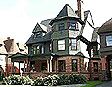
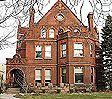
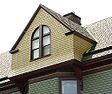
Queen Anne Style in Buffalo, NY - EXTERIORS
1880-1910
On this page below:
|
Click on photos for larger size
|
Essential
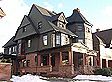
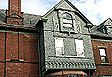
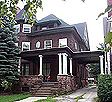
feature: Asymmetrical facade Illustration: 409 Linwood Ave. |
|
|
Dominant
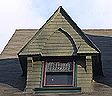
front-facing gable Illustrations: Bemis House, 267 North St. |
|
|
Gable is
cantilevered out beyond the plane of the wall below Illustration: 361 Porter Ave., 390 Linwood Ave. |
|
|
Towers
may be round, square, or polygonal (this example) Illustration: 38 Orton Place. |
|
|
Wooden
tower cantilevered out at the second floor Illustration: 361 Porter Ave. |
|
|
Tower
rises from ground level Illustration: Maytham-Millonzi House |
|
|
Tower is placed
at a front facade corner Illustration: 446 Linwood Ave. |
|
|
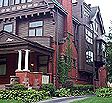
Essential
feature: A porch always covers part or all of the
front facade Illustration: 405 Linwood Ave. |
|
|
Porches
always include the front entrance area Illustration: 390 Linwood Ave. |
|
|
Second-story
porch Illustration: 38 Orton Place. |
|
|
Pedimented
porch Illustration: 437 Linwood Ave. Se also: Tympanum. In Queen Anne, often decorated with applied wood or plaster in foliated shapes |
|
|
Essential
feature: Differing wall textures - Patterned wood
shingles shaped into
varying designs,
including "fish scale" Illustration: 584 West Ferry St. |
|
|
Differing
wall textures - Terra cotta tiles on walls (unusual
for Buffalo,
but common in England) Illustrations: 426 Franklin St. |
|
|
Differing wall
textures on
masonry houses - terra-cotta
panels Illustration: Bemis House, 267 North St. |
|
|
Differing wall
textures - a
variety of materials are used on the different
stories, e.g., shingle
over brick Illustration: 409 Linwood Ave. |
|
|
Brackets
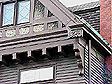
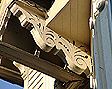
accentuate real and false overhanging Illustrations: 406 Linwood Ave., 584 West Ferry St. |
|
|
Decorative
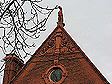
terra-cotta panels in gable Illustration: Bemis House, 267 North St. |
|
|
Gable
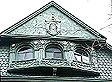
is decorated with patterned shingles and more Illustration: 409 Linwood Ave., 437 Linwood Ave. |
|
|
Dentils Illustration:361 Porter Ave. |
|
|
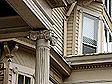
Classic
columns (Ionic
in these
examples) Illustration: 467 Linwood Ave., 584 West Ferry St. |
|
|
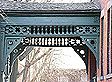
Spindle
work Illustration: The Butler House, 429 Linwood Ave. |
|
|
Oriel window illustration: 406 Linwood Ave. |
|
|
Slate
roof Illustration: Granger House, SE Elmwood and North |
| Vergeboard In Eastlake and Queen Anne styles, carved vergeboards sometimes include scroll-sawn cutouts, bull's eyes, beaded spindles, turned spindles, sunbursts, or (drop) pendants. |
- Bemis/Ransom House
- H. H. Little House
- George L. Lewis House
- 533 Auburn Avenue
- 277 Pennsylvania Ave.
- George Roos House
- 216 Metcalfe Street
- 34 North Pearl Street
- 58 North Pearl Street
- Foster House, 3 St. John's Place
- Bay - 1 North Pearl Street
- Porch - Philip Becker House
- Ellicott Street - ##1093, 1097, 1101, 1123
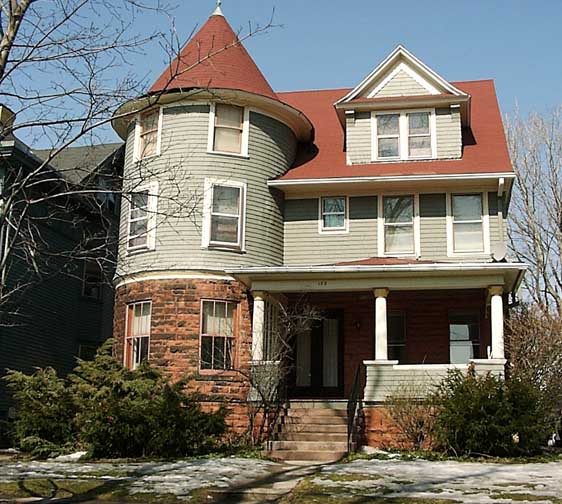
- 123 Lexington Ave. - photo
- Capital - Old Editions Book Shop and Café - photo
- Sampling of "Painted Ladies," SAN FRANCISCO
History
Named for the early eighteenth-century British monarch, the Queen Anne movement began in England in the 1860s. In that country, the term is associated with the revival and reinterpretation of several various architectural trends and styles which proliferated throughout Britain from the late fifteenth through the early eighteenth centuries. The Queen Anne style in Britain had a wide variety of sources and inspirations from Medieval Tudor-era half-timbered structures, to the more Classical-inspired Renaissance era designs of the Elizabethan and Jacobean periods. Gothic influences were also apparent in the Queen Anne style.
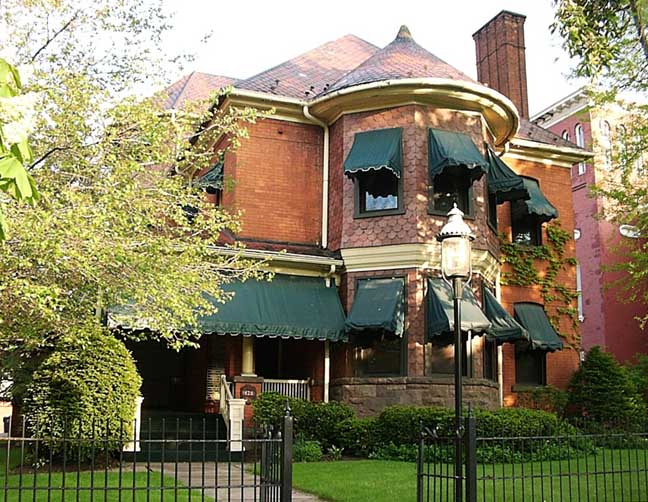
This wide variety of historical and constructional sources all merge in the Queen Anne style in the United States. The style is characterized by irregular forms, massing and shapes, and a wall surface which is frequently broken by recesses, projections, towers and bays. The influence of Medieval England and France is reflected in asymmetrical massing; varied, textured and patterned wall surfaces and planes; and the prominent use of overhangs, projections and jetties.
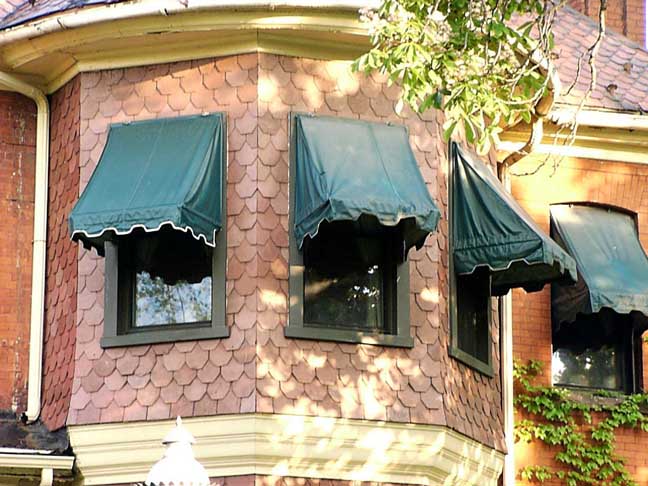
One of the most common elements found in both high-style and vernacular examples is the widespread use of patterned or shaped shingles, available in a myriad of shapes and designs. These shingles could be applied to a single element such as a gable or a tower, or could be used more widespread across the building.
In some examples, exterior surfaces were covered with multiple materials; stone, brick, slate, terra cotta, stucco, half-timber, clapboard, and shingle. Stucco might be molded or studded with stones or broken glass to emulate the pargeting found on old English dwellings.
High hipped roofs and cylindrical or faceted towers or turrets generally with conical roofs brought the forms associated with chateaus, manors, and farmhouses of northwestern and central France to the American landscape.
The Queen Anne style can be generally broken down into four broad categories, based on ornamentation which include the Spindlework subtype, the Free Classic, Half-Timbered and Patterned Masonry. The Spindlework variation accounts for about 50% of Queen Anne architecture and is highlighted by turned porch supports and spindlework ornamentation. This variant is also known as Eastlake detailing, after Charles Eastlake an English furniture designer who promoted such design elements. The Free Classic variant incorporates elements such as Classical columns, pediments, Palladian windows, dentils and other features. Half-timbered examples can fully or partially incorporate faux-half- timbered elements into the building’s facade with shingle or masonry often used. Patterned masonry examples feature polychrome or patterned brickwork or stonework with minimal wood detailing. This type was most prevalent in larger cities such as Chicago, New York and Washington DC and some examples are found in Buffalo’s more fashionable districts along streets like Delaware Avenue and Linwood Avenue
- Clinton Brown Company Architecture/Rebuild: High & Locust Streets Historic District Nomination, Sec 5, pp. 7-8
Aspects of the English Queen Anne spread to America in the 1870s. In this country, the style bears no relation to actual English Architecture of Queen Anne’s reign. First to appear were the Tudoresque dwellings modeled after the early works of English architect Richard Norman Shaw; hence the term Shawian sometimes used for this variant. However, the name is most commonly used for a highly-picturesque eclectic style that freely combines elements copied or abstracted from medieval and classical sources. Not all features were derived from English precedents. French architecture became increasingly influential, as American architects who trained and traveled in France returned with sketches of old buildings, which were then published in periodicals.
These varied sources all come together in Queen Anne building. The influence of medieval England and France is reflected in asymmetrical massing; use of overhangs and jetties; tall chimneys with pilasters, corbelled tops, or other patterned brickwork; and richly patterned and textured wall surfaces. Where financial resources permitted, exterior surfaces were covered with several materials; stone, brick, slate, terra cotta, stucco, half-timber, clapboard, and shingle. Stucco might be molded or studded with stones or broken glass to emulate the pargeting found on old English dwellings. Patterned shingles, very common even on inexpensive houses, imitated in wood the sheathing of slates or tiles found on some medieval structures. High hip roofs and cylindrical or polygonal towers or turrets with conical roofs emulate forms derived from the chateaus, manors, and farmhouses of northwestern and central France. Classical applied ornament is usually derived from American Colonial and Federal sources: broken-scroll pediments; Palladian, elliptical, and circular (bull’s-eye) windows; and garland-and-swag decoration. The inclusion of projecting and recessed porches and balconies, often decked with spindles and turned posts, is one of the less derivative, more inventive features of the American Queen Anne Style. A large number of houses in Buffalo’s West Side dwellings incorporate such elements.
The pure Queen Anne is relatively rare, while the Modern Colonial, Colonial Revival, and hybrid Queen Anne/Modern Colonial and Queen Anne/Colonial Revival styles are plentiful. Further, the influence of the Queen Anne persisted in vernacular building practice, as contractors continued to build projecting bays and towers on residences until the First World War and to use patterned shingle work on dwellings into the 1920s.
The largest settlement curves of the Grant-Ferry-Forest neighborhood correspond to the height of the Queen Anne style’s popularity. The style dominated the residential building stock of the last decade of the nineteenth century and early part of the first decade of the twentieth century , the housing stock of the neighborhood reflects this trend. The West Side of Buffalo offers a wide range of Queen Anne residences from modest to high style. Also common are hybrid examples of the style with elements of the Colonial Revival or Craftsman style. The most commonly seen sub-type of the Queen Anne in the Grant-Ferry-Forest is the two-and-one-half story, front gabled urban residence with modest stylistic features that were adapted by local builders.
- Grant-Ferry-Forest Historic Resources Survey, Section 4, Pages 3-4
The Queen Anne style was the quintessential American Victorian house with "bric-a-brac" and "gingerbread." It was the dominant style of domestic building during the period from about 1880 until 1900; it persisted with decreasing popularity through the first decade of the 20th century.
The style is varied and decoratively rich. Queen Anne houses often often employed elaborate woodwork of the Eastlake type. At the time of construction it was not uncommon for the houses to be painted with as many as six or seven different colors to bring out all the different textures and trim. The fashion was fairly dark colors, along the lines of what we call today "earth tones" -- sienna red, hunter green, burnt yellow, muddy brown, etc.
Roots in England - Richard Norman Shaw
The style was named and popularized by a group of 19th-century English architects led by Richard Norman Shaw (1831-1912).The name is rather inappropriate, for the historical precedents used by Shaw and his followers had little to do with Queen Anne who reigned 1702-14 or the formal Renaissance architecture that was dominant during her reign.
The sources were a combination of 17th and 18th century English and Flemish domestic architecture but incorporated eclectic motifs drawn from many sources. These included the following:
- rubbed-brick arches and dressings over and around openings
- terra cotta embellishments
- open-bed and broken pediments
- monumental chimneys
- shaped and Dutch gables
- tile-hung gabled walls
- white painted balustrades
- balconies
- bay windows
- overhanging eaves
- horizontal bands of leaded windows.
Basements were abolished, and front gardens had wooden fences rather than iron railings.
Shaw designed several small villas in the late 1870s for a new "artistic" suburb of west London called Bedford Park. The basic elements of red brick, white woodwork and features such as porches and oriel windows were rapidly adopted by commercial developers and used into the 1920s.
In AmericaThe Queen Anne proved enormously influential in the United States, where it dominated architectural debate and practice from the 1870s. Shaw's style was given two very distinctive American features: an extensive use of wood, for shingle, cladding, verandahs and decorative facade details, and novel, informal planning.
One of the most interested American architects was H. H. Richardson. Having studied and worked in France, and from his travels around Europe during the early 1860s, Richardson was keenly aware of the various historical precedents around Europe. Richardson was to do in America what Shaw was doing in England. With the Watts-Sherman house of 1875 in Newport, Rhode Island, Richardson paid homage to some of Shaw's buildings. The Watts-Sherman house was the first American building to be called "Queen Anne." Richardson's growing fame in the second half of the 1870s probably influenced other architects to learn of Shaw's work.
The Queen Anne received its first major exposure in America at the 1876 Centennial Exposition in Philadelphia, where the British government constructed several buildings in the style. It caught on quickly and replaced Second Empire and Gothic Revival styles as the most popular of the times..
American architects came to know and admire Shaw's ideas from a book of sketches he published in 1858, and, especially, pen and ink drawings from 1874 in periodicals, including the first architectural magazine, The American Architect and Building News, which were widely distributed in England and in America. Numerous architectural pattern books provided the designs.
This architectural style is considered a Victorian era style because, like the British Victorians, reaction to the Industrial Revolution led to reexamination of the pre-Industrial Revolution past. A revival of Gothic style architecture was the first manifestation of this romantic portrayal of the past.
Queen Anne became an architectural fashion in the 1880s and 1890s, when the industrial revolution was building up steam. North America was caught up in the excitement of new technologies. Factory-made, precut architectural parts were shuttled across the country on a rapidly expanding train network. Exuberant builders combined these pieces to create innovative, and sometimes excessive, homes.
Some of the best known Queen Anne houses are the "painted ladies" of San Francisco.
Balloon Framing / Technological developments
One of the most important technological developments during the second half of the 19th century was the advent of balloon framing, whereby the framework of a house could be made out of uniform lumber; this was becoming increasingly available from commercial mills. The framing system comprised inexpensive two-by-four-inch boards, combined as upright studs and cross-members and held together by cheap, mass-produced nails.
Eventually, by the turn of the century, balloon framing replaced traditional hewn timber construction and simplified the making of more complex architectural features, such as overhangs, bay windows and towers.
Advanced manufacturing techniques were also employed to mass-produce finished windows, doors, brackets and decorative turnings, often more elaborate and sometimes less expensive than their handmade counterparts. Along with plentiful building materials,there was also access to an increasing variety of publications on house building: trade catalogues, pattern books and architectural periodicals.-----
Sources:
- "A Field Guide to American Houses," by Virginia & Lee McAlester. New York: Knopf, 2000
- "Identifying American Architecture," by John J.-G. Blumenson. New York: Norton. 1981
- "American Homes," by Lester Walker. Black Dog and Leventhal Pub., 1981
- Queen Anne Architecture (Jackie Craven) (online Sept. 2015)