Sant'Agnese in Agone
(Church of St. Agatha at the Circus Agonalis)
Piazza Novona,
Rome, Italy
Completed:
1672
Style: Baroque
TEXT Beneath
Illustrations
(Interior photographs not allowed)
2002 Photographs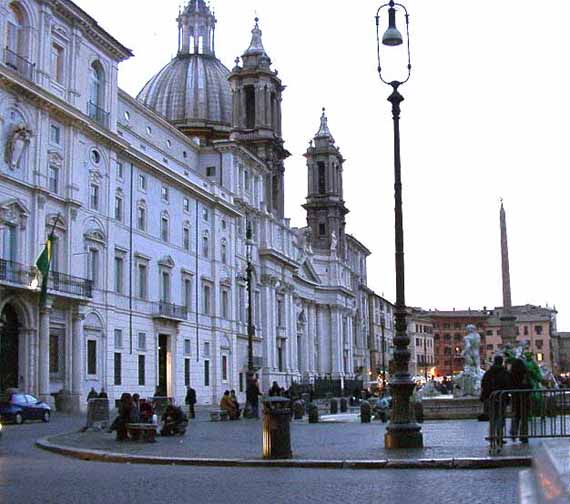 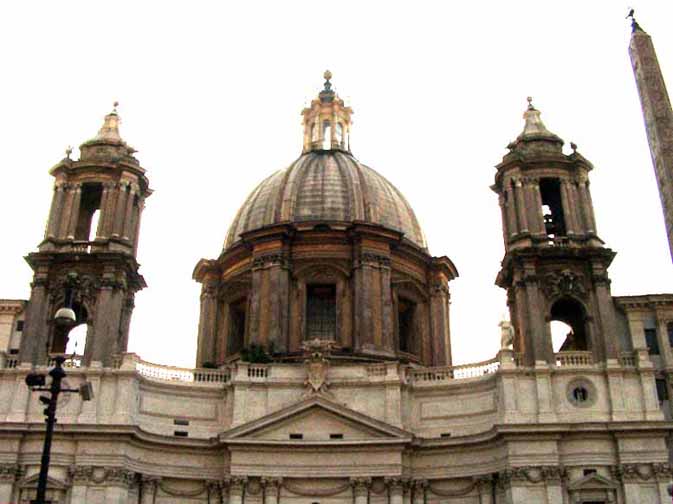 The idea of the twin towers framing a central dome may be indebted to Bernini's bell towers on the facade of Saint Peter's Basilica. The Pamphili family architect Girolamo Rainaldi's design of a concave facade and a central dome framed by twin towers was influential on subsequent church design in Northern Europe. 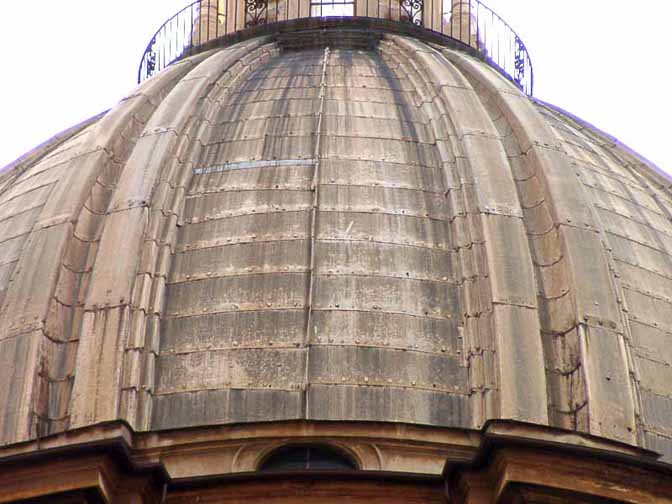 Cupola 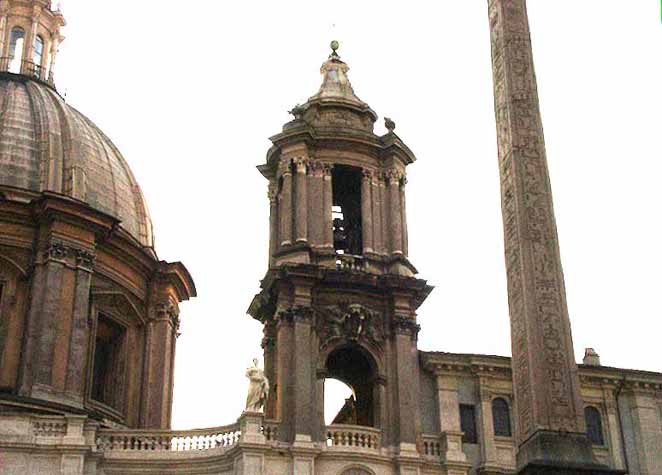 Belfry 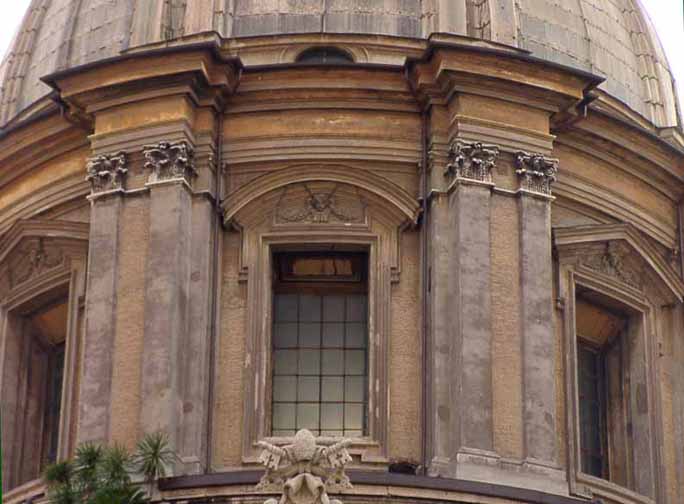 Four Corinthian pilasters........... Triangular and segmental pediments in window surrounds 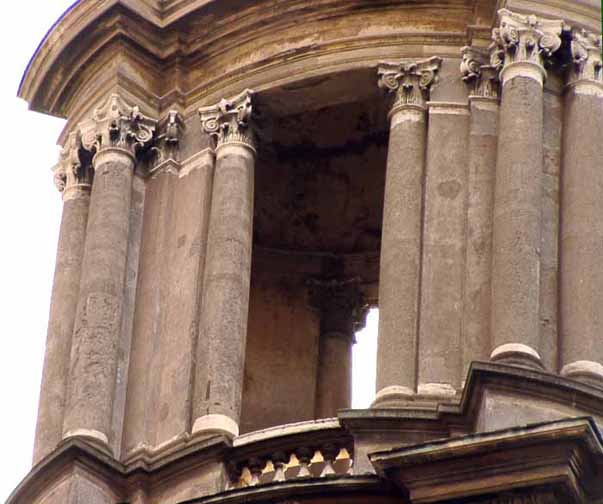 Corinthian columns 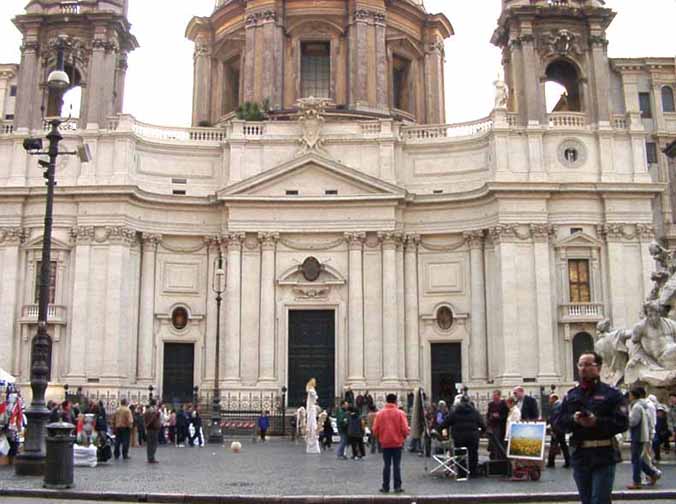 "Because of the narrow width of the piazza, Borromini and the other architects designed the church differently than most other baroque-style churches. The broad horizontals and the cupola rising immediately behind the façade allows viewers standing at any point in the piazza a clear view of the church. It is also important to notice the undulating surface of the façade, a key element of Baroque architecture. This theme is echoed in the columns, which pop out of the plane of the wall, texturing the façade. The curvature of the façade, in addition to the broad openness, appear like arms opened towards the viewer, interacting with them and inviting them to come inside." - Mark Shi, Monuments as Symbols: The Piazza Navona and Berini’s Fountain of the Four Rivers (online April 2013) 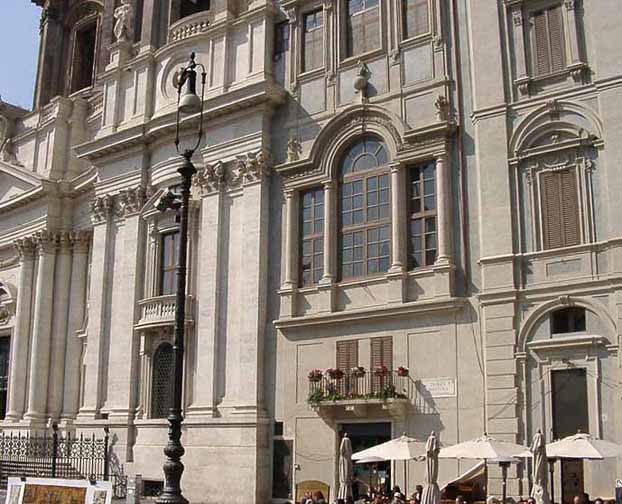 Palladian window: Fanlight ... Engaged columns 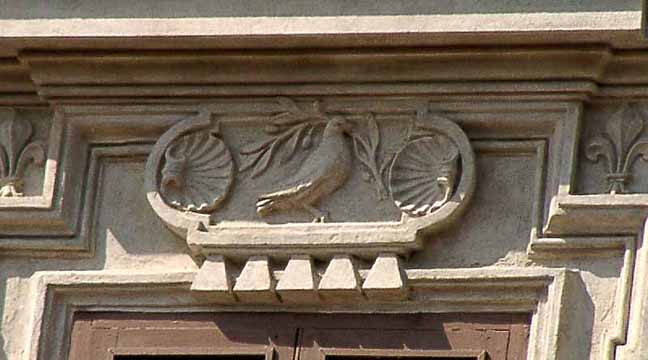 Fleurs-de-lis ... Shells ... Pamphilj family (Pope Innocent X) heraldic dove holding olive branch was early Christian peace symbol ... Five guttae |
2013 Photographs 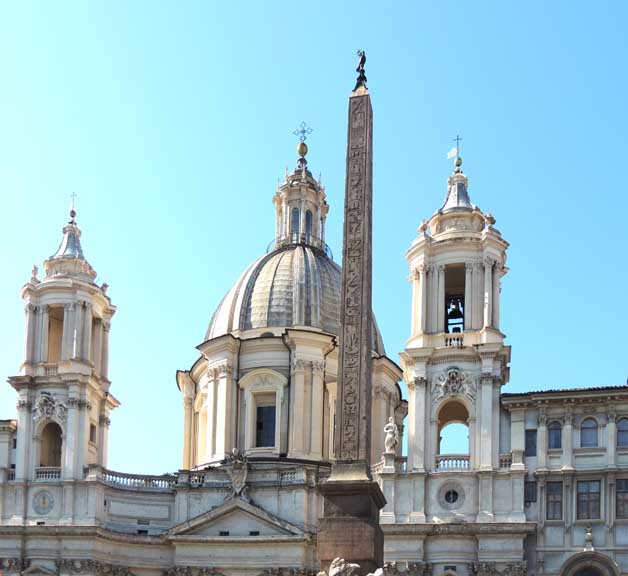 Center: Lantern atop cupola atop drum 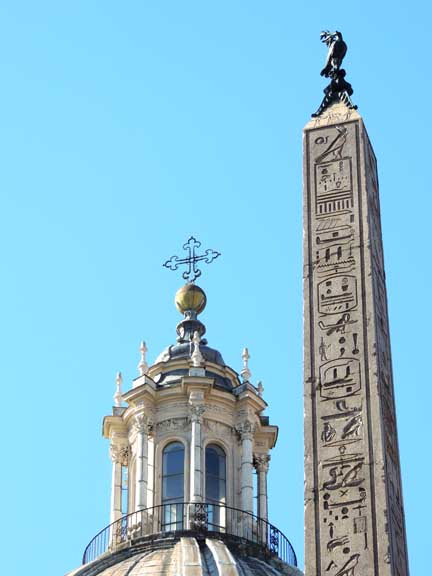 Lantern topped by cross bottony ... Obelisk from the Fountain of the Four Rivers 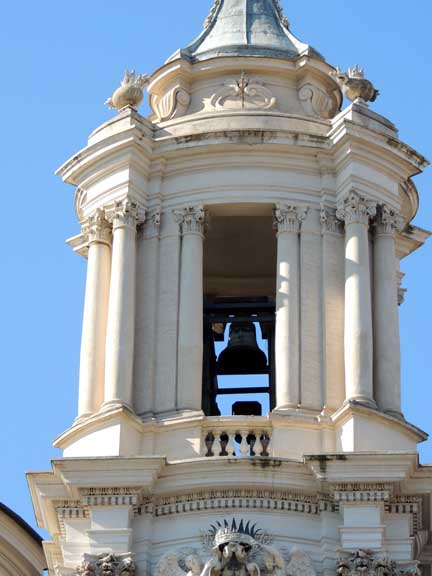 Belfry 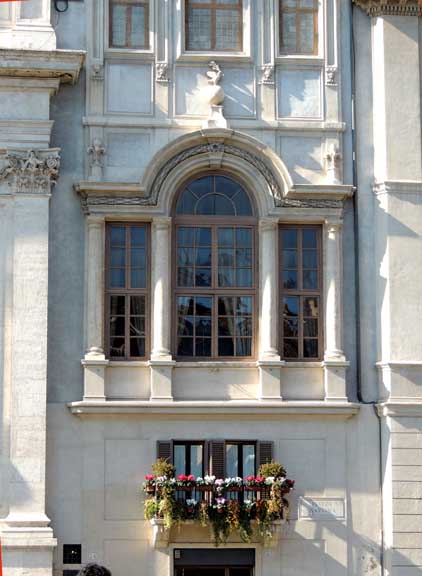 Palladian window: Fanlight ... Engaged columns 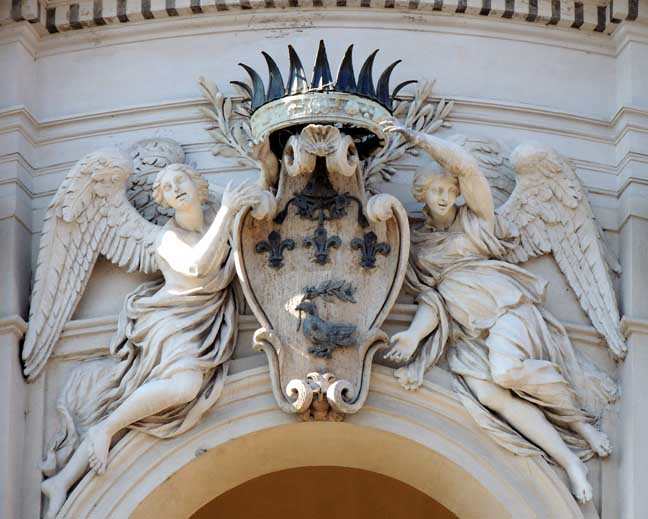 Pamphilj family (Pope Innocent X) heraldic dove holding olive branch was early Christian peace symbol |
Emperor Domitian in AD 86 built a race track and stadium on the Piazza Novona (this was known as Circus Agonalis, a name which by the Middle Ages had been modified to "in agone" and the dialect " 'n 'agone" before arriving at the present Navona.
Saint Agatha was a 13-year-old girl killed in 304 AD for her refusal to renounce her Christian beliefs and marry a pagan. She was thrown into one of the brothels close to the stadium. She was then paraded naked in the circus only for her nakedness to be covered by the miraculous growth of hair. A simple chapel ("oratory") was built on the site of her death. Below the church there are Roman ruins, including the ruins of the brothel where St. Agatha was martyred.
The Church
"The name of this church - Sant'Agnese in Agone - is unrelated to the ‘agony’ of
the martyr: in agone was the
ancient name of Piazza Navona (piazza
in agone),
and meant instead, from the Greek, ‘in the site of the competitions’,
because Piazza Navona was built on the form of an ancient Roman stadium
on the Greek model, with one flat end, and was used for footraces. From
‘in agone’, the popular use and pronunciation changed the name into
‘Navona’, but other roads in the area kept the original name." - Wikipedia (online April 2013)
A simple chapel ("oratory") was built on the site of St. Agatha's death. Below the church there are Roman ruins, including the ruins of the brothel where St. Agatha was martyred.
Sant'Agnese in Agone is a 17th century Baroque church designed by Girolamo Rainaldi and his son, Carlo Rainaldi for the Pamphilj Pope Innocent X. In 1653 architect Francesco Borromini replaced Rainaldi to finish the design of the church.
After the death of Pope Innocent X work stalled and Carlo Rainaldi was reinstated in 1668 to once again complete the building. The church was eventually consecrated in 1672.
With the election in 1644 of Pope Innocent X (Giovan Battista Pamphilj 1572-1655 ) a Roman family entered history.
The Pope was born in the family palace in Piazza Navona (now the Brazilian Embassy) and this explains why he devoted so much effort into transforming the vegetable market among the ruins of the Stadium of Domitianus into one of the most impressive piazza of Rome.
The Pamphilj emphasized the assumed Greek meaning of their name (Pan=everybody filios=lover/friend- therefore" everybody's friend") and they made large use of their heraldic dove with the olive leaves, which in their view was a symbol of their friendliness.
Here the doves are at the entrance of the church of Santa Agnese in Agone, where the Pope is buried. Originally the façade was on Via dell'Anima, but Borromini restructured the church and changed the entrance to Piazza Navona, where it became the focal point, highlighted by the fountain of the Four Rivers by Bernini in front of its door.
- Where the Dove Flies (online April 2013)
Francesco Borromini (1599 -1667)
Borromini was the son of a stonemason and began his career as a stonemason himself. He soon went to Milan to study and practice his craft. He moved to Rome in 1619 and started working for Carlo Maderno, his distant relative, at Saint Peter's and then also at the Palazzo Barberini. When Maderno died in 1629, he and Pietro da Cortona continued to work on the palace under the direction of Bernini. Once he had become established in Rome, he changed his name from Castelli to Borromini.
In 1634, Borromini received his first major independent commission to design the church, cloister and monastic buildings of San Carlo alle Quattro Fontane.
His career was constrained by his personality. Unlike Bernini who easily adopted the mantle of the charming courtier in his pursuit of important commissions, Borromini was both melancholic and quick in temper which resulted in him withdrawing from certain jobs, and his death was by suicide.
Sources:
- "An Outline of European Architecture," by Nikolaus Pevsner. Pelican Books, 1975.
- "Gardner's Art Through the Ages, Tenth Edition," by Richard G. Tansey and Fred S. Kleiner. Harcourt Brace College Pub. 1996
- "The Annotated Arch," by Carol Strickland. Pub. by Andrews McMeel