Illustrated Architecture Dictionary .................................... Illustrated FURNITURE Glossary
Fret
Alternate name in architecture: key pattern or meander
Alternate name in furniture: Chinese key

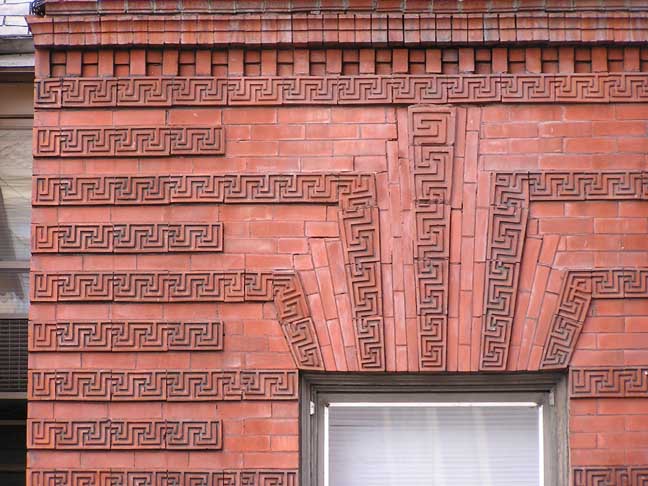
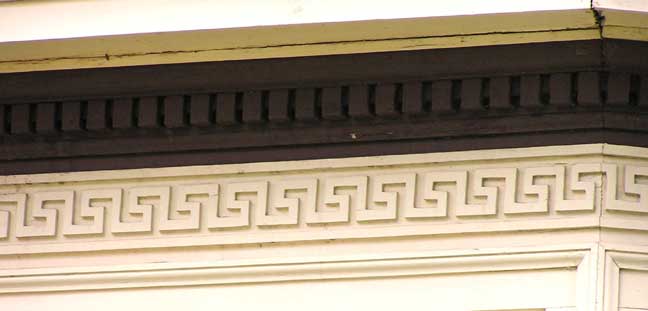
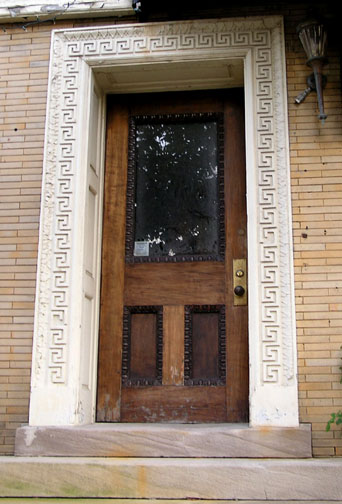
ArchitectureA repeating ornamental design of interlaced vertical and horizontal lines, such as the Greek key pattern, in T, L, or square-cornered G shapes
Old French: "fret" = grating
Some historians feel that the Greek key (illustrated above) has its basis in the Greek myth of the labyrinth that imprisoned the minotaur.
A meander is a running ornament consisting of a fret design with many involved turnings and an intricate variety of designs
A type of running ornament
Found in classical Greek and Roman architecture and derivatives, including Beaux Arts Classicism, Classical Revival, Federal, Georgian Revival, Greek Revival, Neoclassicism, Renaissance Revival, Second Empire
Spiral, Meander, Key Pattern, Maze
The spiral is a universal element in all decoration, in primitive as well as in the most sophisticated art. The running spiral (also known as running dog,wave scroll or Vitruvian scroll) and the meander (also known as Greek fret, Greek key, labyrinth, maze, key pattern) are curved and angular variations of the same motif.
Other figures, for example the four-strand spiral and the swastika, are similarly related.
Spiral and meander motifs, and their intermediate forms, have a long history in the Mediterranean....Meanders and key patterns are today closely associated with Greek art and architecture. In the formalized Orders of architecture the meander motif was assigned to flat vertical surfaces. In the eighteenth-century European revival of interest in classical Greece as a source of ornament, it was the in the meander and key patterns which, above all others, signified Greek style and taste.
It is generally accepted that the name of the motif [meander] refers to the winding river Meander in Anatolia, Turkey... The connection with water perhaps persists in Roman times, when the motif is frequently used on mosaic floors in bath houses.With few exceptions, these motifs carry no symbolic messages in Greek and Roman art.
In Greek vase painting of the fifth century BC, however, the meander became associated with a popular story drawn from the legends concerning King Minos of Crete, the story of Theseus slaying the Minotaur and finding his way in and out of the labyrinth. In these representations Theseus and the Minotaur - part bull, part man - are shown as realistic figures, while the Labyrinth is often indicated by a simple meander border, attached to a door post or pillar representing the entrance. In these scenes, therefore, the meander border became the conventional sign or ideogram for the Labyrinth.- British Museum Pattern Books: Roman Designs, by Eva Wilson, 1999, p. 12.
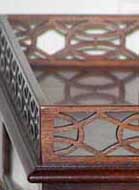
Chinese fret: Lattice ornament on balustrades, gates, friezes, and railings, made of square-sectioned timber, and forming square and rectangular patterns, with diagonals adding triangular and other shapes.
Highly developed by both the Chinese and the Japanese for textiles as well as for architectural ornament, the fret occurs not only as a band but also as a complicated allover pattern, sometimes with acute and obtuse angles instead of the more usual right angles.
The word "chinoiserie" comes from the French language. It means simply, "Chinese like." The concept of Chinoiserie fretwork has been employed in architecture and interior design for several centuries. The best known designer that made Chinoiserie a household standard is Thomas Chippendale who visited China during the development of his own cabinetry studio in Great Britain in the middle of the 18th century. The Chinoiserie introduced by Chippendale caught the design world's attention and spread immediately throughout Europe. The staggered vertical and horizontal lines of this fretwork motif are common in ancient Chinese architecture and still used today.
Because the fret is one of the simplest and most natural of decorative forms, it is one of the most widely spread, found from early times in most art forms and on all continents.
Its most important development, however, came at the hands of the Greeks (hence the common name Greek fret or Greek key), who used it for pottery and for painted decoration of architectural members.
- Encyclopædia Britannica (online March 2018)
FurnitureFretwork: Ornamental woodwork cut to represent small interlacing fillets or trellis work.
It is usually made in a complicated, repeating, geometric pattern.
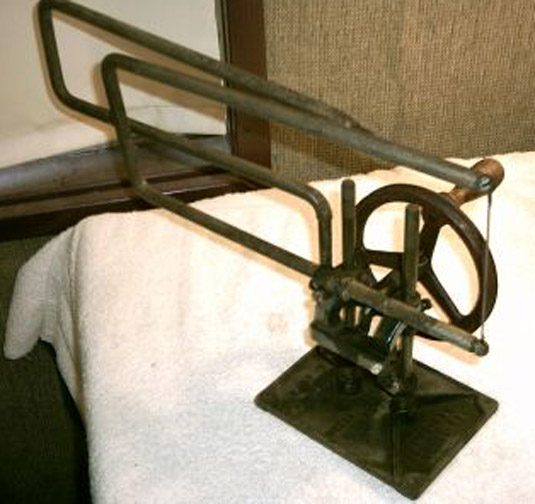
A favored technique of Chippendale in his Chinese period (mid-18th century)Scroll saw: In the 19th century, the Victorians used scroll saws for the cutting of fretwork. See photos and explanation of a large treadle lathe and scroll saw. See also: photo of hand crank scroll saw and photo of antique treadle powered scroll saw.
Moorish fretwork: The Moors possessed a large part of Spain during the early Gothic period, and thus greatly influenced the style of Spanish and Portuguese art, architecture, and decoration.
Examples from Buffalo:
- Left illustration above: Greek key - Albright-Knox Art Gallery
- George N. Pierce Mausoleum
- Williams-Butler House / Jacobs Executive Development Center
- US Court House
- Root Building
- Frederick W Humble Bldg., 84 Mariner St.
- 177 Bidwell Pkwy.
- 491 Delaware Ave., The Midway
- A. Simson House, 56 North Pearl Street
- Greek meander - John W. Cowper House
- Greek meander - Tracy Monument
- Staircase - Bemis-Jones House
- Wallpaper: Boies-Lord House (Hamburg)
- Furniture: Right illustration above: Reproduction Chippendale English tea table - Kittinger Furniture Company
- Furniture: Armchair - Ansley Wilcox Mansion / Theodore Roosevelt Inaugural Site
- Mirror - American Antique Furniture, Orchard Park, NY
Other examples:
- See Islamic style/ Muslim style
- Greek - Drayton Hall, Charleston SC
- Greek - Amphorae, Museum of Art and History in Geneva, Switzerland
- Cast iron balcony - Savannah, Georgia
- Norman fret - St. Denis Abbey
- Greek meander mosaic floor - Capitoline Museums, Rome, Italy
- Mosaic floor - Vatican Museums, Vatican City, Italy
- Moorish Fretwork panels - Amelia Givin Library, Mt. Holly Springs, Pa.
- Chinese, 3 examples - Shanghai Old Town Yuyuan Bazaar, China
- Summer Palace, Beijing
- Furniture: Chippendale fret-carved mirror - Fairmount Park Woodford House, Philadelphia
- Furniture: Moorish Fretwork: - Interior Design Update
- Furniture: George III Secretary - Dana Tillou Fine Arts