Illustrated Architecture Dictionary ............. Styles of Architecture...............Renaissance Revival FURNITURE
Illustrated Architecture Dictionary
............. Styles of Architecture...............Renaissance
Revival FURNITURE
Beaux Arts Classicism / American Renaissance
boh ZAR, - ZART
1890-1920
| Neoclassicism/Neoclassical (Neo-Classical) |
Literally: "New Classicism." European and American architecture style inspired by Classical Greek - and especially Roman - ruins. |
| Georgian | Four King Georges in England. George III ruled England when Neoclassicism was popular. |
| Georgian Neoclassical | Neoclassicism named after George III in England. Encompasses both Palladian and Adamesque Neoclassical styles. |
| Palladian Neoclassical | Earlier version of European Neoclassicism based on the books of Italian Renaissance architect Andrea Palladio who studied Roman ruins in Italy. |
| Adam style/Adamesque | Later version of European Neoclassicism based on Robert's Adam's studies of excavations at Herculaneum and Pompeii. |
| Colonial | Styles of architecture during America's colonial period, i.e., before the Revolutionary War. The most prominent style was Georgian because most the colonies were English owned. |
| Federal | The American term for Adamesque after the Revolutionary War. "Federal" is a a patriotic term. |
| Roman Classicism/ / Jeffersonian Classicism / Classic(al) Revival | Neoclassical version inspired by Renaissance-inspired
Palladian Neoclassical style. Thomas Jefferson owned three copies of
Palladio's books and used Palladian ideals in designing Monticello, etc. This vision of Neoclassicism competed with the simpler Federal style. |
| Beaux-Arts Classicism | A very rich, lavish and heavily ornamented classical style taught at L'Ecole des Beaux Arts in Paris in the 19th century. Influenced the last phase of Neoclassicism in the United States |
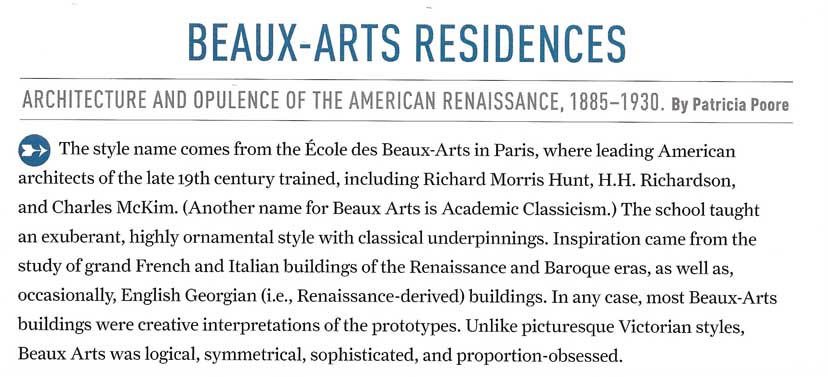
Beaux-Arts Architecture
A very rich, lavish and heavily ornamented classical style taught at L'Ecole des Beaux Arts in Paris in the 19th century
The term "Beaux Arts" is the approximate English equivalent of "Fine Arts."
The style was popularized during the 1893 Columbian Exposition in Chicago in 1893. One outgrowth of the Expo was the reform movement advocated by Daniel Burnham, the City Beautiful Movement.
Very influential in the US in that many of the leading late 19th century architects had been trained at Ecole des Beaux Arts, e.g., Richard Morris Hunt (the first American to study there) , H. H. Richardson (the second American to study there, but who chose to develop his own style, "Richardsonian Romanesque") and Charles McKim,
More than any other style (except perhaps the Chateauesque), the Beaux Arts expressed the taste and values of America's industrial barons at the turn of the century. In those pre-income tax days, great fortunes were proudly displayed in increasingly ornate and expensive houses.
Broadly speaking, the term "Beaux Arts" refers to the American Renaissance period from about 1890 to 1920 and encompasses the French Renaissance, Italian Renaissance, and Neoclassical Revivals.In Buffalo, the movement was featured at the Pan-American Exposition in 1901.
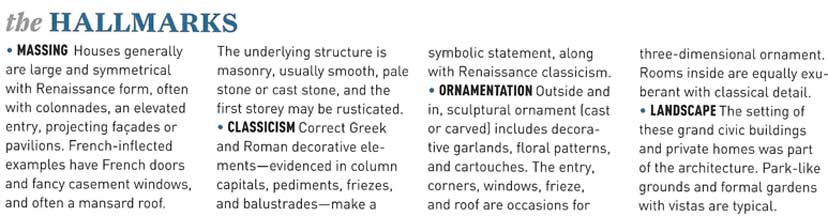
Features:
- Symmetrical facade
- Roofs: flat, low-pitched; mansard if modeled after French Renaissance Revival
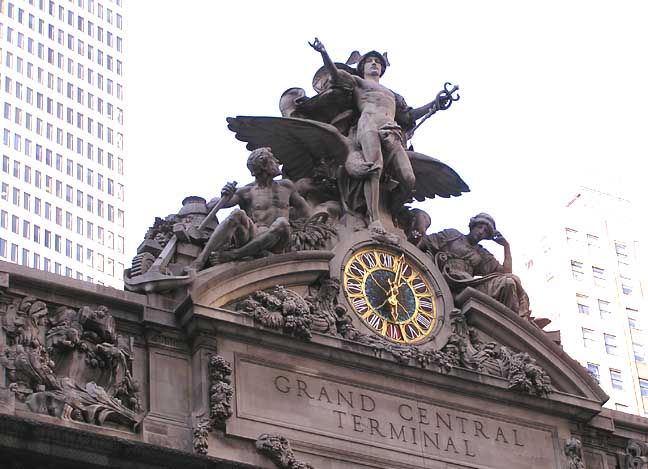
- Wall surfaces with decorative garlands, floral patterns, or cartouches dripping with sculptural ornament
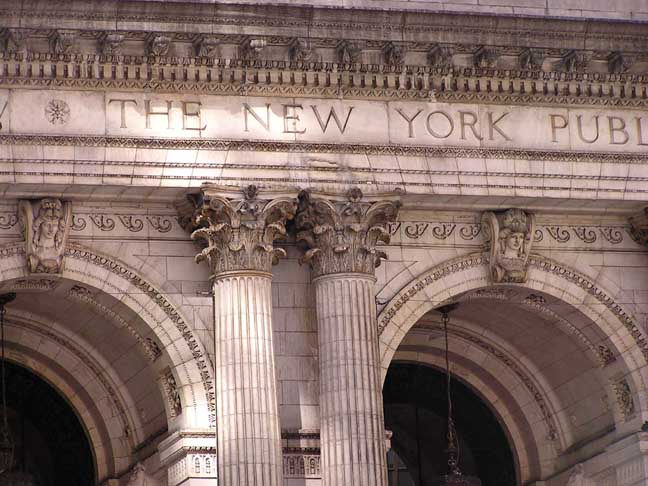
- Facades with quoins, pilasters, or columns (usually paired with Ionic or Corinthian capitals)
- Walls of masonry (usually smooth, light-colored stone)
- First story may be rusticated
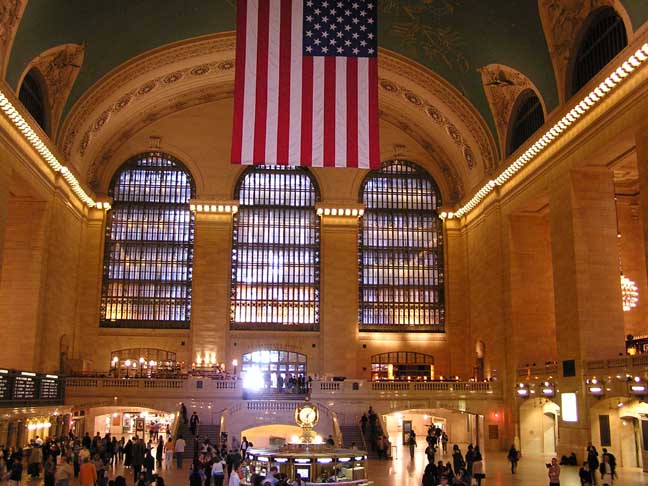
- Large and grandiose compositions
- Exuberance of detail and variety of stone finishes
- Projecting facades or pavilions
- Paired colossal columns
- Enriched moldings
- Free-sanding statuary
- Windows: framed by freestanding columns, balustraded sill, and pedimented entablature on top
- Pronounced cornices and enriched entablatures are topped with a tall parapet, balustrade, or attic story
Old-House Journal, 2020
"Beaux Arts: A Capital Idea"
The Beaux-Arts style, also called the American Renaissance, is about as formal as architecture can get. Based on classical European precedents primarily French and Italian palaces and palazzos of the 16th to the 18th century - this grandly formal style transformed America's major cities between the 1880s and the 1920s after being introduced at the 1893 World's Columbian Exposition in Chicago to an eager nation that had begun to tire of Victorian excesses.
Soon, Beaux-Arts architecture was swept along by the turn-of-the-20th-century City Beautiful Movement, which left in its wake a sea of magnificent public buildings of polished stone, from state capitols courthouses, and city halls to train stations, libraries, and museums.
Beaux Arts also produced some of the most costly and beautiful private homes ever seen in the United States - not only in cities, but also in resort towns and on country estates....
Materials
Since wooden buildings lack the gravitas the style required, Beaux-Arts structures were invariably constructed of masonry, usually a light-colored, smooth-surfaced, ashlar-cut stone... But the term "stone" needs o be qualified. Decorative exterior elements on these stone buildings weren't necessarily carved out of solid limestone or marble. They might very well have been made from cast stone (a composite of ground stone and cement, much like some of today's engineered stone countertops), or from molded terra cotta, or even from pressed tin painted to look like stone.
Excerpted from Historic Resources Intensive Level Survey: Niagara Falls, NY
Survey conducted by Clinton Brown Company Architecture pc
Text by Francis R. Kowsky
Foremost among the buildings from this time are those in the Neo-Classical style and identified with the Ecole de Beaux-Arts, the Parisian architectural school where many Americans of the day went to study architecture.
Imbued with the principles of monumental Classicism - students learned as much about Roman and Renaissance buildings as they did about principals of construction and the properties of materials -- returning architects sought to dignify life in our fledgling cities with columned and vaulted edifices. Indeed, it was in housing the functions of modern urban life were designers like McKim, Mead & White, Carrere and Hastings, and Richard Morris Hunt.
The style received an enormous boost in the professional and public imagination with the staging at Chicago of the World’s Columbian Exposition in 1893. The Chicago exposition created a fictive metropolis of Neo-Classical buildings, fountains, and statuary that was so compelling that it aroused a desire to make real American cities look more and more like the world of the fair. The resulting “City Beautiful Movement” lasted through the 1930s when the Great Depression ended the optimism and prosperity that had sustained it.
Francis R. Kowsky
Excerpted from
"Reading Buildings in Buffalo," in Building Buffalo: Buildings From Books, Books From Buildings,
Buffalo & Erie County Public Library, Buffalo NY, 2017, p. 50.
During the last quarter of the nineteenth century, American neoclassicism embraced the architecture of Rome and the Renaissance together with that of Greece. How to adapt and combine elements of this broad classical heritage to meet present demands was the aim of a new class of professional architects .
The Ecole des Beaux-Arts in Paris epitomized this methodology. Many Americans trained in Paris.
Locally, the Atelier Rectagon, formed in the 1920s under the auspices of the Buffalo Chapter of the American Institute of Architects (organized in 1892) served as an informal school of Ecole des Beaux-Arts architectural design methods.
The term Beaux-Arts style or Beaux-Arts Classicism became part of the lexicon of American architecture during the period. Truly, the past was prologue for many of the men and the few women who shaped the great urban expansion that began after the Civil War.
The first person from Buffalo reputed to have studied in Paris at the Ecole des Beaux-Arts was George Cary (1859-1945).
FurnitureArchitects of the grandest homes of the era, inspired by Europe's more palatial buildings, designed or commissioned equally grand furnishings for their interiors, from Renaissance-style Savonarola chairs to Neoclassical Louis XVI-style beds and settees.
Examples from Buffalo:
- Illustration above: Buffalo Savings Bank
- Brisbane Building
- Campanile Apartments
- Ellicott Square Building
- Fosdick-Masten Park H.S. / City Honors School
- Otto Building /Theater Place
- Market Arcade
- Perron Building / Washington Surplus
- Spaulding Building
- Sidway Building
- Statler Hotel
- Erlanger Theater
- McKinley Monument
- Midway Row Houses
- John W. Bush House
- Stella Lowry House
- Knox House / Blessed Sacrament RC Church Parish Office
- Grace Millard Knox House / Computer Task Group Building
- Forman-Cabana House
- Williams-Butler House
- Williams-Pratt House
- Lackawanna Steel Company Administration Building
- Telephone Building
- 678 Main Street
- Dome interior: North Park Theatre
- Furniture: See Renaissance Revival furniture
Other examples:
- L'Ecole des Beaux Arts, Paris, France
- Musée d'Orsay, Paris, France
- Marshall Field and Company Store, Chicago, IL
- Rookery, Chicago, IL
- Ellis Island Great Hall
- Grand Central Terminal, New York City
- The New York Public Library, New York City (designed by Carrere & Hastings)