Colonial/Colonial Revival
Architecture................Colonial/Colonial
Revival FURNITURE.....
.......Styles
of Architecture
Architecture
Around the World
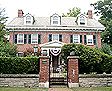
Georgian / Georgian Revival in Buffalo, NY
| Neoclassicism/Neoclassical (Neo-Classical) |
Literally: "New Classicism." European and American architecture style inspired by Classical Greek - and especially Roman - ruins. |
| Georgian | "The prevailing style of the 18th cent.
In Great Britain and the North American colonies, so
named after George I, George II, and George III
(1714-1820, but commonly not including George IV.
Derived from classical, Renaissance, and Baroque
forms." - Illustrated Dictionary of Historic
Architecture, Ed. by Cyril M. Harris. Dover Pub.
1977 |
| Georgian Neoclassical | Neoclassicism named after George III in England. Encompasses both Palladian and Adamesque Neoclassical styles. |
| Palladian Neoclassical | Earlier version of European Neoclassicism based on the books of Italian Renaissance architect Andrea Palladio who studied Roman ruins in Italy. |
| Adam style/Adamesque | Later version of European Neoclassicism based on Robert's Adam's studies of excavations at Herculaneum and Pompeii. |
| Colonial | Styles of architecture during America's colonial period, i.e., before the Revolutionary War. The most prominent style was Georgian because most the colonies were English owned. |
| Federal | The American term for Adamesque after the Revolutionary War. "Federal" is a a patriotic term. |
| Roman Classicism/ / Jeffersonian Classicism / Classic(al) Revival | Neoclassical version inspired by Renaissance-inspired
Palladian
Neoclassical style. Thomas Jefferson owned three
copies of Palladio's books and used Palladian ideals
in designing Monticello, etc. This vision of Neoclassicism competed with the simpler Federal style. |
| Beaux-Arts Classicism | A very rich, lavish and heavily ornamented classical style taught at L'Ecole des Beaux Arts in Paris in the 19th century. Influenced the last phase of Neoclassicism in the United States |
On this page, below:
Georgian Style 1714-1820 (England, U.S.)
England
In Europe, the dominant style of architecture during the 18th century is known as "Neoclassical."
In Great Britain, in the first half of the 18th century, the first phase of Neoclassicism was influenced by the books of the Italian Renaissance architect Andrea Palladio (1508-80).
In the second half of the 18th century Robert Adam (1760-1792) first popularized a simpler, purer Neoclassical style based on excavations in Herculaneum and Pompeii.
Both Palladian and Adam variations of Neoclassicism are also referred to in terms of the reigning monarch (1760-1820) as George III, or simply Georgian.
Examples of British Georgian architecture:
- Adam's Portland Place, in London
- Adam's Charlotte Square, in Edinburgh
- The Circus, Bath England(1754-1768)
U.S.In the U. S., Neoclassicism (both earlier Palladian and later Adamesque) is referred to as "Colonial" (until the Revolutionary War), and then "Federal" (after the Revolutionary War).
In New England, the English Georgian style came to America by way of British pattern books (especially Giacomo Leoni's 1715 edition of Palladio's Works) and an ever-swelling wave of masons, carpenters, and joiners who emigrated from England.
In New England, Colonial architecture is also referred to as "Georgian."
The first example of Georgian style in America was the Wren Building (begun in 1695) at the College of William and Mary, and soon after that the Governor's Palace and the Capitol in Williamsburg, Virginia.
Another excellent example of the style near Charleston, S. C., is Drayton Hall (1738-42).
"Federal" style is Adamesque.
- Wren Building (begun 1695)
- Governor's Palace, Williamsburg, Va. (1714)
- Capitol, Williamsburg, Va. (1705 design)
- Bruton Parish Church, Williamsburg, Va. (1715 design)
- George Wythe House, Williamsburg, Va. (mid-1750s design)
- Drayton Hall, Charleston, S. C. (1738-42)
- Carpenters' Hall, Philadelphia, Pa. (1770-73)
- Todd House, Philadelphia, Pa. (1775)
- Independence Hall, Philadelphia, Pa. (1732-1748 )
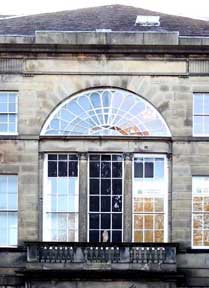
To aid access, sash windows were replaced by French doors in the 1780s and 1790s.
Variations on conventional sashes occur at the end of the century. Round-headed window openings become popular..."
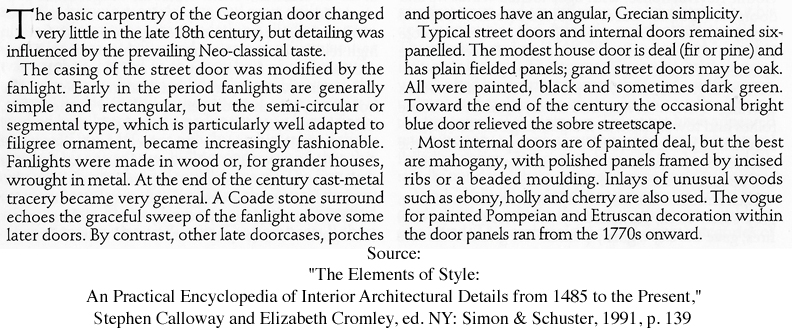
- "The Elements of Style: An Practical Encyclopedia of Interior Architectural Details from 1485 to the Present," Stephen Calloway and Elizabeth Cromley, ed. NY: Simon & Schuster, 1991, p. 143
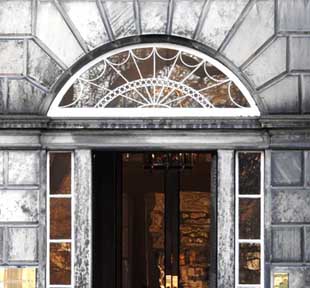
Exterior doors
-----------
Spiderweb muntins fanlight - Charlotte Square, Edinburgh, Scotland
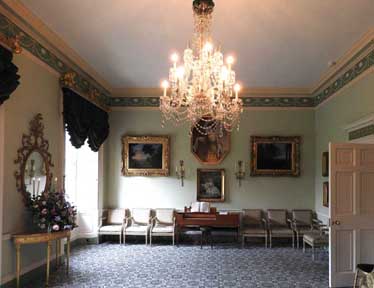
"When the house was first occupied, guests would have been taken straight to the Drawing Room, where they would have been received by their host and hostesses. The room has been arranged in a formal eighteenth century manner, to be used for entertaining, for promenade [a march of guests into a ballroom constituting the opening of a formal ball] and for important occasions. For everyday living the back drawing room or parlour would have been used."
- "The Georgian House," Introduction. Brochure sold at The Georgian House museum, Edinburgh, Scotland.
Georgian Revival 1900-1940 (U. S.)
Main source: "A Field Guide to American Houses," by Virginia & Lee McAlester. New York: Knopf, 2000, p. 138
"Georgian Revival" is sometimes referred to as "Colonial Revival" (1870-1920). The English Georgian style was the most prevalent type of Colonial buildings, but certainly not the only one. Two obvious exceptions are styles that were used by the Dutch and French.
Early examples of Colonial Revival were rarely historically correct copies but were instead free interpretations with details inspired by colonial precedents. During the first decade of this century, Colonial Revival fashion shifted toward carefully researched copies with more correct proportions and details. This was encouraged by new methods of printing that permitted wide dissemination of photographs in books and periodicals.
In 1898 The American Architect and Building News began an extensive series called "The Georgian Period: Being photographs and measured drawings of Colonial Work with text." This was joined in 1915 by the White Pine Series of Architectural Monographs, which was dominated by photographs of colonial buildings. These and similar ventures led to a wide understanding of the prototypes on which the Revival was based.
Colonial Revival houses built in the years between 1915 and 1935 reflect these influences by more closely resembling early prototypes than did those built earlier or later.
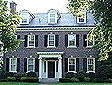
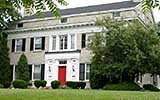
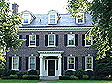
The overall features of Georgian Revival may be described as symmetrical composition enriched with classical detail.
Georgian Revival identifying features:
------------
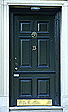
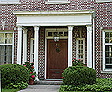
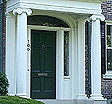
- Paneled front door, usually centered and capped by an elaborate decorative crown (entablature) supported by decorative pilasters (flattened columns). The main door is the principal ornamental feature of the Georgian facade.
- Usually with a row of small rectangular panes of glass beneath the crown, either within the door or in a transom just above
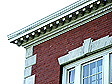
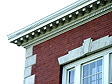
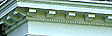
- Cornice usually emphasized by decorative moldings, most commonly with tooth-like dentils
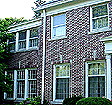
- Windows with double-hung sashes having many small panes (most commonly nine or twelve panes per sash) separated by thick wooden muntins;
- Windows aligned horizontally and vertically in symmetrical rows, never in adjacent pairs, usually five-ranked on front facade, less commonly three- or seven-ranked.
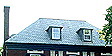
- Typical roofs are side-gabled, gambrel, or hipped.
- One difference between Georgian Revival and Colonial Revival is that, in general, Georgian Revivals do not have a large porch or portico, whereas Colonial Revivals do.
Interiors
Floor plan: approximately square shape. The four rooms on the main floor -- two front and two back -- are of about equal size and flank a central stair hall that extends throughout he depth of the house.
Examples of Georgian Revival buildings in addition to those pictured below in"Illustrated Georgian Revival Typical Features":
- Pomeroy House
- Philip Smith / College Club House
- 56 Chapin Parkway
- 40 North Street (Bryant & Stratton Business Institute/Tapestry Charter School)
- George K. Birge House / D.A.R. House, 477 Delaware Ave.
- Root House - DEMOLISHED
- Bennett High School
- Trible House
- Ralph G. Kittinger House
- Irvine J. Kittinger House
- Photo - Dining room in the Wilcox Mansion / Theodore Roosevelt Inaugural Site
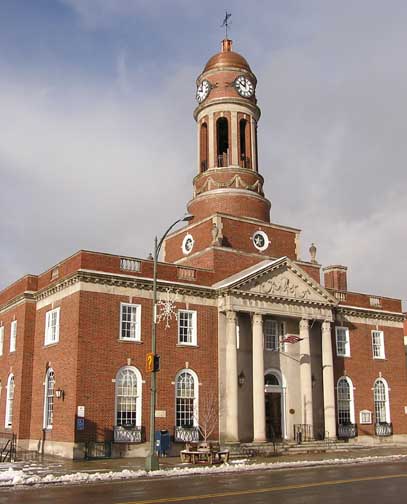
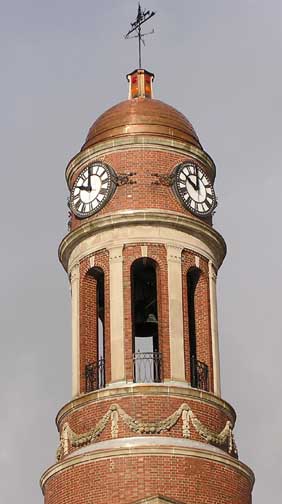
- Photo - Harrietstown, NY, Town Hall ... Detail
|
Click on photos for larger size |
Overall: Symmetrical composition enriched with classical detail |
|
|
Five bays
(division of space between windows or doors) Windows aligned horizontally and vertically in symmetrical rows, never in adjacent pairs, usually five-ranked on front facade Illustration: 109 Chapin Pkwy |
|
|
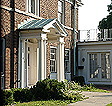
Center entrance Paneled front door, usually centered and capped by an elaborate decorative crown (entablature) supported by decorative pilasters (flattened columns) Illustration: Larkin House |
|
|
Paneled door Illustration: 33 Chapin Pkwy |
|
|
Transom
over door Usually with a row of small rectangular panes of glass beneath the crown, either within the door or in a transom just above Illustration: 41 Chapin |
|
|
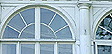
Fanlight
The fanlight became an increasingly important element in the design of the front door as the 18th century progressed. Gradually it became more popular to reduce the height of the door, replacing its upper register of panels with a fixed glazed panel ("fanlight") that admitted light to the hallway. Illustration: Birge House Leaded glass - Ansley Wilcox Mansion / Theodore Roosevelt Inaugural Site |
|
|
Fanlight
over door Illustration: 109 Chapin Pkwy |
|
|
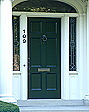
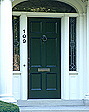
Side
lights on either side of
door Illustration: 109 Chapin Pkwy |
|
|
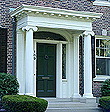
Columned portico
supporting entablature. Illustration: 109 Chapin Pkwy |
|
|
Fluted
columns Illustration: 109 Chapin Pkwy |
|
|
Monumental pilasters Illustration: UB- Hayes Hall |
|
|
Modillions Illustration: Birge House |
|
|
Dentils
(tooth like moldings) Illustration: Birge House |
|
|
Egg and
dart molding (in
illustration, below modillions) Illustration: 109 Chapin Pkwy |
|
|
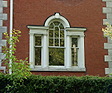
Flat window arch with
keystone Illustration: 24 Chapin Pkwy |
|
|
Sliding sash windows, each
sash having several lights using as few as 6 or as
many as 20 panes of glass in one sash Illustration: 41 Chapin Pkwy |
|
|
Symmetrically placed dormers Illustration: 109 Chapin Pkwy |
|
|
Palladian
(Venetian) window Illustration: Birge House |
|
|
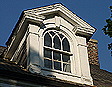
Pedimented
dormers Illustration: 24 Chapin Pkwy |
|
|
Corner quoins
Illustration: Birge House |
|
|
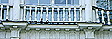
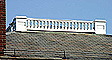
Balustrade Illustration: Birge House See also: Drayton Hall near Charleston, S.C. |
|
|
Stone course bands Illustration: 3 Chapin |
|
|
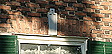
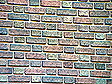
Bricks laid in Flemish bond
pattern: alternating headers (ends) and stretchers
(sides) Illustration: 33 Chapin Pkwy |
|
|
Hipped
roof (sloped inward on
all four sides) Illustration: 33 Chapin Pkwy |
|
|
Hipped
roof with balustraded
deck Illustration: 165 Chapin Pkwy |
|
|
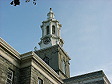
Civic and ecclesiastical
buildings: Hipped
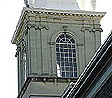
roof with cupola Illustration: UB- Hayes Hall |
|
|
Symmetrically placed
chimneys, usually at the end walls Illustration: 176 Windsor |
Sources:
- Preservation Coalition tour of Chapin Parkway, June 2001, Tim Tielman, tour guide
- "A Visual Dictionary of Architecture," by Francis D. K. Ching. New York: John Wiley & Sons, 1997
- "Identifying American Architecture," by John J.-G Blumenson. New York: Norton. 1981
- "Illustrated Dictionary of Architecture," by Ernest Burden. McGraw-Hill , 1998
- "The Visual Dictionary of American Domestic Architecture," by Rachel Carley. New York: Henry Holt & Co., 1994
- "A Field Guide to American Architecture," by Carole Rifkind. New York: New American Library, 1980
- "A Field Guide to American Houses," by Virginia & Lee McAlester. New York: Knopf, 2000