Colonial Revival FURNITURE ....... Illustrated Architecture Dictionary ............... Styles of Architecture
Colonial Revival FURNITURE ....... Illustrated
Architecture Dictionary ............... Styles of
Architecture
Colonial / Colonial Revival Architecture
|
|
 |
On this page:
- Neoclassicism - Terminology
- Colonial styles- Pre-Revolutionary War
- Colonial Revival 1870-1920
- Dutch Colonial Revival
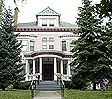
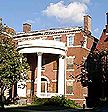
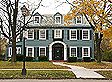
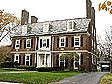
- Examples of Colonial Revival Architecture in Buffalo
See also: Colonial Revival FURNITURE
| Neoclassicism/Neoclassical (Neo-Classical) |
Literally: "New Classicism." European and American architecture style inspired by Classical Greek - and especially Roman - ruins. |
| Georgian | Four King Georges in England. George III ruled England when Neoclassicism was popular. |
| Georgian Neoclassical | Neoclassicism named after George III in England. Encompasses both Palladian and Adamesque Neoclassical styles. |
| Palladian Neoclassical | Earlier version of European Neoclassicism based on the books of Italian Renaissance architect Andrea Palladio who studied Roman ruins in Italy. |
| Adam style/Adamesque | Later version of European Neoclassicism based on Robert's Adam's studies of excavations at Herculaneum and Pompeii. |
| Colonial | Styles of architecture during America's colonial period, i.e., before the Revolutionary War. The most prominent style was Georgian because most the colonies were English owned. |
| Federal | The American term for Adamesque after the Revolutionary War. "Federal" is a a patriotic term. |
| Roman Classicism/ / Jeffersonian Classicism / Classic(al) Revival | Neoclassical version inspired by Renaissance-inspired
Palladian Neoclassical style. Thomas Jefferson owned three copies of
Palladio's books and used Palladian ideals in designing Monticello, etc. This vision of Neoclassicism competed with the simpler Federal style. |
| Beaux-Arts Classicism | A very rich, lavish and heavily ornamented classical style taught at L'Ecole des Beaux Arts in Paris in the 19th century. Influenced the last phase of Neoclassicism in the United States |
| Temple-front |
Element
of a facade resembling the front of a Classical temple. |
Colonial styles - Pre-Revolutionary War
"Colonial" style in architecture and furniture includes all the styles which existed during the Colonial period of American history. The Colonial period ended once the Colonies declared independence from England.
- Spanish Colonial 1600-1840
- Southern Colonial 1600-1700
- New England Colonial 1600-1700
- Jamestown settlement (1606)
- New England Colonial 1700-1800
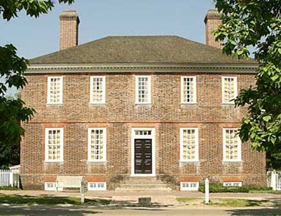
- Left illustration above: George Wythe House, Williamsburg, Va. (mid-1750s design)
- Wren Building (begun 1695)
- Governor's Palace, Williamsburg, Va. (1714)
- Capitol, Williamsburg, Va. (1705 design)
- Bruton Parish Church, Williamsburg, Va. (1715 design)
- Drayton Hall, Charleston, S. C. (1738-42)
- French Colonial 1700-1830
- Dutch Colonial 1700-1830
Colonial furniture styles, of course, corresponded to the architectural styles.
Colonial Revival 1880-1955
Definition: The reuse of Colonial design in the US toward the end of the 19th and into the 20th century, typically in bank buildings, churches and suburban homes.This architectural style is considered a Victorian era style because, like the British Victorians, reaction to the Industrial Revolution led to reexamination of the pre-Industrial Revolution past and a revival of Gothic Tudor Revival and Colonial Revival.
The Philadelphia Centennial of 1876 is credited with first awakening an interest in our colonial architectural heritage. Following on the heels of America's Centennial celebrations, the Colonial Revival emerged in the early 1880s. The style, which borrowed heavily from early American architecture - particularly Georgian style buildings - was largely an outgrowth of a new pride in America's past and a rapidly growing interest in historic preservation. Among the leaders of the movement were the partners at McKim, Mead and White, who had made a tour of New England's historic towns in 1878.
In the early phase, the Colonial Revival style remained the exclusive domain of fashionable architectural firms and was favored for the large residences of wealthy clients.
The Colonial Revival building is often a combination of various Colonial styles and contemporary elements. Generally the Revival house is larger than its Colonial counterpart and some of the individual elements are exaggerated or out of proportion with other parts of the house. Some Revival houses, however, are executed with such historical accuracy that they are difficult to distinguish from original houses.Georgian Revival is sometimes referred to as "Colonial Revival."
See Colonial Revival staircases
(1880-1955)
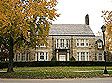
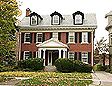
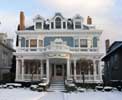
Growing interest in classical design and greater regard for more “correct” composition encouraged the development of the Colonial Revival style. Colonial Revival houses typically have massing and detail derived from Colonial and Federal prototypes, but the size and scale of Colonial Revival house are larger than those of the original models.
Most Colonial Revival buildings have contained rectilinear massing, broken perhaps by bay windows; symmetrical facades with central entrances; front porches with columns and classical balustrades; relatively uniform roofs, sometimes elaborated on the facade by a cross gable or a row of dormers; and window shutters. Palladian windows, corner pilasters, and garland-and-swag trim are common decorative elements. Materials used range from wood clapboard and shingle to brick and stone. Often the entry door is accented with a decorative surround or entry porch, a feature far less common to original Colonial houses.
The models for the Colonial Revival style homes in America were originally constructed by English colonists arriving in the late-seventeenth century. These early colonists modeled their homes after the half-timbered houses of England, but adapted the style to the stormy New England weather. Over time a sturdy and practical, modest, one- to one-and-a-half-story, regularly planned and often symmetric house with wooden shutters emerged. Much later, in the late 1800s and early 1900s, a renewed interest in America's past inspired a variety of Colonial Revival styles, including Dutch Colonial and Cape Cod. Colonial Revival Cape Cod houses became especially popular during the 1930s. These small, economical houses were mass-produced in suburban developments across the United States.
A unique variant which is especially prominent in downstate New York is the Dutch Colonial Revival style. Due to the area’s early settlement by Dutch colonists, the Hudson Valley region contains some of the nation’s only examples of Dutch Colonial architecture, and as a result the Dutch Colonial Revival style appears frequently in the area. One of the most defining characteristics of the variation is the flared eaves which distinguished the Dutch Colonial Revival style from other Colonial Revival styles
- Clinton Brown Company Architecture/Rebuild: High & Locust Streets Historic District Nomination, Sec 5, pp. 11-13
----------------
Colonial Revival common characteristics:
- Facade: Symmetrical, often with side porches
- Facade: Asymmetrical (not present or were rarely found in their colonial prototypes)
- Classical cornice (common)
- Cornice parapet
- Cupola
- Entablature
- Entry: decorated with
- Sidelights,
- Transoms
- Swan's neck pediment
- Broken pediments (not present or were rarely found in their colonial prototypes)
- Fanlight over the main entry door
- Pediment supported by pilasters that may extend forward and be supported on columns so as to form an entry porch
- Voussoirs
- Entry: Large porches or porticos (Generally not true for Georgian Revival houses.)
- Roof:
- Walls: clapboard
- Walls: Flemish (red) brick
- Captain's walk
- Windows:
- bay window
- symmetrically arrayed windows in the facade, often, adjacent pairs of windows (or three adjacent windows) treated as single architectural unit
- double-hung
- louvered shutters
- straight window heads
- splayed lintels
- Palladian window (not present or were rarely found in their colonial prototypes)
- rectangular sash windows with multiple panes in both the upper and lower sashes
- Classical detailing such as
- Interior: grand staircase (sometimes freestanding)
- Interior: paneled wainscot
- Interior: fireplaces with
- fans
- swags
- ellipse
- dentils in entablature
- marble facing under mantle
- colonettes (small, relatively thin columns)
Text sources:
- "Identifying American Architecture," by John J.-G Blumenson. New York: Norton. 1981
- "Illustrated Dictionary of Architecture," by Ernest Burden. McGraw-Hill , 1998
- "The Visual Dictionary of American Domestic Architecture," by Rachel Carley. New York: Henry Holt & Co., 1994
Excerpted from "American Revivalism," By Donald Albrecht and Thomas Mellins, published in The Magazine Antiques, May/June 2011, p. 99
A major watershed in the evolution of the colonial revival occurred in 1877 when four young architects - Charles Follen McKim, William Rutherford Mead, William Bigelow, and Stanford White - toured New England, sketching and measuring historic, colonial era houses in Marblehaed, Newburyport, and Salem, Massachusetts, as well as in Portsmouth, New Hampshire. (Even before this joint effort, McKim had visited and sketched colonial buildings for years on his own in Newport, Rhode Island.) In the process, a new direction in American architecture was forged.
The firm of McKim, Mead and White was established in New York in 1879, and three years later the architects began to design the H. A. C. Taylor House in Newport. Completed in 1886 the house was a pioneering example of the colonial revival.
McKim, Mead and White followed this foray into the colonial revival with the Mount Vernon-inspired James L. Bresse House (1906) on Long Island, as well as numerous residences in New York City.
Dutch Colonial Revival 1880-1955
Of the many forms of the Colonial Revival style, the Dutch cottage variant is among the most distinctive. Adapted from eighteenth century farmhouses erected by Dutch settlers, the defining characteristic of the style is a gambrel roof, which was introduced to America by the Dutch in the Mid-Atlantic colonies. The double-pitch of the gambrel roof created more space in the upper story, while allowing for the rapid run-off of rainfall, common to the eastern seaboard.
Dutch Colonial Revival houses are typically a tall one-and-one-half story building with a large flank-gambrel roof containing the second floor and attic. The lower roof slopes at both front and rear are broken by large full-width shed dormers on the second story level; the dormers usually dominate the roof, and the gambrel form is sometimes evident only on the end walls.
- Historic Resources Intensive Level Survey - Grant-Ferry-Forest, Vol. 1
Common characteristics:
- Gambrel roofs (i.e., a curving roof with a shape similar to a barn roof)
- Symmetrical facades
- Doorways ornamented with columns, sidelights and transoms
|
Click on illustrations for larger size |
|
|
|
|
1782 Seneca St. |
|||
|
|
|
|
|
|
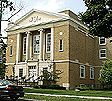
Rockwell Hall, State U.
College at Buffalo |
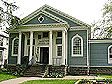
Fraternal Lodge 625 / Wood
Senior Residence in Hamburg |
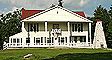
Bethlehem
Steel Management Club / |
|
|
|
|
|
|
|
|
|
|
|
|
175 Depew Ave. |
Depew Ave. |
237 Depew Ave. |
260 Depew Ave. |
|
|
|
|
|
|
260 Depew Ave. |
270 Depew Ave. |
25 Colonial Circle |
Other Colonial Revival sites on Buffalo Architecture & History website:
- Metcalfe House (demolished)
- Charles Mosier House
- Lansing House, 29 Oakland Place
- 305 Elmwood Avenue
- Mann House
- Gunsberg House/ Buffalo State College President's House
- Hazel Surdam House Dutch Colonial
- Statler Hotel
- Trible House
- 734 Richmond Ave.
- 186 Bidwell Parkway
- Wendt House
- Crawford (William J.) House
- Myron P. Bush House
- Buffalo Zoo Elephant House
- Fireplace - Sears House
- Fireplace - Bush/Depew House
- Fireplace - Risman House