Illustrated Dictionaries - Table of Contents .................Wikipedia: Saint Symbolism
Iconography
in Art and Architecture
Study
of the symbolic, often religious, meaning of objects, persons, or
events depicted in works of art
Research contributions by Gregory L. Witul
| Image | History | Examples | ||||||||||||||||||||||||||||||||||||||||||
| Abraham | Abraham
features in the Book of Genesis as the founding patriarch of
the Israelites, Ishmaelites, Midianites and Edomite peoples.
He is widely regarded as the patriarch of Jews, Christians,
and Muslims and a prime believer in monotheism. Genesis 22:1-24 is the story of Abraham and Isaac Genesis 14:18-20 is the story of Abraham and Melchisedech. Also see Melchisedech below. Depictions: Abraham, Isaac and angel |
Stained
glass: Grace Episcopal Church, Lockport Abraham portrait St. John's Grace Episcopal Church St. John the Evangelist RC Church St. Joseph RC Cathedral Mosaic: St. Louis RC Church Painting: Hermitage Museum, St. Petersburg, Russia Sculpture: Campanile, Florence, Italy |
||||||||||||||||||||||||||||||||||||||||||
| Acanthus leaf | See Illustrated Architecture Dictionary: Acanthus leaf | |||||||||||||||||||||||||||||||||||||||||||
| Acorn | Symbol of fertility and life. | |||||||||||||||||||||||||||||||||||||||||||
| Adam and Eve | See Garden of Eden below | |||||||||||||||||||||||||||||||||||||||||||
| Aeneas | Trojan hero, the son of prince Anchises and the goddess Venus. His father was also the second cousin of King Priam of Troy. The journey of Aeneas from Troy, (led by Venus, his mother) which led to the founding of the city Rome, is recounted in Virgil's Aeneid. - Source: Wikipedia: Aeneas | Sculpture: Museum at Delphi, Greece | ||||||||||||||||||||||||||||||||||||||||||
| Agony in the Garden | ||||||||||||||||||||||||||||||||||||||||||||
| Alpha and Omega | ||||||||||||||||||||||||||||||||||||||||||||
| Altar | A raised
structure on which gifts or sacrifices to a god are made. For Christian and Hebrew examples in the Buffalo area, see Buffalo's Houses of Worship on Buffalo as an Architectural Museum Website See also: Baldachino. |
|||||||||||||||||||||||||||||||||||||||||||
| Amen /Amun/ Amon/ Amen-Re/ Amon-Ra/ Amon-Re | See Illustrated Dictionary of Egyptian Mythology: Amen | |||||||||||||||||||||||||||||||||||||||||||
| Anchor | Christian
symbol for hope. In cemeteries, commonly used in the 18th and 19th centuries to represent the deceased's seafaring profession. Also used, often wrapped in vines, to represent firm Christian faith. |
Sculpture:
Blocher
Monument,
Forest Lawn Cemetery Stained glass: Unitarian Universalist Church |
||||||||||||||||||||||||||||||||||||||||||
| Angels | ||||||||||||||||||||||||||||||||||||||||||||
| Angels with musical instruments | ||||||||||||||||||||||||||||||||||||||||||||
| Angels, Orders of | ||||||||||||||||||||||||||||||||||||||||||||
| Ankh | See illustrated Dictionary of Egyptian Mythology: Ankh | |||||||||||||||||||||||||||||||||||||||||||
| Annunciation | ||||||||||||||||||||||||||||||||||||||||||||
| Anubis | See illustrated Dictionary of Egyptian Mythology: Anubis | |||||||||||||||||||||||||||||||||||||||||||
| Apedemak | See illustrated Dictionary of Egyptian Mythology: Apedemak | |||||||||||||||||||||||||||||||||||||||||||
| Apostles, Attributes of |
See also Wikipedia: Saint symbolism |
Stained
glass:
Central Park United Methodist Church Paintings: Buffalo Religious Arts Museum |
||||||||||||||||||||||||||||||||||||||||||
| Apostles, Commissioning of | "And
he [Jesus] said unto them, Go ye into all the world, and
preach the gospel to every creature." - Mark 16:15 Depictions: Jesus with apostles |
Stained
glass: First Presbyterian Church, Lockport |
||||||||||||||||||||||||||||||||||||||||||
| Apostles' Creed | New Advent: Apostles' Creed | Sculpture:
Blessed
Trinity
RC Church Stained glass: Holy Trinity Lutheran Church |
||||||||||||||||||||||||||||||||||||||||||
| Archangel Gabriel | See Iconography in Art and Architecture: Archangel Gabriel | |||||||||||||||||||||||||||||||||||||||||||
| Archangel Michael | See Iconography in Art and Architecture: Archangel Michael | |||||||||||||||||||||||||||||||||||||||||||
| Ark
of the Covenant See also: Noah's Ark |
Biblical
vessel, described in 1
Kings 8:9 as solely containing the Ten
Commandments tablets. According to the Pentateuch, the Ark was built at the command of God, in accord with Moses' prophetic vision on Mount Sinai (Exodus 25:10-16). According to Hebrews 9:4 and some traditional interpretations of Exodus 16:33-34 and Numbers 17:25-26 (or Numbers 17:10-11 in some translations), the Ark also contained Aaron's rod and a jar of manna. Holy Ark: The only remnant of the Ark in Jewish life today is the Holy Ark in which Torah scrolls are kept in synagogues. These Arks often are decorated with copies of the Tablets, reminiscent of the contents of the actual Ark of ancient times. Symbolism: God's permanent covenant(s) with the Jewish people. |
|||||||||||||||||||||||||||||||||||||||||||
| Ascension | ||||||||||||||||||||||||||||||||||||||||||||
| Asher |
The
eighth son of Jacob and the father of the tribe of Asher, one
of the twelve tribes of Israel. His mother was Zilpah, Leah's
maidservant. Leah named him Asher, saying "Happy am I"
(Genesis 30:13). Asher played a role in the plot to sell his brother Joseph into slavery. Asher and his four sons and daughter later settled in Egypt. Jacob blessed Asher on his deathbed, saying: "From Asher will come the richest food; he will provide the king's delights" (Genesis 49:20) Symbol: Olive tree |
|||||||||||||||||||||||||||||||||||||||||||
| Astrological
signs
of the zodiac |
Astrology
is the study of correlations of celestial events with behavior
on earth, particularly correlations which cannot be explained
by gravitation, magnetism, or other forces that are
well-established in physics or other sciences. Aries - The Ram Taurus - The Bull Gemini - The Twins Cancer - The Crab Leo - The Lion Virgo - The Maiden Libra - The Scales Scorpio - The Scorpion Sagittarius - The (Centaur) Archer Capricornus - "Goat-horned" (The Sea-Goat) Aquarius - The Water-Bearer Pisces - The Fishes |
Paintings:
Buffalo Savings Bank / Goldome / M&T Bank Branch: Zodiac Mosaic floor: Florence Baptistery, Italy |
||||||||||||||||||||||||||||||||||||||||||
| Assumption (of Mary into Heaven) | ||||||||||||||||||||||||||||||||||||||||||||
| Athena | Greek
goddess of wisdom See Wikipedia: Athena |
Sculpture: Acropolis Museum, Athens, Greece | ||||||||||||||||||||||||||||||||||||||||||
| Bacchus |
Greek
name: Dionysus The god of wine "The Roman god of wine and revelry, Bacchus, seems to have been formed from the hellenization of the native Italian god Liber, patron of viticulture, to become a Roman version of Dionysos. Like Dionysos (see Greeks), Bacchus is associated predominantly with female followers (in Greek, these were known as maenads) and is also traditionally accompanied by goat–man satyrs (see chimera) who are in a state of almost perpetual sexual arousal. The secret rites of Bacchus, the Bacchanalia, were introduced to Rome in the third century bc, and were officially banned from Italy in a famous decree of 186 bc, apparently because of fears that the meetings associated with them were being used for political conspiracies; the authority of the leader of a Bacchic cell over those who belonged to it could be seen as threatening the authority of the family and of the patron–client system which linked members of society through vertical ties." - Columbia Encyclopedia (online April 2016) |
Sculpture:
Milan Cathedral Museum By Michaelangelo |
||||||||||||||||||||||||||||||||||||||||||
| Baptism of Jesus | See also: John the Baptist below | |||||||||||||||||||||||||||||||||||||||||||
| Baptismal font | ||||||||||||||||||||||||||||||||||||||||||||
| Beatitudes | ||||||||||||||||||||||||||||||||||||||||||||
| Biscione |
The
biscione, also known as the vipera ("viper"), is a heraldic
charge showing in argent an azure
serpent in the act of consuming a human; usually a
child and sometimes described as a Moor. It was the emblem of the House of Visconti from the 11th century, becoming associated with Milan as the Visconti gained control over the city in 1277. When the Visconti family died out in the 15th century, the emblem retained its association with the Duchy of Milan and became part of the coats of arms of the House of Sforza; the presence of biscione in Poland (Sanok) and Belarus (Pruzhany) is due to queen Bona Sforza. The word biscione is an augmentative of Italian biscia "non-venomous snake; grass snake". As the symbol of Milan, the biscione is also used by the football club Inter Milan, by car manufacturer Alfa Romeo. |
Sculpture:
Sforza
Castle |
||||||||||||||||||||||||||||||||||||||||||
| Blue | Traditional
color for both Christ and the Virgin
Mary. Heaven and heavenly love. |
|||||||||||||||||||||||||||||||||||||||||||
| Book of Kells | See Celtic art: Book of Kells | Manuscripts: 4 Evangelists' Symbols |
||||||||||||||||||||||||||||||||||||||||||
| Book
of Lindisfarne |
See
Book
of
Lindisfarne |
Manuscripts: Carpet Page, Holy Family Church Canon Table, Holy Family Church |
||||||||||||||||||||||||||||||||||||||||||
| Caduceus | See Illustrated Architecture Dictionary: Caduceus | |||||||||||||||||||||||||||||||||||||||||||
| Cain
& Abel |
In
the biblical Book
of
Genesis, Cain and Abel are the first two sons of Adam
and Eve. Cain, the firstborn, was a farmer, and his
brother Abel was a shepherd. The brothers made sacrifices to
God, each of his own produce, but God favored Abel's
sacrifice instead of Cain's. Cain kills Abel.
God places a mark on Cain. |
Sculpture: Opera del Duomo Museum, Florence, Italy |
||||||||||||||||||||||||||||||||||||||||||
| Cana, Marriage at | ||||||||||||||||||||||||||||||||||||||||||||
| Canon
Table |
||||||||||||||||||||||||||||||||||||||||||||
| Cary |
||||||||||||||||||||||||||||||||||||||||||||
| Celtic knot, cross | See Illustrated Architecture Dictionary: Celtic | |||||||||||||||||||||||||||||||||||||||||||
| Censer | Vessel
in which incense is burnt ceremonially. "Ancient tradition ascribes to the censer smoke the symbolism of blessing by the Holy Spirit while another tradition has incense burning as generally representing the prayers of the people rising towards Heaven. One commonly sung psalm during the censing is 'Let my prayer rise like incense before Thee, my hands like the evening sacrifice.' " - Orthodox Store Revelation 8:1-5 |
Terra
cotta: St. Luke's Roman Catholic Church/St. Luke's Mission of Mercy |
||||||||||||||||||||||||||||||||||||||||||
| Centaur |
A
mythological creature with the head, arms, and torso of a
human and the body and legs of a horse. Iconography: "This half-human and half-horse composition has led many writers to treat them as liminal beings, caught between the two natures, embodied in contrasted myths, both as the embodiment of untamed nature, as in their battle with the Lapiths (their kin), or conversely as teachers, like Chiron [teacher of the gods]." - Wikipedia (online October 2014) |
Sculpture: Holley House, Lockport, NY Buffalo History Museum City Honors School Palazzo Medici-Riccardi, Florence, Italy Pompeii, Italy Olympia, Greece Parthenon, Athens, Greece House At the Minute, Prague, Czech Republic Kinsky Palace, Prague, Czech Republic |
||||||||||||||||||||||||||||||||||||||||||
| Chalice | In
Chritianity, the two main associations are with the
Last
Supper and the Crucifixion ) where angels are sometimes depicted holding a chalice under Christ's bleeding hand wounds, collecting the precious blood as it drips. |
Stained glass: Holy Family Church | ||||||||||||||||||||||||||||||||||||||||||
| Chestnut tree | Symbolizes Justice, Honesty and Chastity | Terra cotta: Ansonia Building | ||||||||||||||||||||||||||||||||||||||||||
| Children, Christ with | ||||||||||||||||||||||||||||||||||||||||||||
| Christ | ||||||||||||||||||||||||||||||||||||||||||||
| Cinquefoil | See Illustrated Architecture Dictionary: Cinquefoil | |||||||||||||||||||||||||||||||||||||||||||
| Circle |
Symbolizes infinity, the universe, God, eternity, perfection, the year, heaven Squares and circles seem to have almost universal significance in symbolizing
Important in deign and interpretation of rose windows (See Illustrated Architecture Dictionary: Rose window) |
|||||||||||||||||||||||||||||||||||||||||||
| Column | See Illustrated Architecture Dictionary: Column | |||||||||||||||||||||||||||||||||||||||||||
| Commandments | See Moses and Ten Commandments below | |||||||||||||||||||||||||||||||||||||||||||
| Creation | 7
Day version: Genesis
1-2:3 Adam and Eve version: Genesis 2:4-3:24 |
Stained
glass: Westminster Presbyterian Church St. John's Grace Episcopal Church St. John the Evangelist RC Church Holy Trinity Lutheran Church |
||||||||||||||||||||||||||||||||||||||||||
| Crescent
Moon |
The
so called Luna, half moon, or sickle of the moon, also waning
and waxing moon, is a sign of fertility, related to life and
death, and thus a popular symbol in many religions. It
pinpoints changing seasons, ebb and tide (and related
inundations as harbingers of fertility), and the feminine
menstrual cycle. Often used in the depiction of Mary Immaculate. |
|||||||||||||||||||||||||||||||||||||||||||
| Crook and flail | ||||||||||||||||||||||||||||||||||||||||||||
| Crosier
/ Crozier |
Hooked
staff
resembling a shepherd's crook carried by a bishop as a
symbol of pastoral office. Symbol of the Good Shepherd |
Stained
glass: St. Stephen RC Church Holy Family Church Metal: Opera del Duomo Museum Florence, Italy Basilica of San Petronio, Bologa, Italy |
||||||||||||||||||||||||||||||||||||||||||
| Cross | ||||||||||||||||||||||||||||||||||||||||||||
| Crown | A
crown is the traditional symbolic form of headgear worn by a
monarch or by a deity, for whom the crown traditionally
represents power, legitimacy, immortality, righteousness,
victory, triumph, resurrection, honour and glory of life after
death. In Christianity, crowns and palm leaves (below) are attributes of saints. See also Ancient Egyptian Crowns/Headdresses See Lions with Commandment Tablets in Judaism |
Stained
glass: Episcopal Church of the Ascension Annunciation RC Church Metal: Buffalo Religious Art Center Temple Beth Zion Holocaust Memorial Synagogue, Moscow, Russia |
||||||||||||||||||||||||||||||||||||||||||
| Crown of thorns | ||||||||||||||||||||||||||||||||||||||||||||
| Crozier | See
Crosier above |
|||||||||||||||||||||||||||||||||||||||||||
| Crucifix | ||||||||||||||||||||||||||||||||||||||||||||
| Crucifixion | ||||||||||||||||||||||||||||||||||||||||||||
| Cypress tree | Cypress
was
the first choice for Iranian Gardens.. The oldest living
Cypress is the Sarv-e-Abarkooh in Iran's Yazd Province. Its
age is estimated to be
approximately
4000 years. In Greek mythology, the cypress is associated with the underworld, grief and mourning. Ancient Roman funerary rites used it extensively. See Wikipedia: Cypress tree Reference to death |
|||||||||||||||||||||||||||||||||||||||||||
| Daniel | Christians
refer to Daniel as one of the four major prophets.( Isaiah,
Jeremiah, and Ezekie) Daniel in the lions den: Daniel 6:4-27 Book of Daniel |
Stained
glass: Westminster
Presbyterian Church Painting: Buffalo Religious Arts Center |
||||||||||||||||||||||||||||||||||||||||||
| David,
King |
The
Book
of Samuel is the primary source of information on his life and
reign; there is little archaeological evidence to confirm the
Bible's picture
of David Jewish tradition posits that t he Psalms are the work of David (seventy-three Psalms are with David's name), based on the writings of ten ancient psalmists Depictions: David Playing a Harp / David and Goliath / David and Saul / David and Bathsheba |
Stained
glass: First Presbyterian Church, Lockport Grace Episcopal Church, Lockport Westminster Pr St. Gerard's RC Church With harp Assumption RC Church Slaying Goliath St. Margaret's RC Church Basilica of Santa Croce, Florence, Italy Painting: Catalonian National Art Museum, Barcelona, Spain Sculpture: By Donatello (1409 marble) By Donatello (c.1467 bronze) By Verrocchio By Pisano (1337-1341 stone) |
||||||||||||||||||||||||||||||||||||||||||
| Deborah | A prophet and the only woman Judge of Israel, with Barak. Overcame King Jabin of the Canaanites in a battle (Book of Judges: 4 and 5). | Stained
glass: Grace Episcopal Church, Lockport Annunciation Greek Orthodox Church |
||||||||||||||||||||||||||||||||||||||||||
| Dionysus |
||||||||||||||||||||||||||||||||||||||||||||
| Doctor of the church | In the Roman Catholic Church, a title conferred on 33 saints who distinguished themselves through the orthodoxy of their theological teaching. LIST. | |||||||||||||||||||||||||||||||||||||||||||
| Dolphin | See Illustrated Architecture Dictionary: Dolphin | |||||||||||||||||||||||||||||||||||||||||||
| Double-headed
eagle |
"The
double-headed eagle is a common symbol in heraldry and
vexillology. It is most commonly associated with the Byzantine
Empire and the Holy Roman Empire. In Byzantine heraldry, the
heads represent the dual sovereignty of the Emperor (secular
and religious) and/or dominance of the Byzantine Emperors over
both East and West. In the Holy Roman Empire's heraldry, it
represented the Church and the State. Several Eastern European
nations adopted it from the Byzantines and continue to use it
as their national symbol to this day, the most prominent being
Russia. However, the design was in use in the East for
centuries before it was officially adopted by the Byzantines,
and was independently adopted as the symbol of several other
historical states..." - Wikipedia (April 2011) |
Sculpture:
Historical Museum, Moscow, Russia Peterhof Palace, St. Petersburg, Russia Hermitage Museum, St. Petersburg, Russia Throne Hermitage Museum, St. Petersburg, Russia Exterior The Church on Spilled Blood, St. Petersburg, Russia |
||||||||||||||||||||||||||||||||||||||||||
| Dove
See also Pentecost below |
In
Genesis
in the Bible, Noah sends out a dove after the flood. In the New Testament a dove is the symbol of the Holy Spirit/Holy Ghost. Luke 2.24: "... offer a sacrifice in keeping with what is said in the Law of the Lord: "a pair of doves or two young pigeons." In Islam, doves and the pigeon clan in general are respected and favoured because they are believed to have assisted the prophet of Islam, Muhammad in distracting his enemies outside the cave of Thaw'r in the great Hijra. Symbol for the Holy Spirit/Holy Ghost, used especially in representations of our Lord's Baptism and the Pentecost. Symbols of peace and purity. |
Stained
glass: First Presbyterian Church, Lockport Grace Episcopal Church, Lockport Westminster Presbyterian Church Trinity Episcopal Church Annunciation RC Church Ex. 1 Annunciation RC Church Ex. 2 Annunciation RC Church Ex. 3 Painting: Pitti Palace, Florence, Italy Mural: St. Luke's Roman Catholic Church/St. Luke's Mission of Mercy Mosaic: Church on Spilled Blood, St. Petersburg, Russia Sculpture: Bargello, Florence, Italy |
||||||||||||||||||||||||||||||||||||||||||
| Eagle | Eagle
symbolizes
Saint
John the Evangelist
and his gospel. Eagle lecterns, symbolizing Saint John the Evangelist and his gospel, are popular in Christian churches and standard in Anglican/Episcopal churches. Symbol of Poland, Russia and other nations. Bald eagle a symbol ofAmerica. Double-headed eagle symbol of Byzantine and Holy Roman empires. Heads represent the dual sovereignty of the Emperor, secular and religious. "It is considered to be the king of the air and the messenger of the highest Gods. Mythologically, it is connected by the Greeks with the God Zeus, by the Romans with Jupiter, by the Germanic tribes with Odin, by the Judeo-Christian scriptures with God, and in Christian art with Saint John the Evangelist." - Wikipedia (July 2011) Symbolizes strength, courage, farsightedness and immortality. |
Sculpture: Episcopal Church of the Ascension Trinity Church, Boston, MA Kensington High School / Olmsted School |
||||||||||||||||||||||||||||||||||||||||||
| Egyptian mythology | ||||||||||||||||||||||||||||||||||||||||||||
| 8 (eight) | Number
symbol of the Resurrection as it was on the eighth day after
Christps entry into Jerusalem that he rose from the grave. Winds of heaven. |
|||||||||||||||||||||||||||||||||||||||||||
| Elias | According
to the Bible, Elias was the only man taken up to heaven alive
(2
Kings 2:11). He was considered the Old Testament predecessor of St. John the Baptist, and sometimes even of Christ and the Mother of god. He is sometimes depicted ascending in a firey chariot drawn by four horses. See also Transfiguration below |
|||||||||||||||||||||||||||||||||||||||||||
| Elijah | Prophet in Israel in the 9th century BC. He appears in the Hebrew Bible, Talmud, Mishnah, Christian Bible, and the Qur'an. According to the Books of Kings, Elijah raised the dead, brought fire down from the sky, and ascended into heaven in a chariot | Stained
glass: Grace Episcopal Church, Lockport Trinity Episcopal Church St. Paul Episcopal Cathedral |
||||||||||||||||||||||||||||||||||||||||||
| Epiphany, Magi | ||||||||||||||||||||||||||||||||||||||||||||
| Episcopal Shield and Flag | Adopted
in 1940 by the General Convention of the Episcopal Church Combination of St. George's red cross on white (St. George is the patron of England) and St. Andrew's saltire (St. Andrew is the patron of Scotland). The cross-crosslets represent the nine original dioceses. See also: Short history of the beginnings of the Episcopal Church in America |
Stained glass: Episcopal Church of the Ascension | ||||||||||||||||||||||||||||||||||||||||||
| Esther | Esther
is
described in the Book
of
Esther as a Jewish queen of the Persian king Ahasuerus
(commonly identified as Xerxes I, reigned 486–465 BCE). In
the narrative, Ahasuerus seeks a new wife after his queen,
Vashti, refuses to obey him, and Esther is chosen for her
beauty. |
Stained
glass: Annunciation
Greek
Orthodox Church |
||||||||||||||||||||||||||||||||||||||||||
| Evangelists | ||||||||||||||||||||||||||||||||||||||||||||
| Eye of Horus | SeeIllustrated Dictionary of Egyptian Mythology: Horus | |||||||||||||||||||||||||||||||||||||||||||
| Eye of Providence / the All-seeing Eye | Symbol
showing an eye
surrounded by rays of light and usually enclosed by a triangle
(symbol of the Trinity.)
It is sometimes interpreted as representing the eye of God keeping watch on humankind Cf., One Dollar bill. (reverse of Great Seal of the United States) Cf., Eye of Horus Cf., Freemasonry symbol For more information and illustrations, see Wikipedia: Eye of Providence |
Stained glass: Trinity Episcopal Church | ||||||||||||||||||||||||||||||||||||||||||
| Ezechiel | Ezechiel Old Testament prophet |
Painting: Buffalo Religious Arts Center | ||||||||||||||||||||||||||||||||||||||||||
| Falcon | ||||||||||||||||||||||||||||||||||||||||||||
| Fasces | ||||||||||||||||||||||||||||||||||||||||||||
| Festoon | See
Festoon Commonly found in cemeteries Saintliness and glory Vicory in death |
|||||||||||||||||||||||||||||||||||||||||||
| Fire |
The
knowledge, mastery and use of fire figure amongst the most
important achievements of humanity. The Ancient Greeks, for example, explained the presence of fire on earth through the myth of Prometheus. The divine origin of fire made it a sacred element. The Greeks maintained perpetual fires in front of their main temples. Cf., urn and torch |
|||||||||||||||||||||||||||||||||||||||||||
| Fish |
||||||||||||||||||||||||||||||||||||||||||||
| Five | Symbolizes the five wounds of Christ | |||||||||||||||||||||||||||||||||||||||||||
| Fleur-de-lis | Sculpture: Episcopal Church of the Good Shepherd | |||||||||||||||||||||||||||||||||||||||||||
| Flight Into Egypt | ||||||||||||||||||||||||||||||||||||||||||||
| 4 (Four) | Seasons Square Elements (wind, earth, fire, air) Rivers in Genesis Evangelists - See Matthew, Mark, Luke, and John |
|||||||||||||||||||||||||||||||||||||||||||
| Fourteen Holy Helpers | The
are a group of saints venerated together in Roman Catholicism
because their intercession was thought to be particularly
effective, especially against various diseases. This group of
Nothelfer ("helpers in need") originated in the 14th century
at first in the Rhineland, largely as a result of the epidemic
(probably of bubonic plague) that became known as the Black
Death. List includes St. George (see below) See a list on Widipedia: Fourteen Holy Helpers |
|||||||||||||||||||||||||||||||||||||||||||
| Garden
of Eden Adam, Eve |
Genesis
2-3 Adam, eve, serpent, apple (apple not found in Bible) |
Painting:
Blessed Trinity RC Church Hermitage Museum, St. Petersburg, Russia Stained glass: Westminster Presbyterian Church St. John the Evangelist RC Church Holy Trinity Lutheran Church Sculpture: St. Peter's Basilica, Vatican City Cologne Cathedral, Germany Opera del Duomo Museum, Florence, Italy Florence Baptistery, Italy - interior Basilica of San Petronio, Bologna, Italy |
||||||||||||||||||||||||||||||||||||||||||
| Garden of Gethsemane / Mount of Olives | ||||||||||||||||||||||||||||||||||||||||||||
| God the Father | In
Judaism, God is called Father because he is the creator,
law-giver, and protector. In Christianity, God is called Father because of the mystery of the Father-Son relationship revealed by Jesus Christ and because he is the creator, law-giver, and protector. He is viewed as immense, omnipotent, omniscient, omnipresent with infinite power and charity that goes beyond human understanding. One person in the Trinity (below) in Christianity. Depictions: As
a burning bush appearing to Moses.
As the
Hand of God, often emerging from a cloud, was used as early
as the 3rd century.
By
the twelfth centuryas the head or bust was usually shown in
some form of frame of clouds in the top of the picture
space, where the Hand of God had formerly appeared.
The amount of the body shown increased to a half-length figure, then a full-length, usually enthroned, as in Giotto's fresco of c. 1305 in Padua. In full-length human form by the 15th century, sometimes as a patriarch, with benign, yet powerful countenance and with long white hair and a beard. Sometimes wears a triangular halo (reference to the Trinity). |
Mosaic: Church on Spilled Blood, St. Petersburg, Russia |
||||||||||||||||||||||||||||||||||||||||||
| Good Samaritan, Parable of | Luke10:
25-37. Depictions: Father and returning son |
Wood
carving: Westminster
Presbyterian
Church Stained glass: Trinity Episcopal Church |
||||||||||||||||||||||||||||||||||||||||||
| Good Shepherd, Christ as | ||||||||||||||||||||||||||||||||||||||||||||
| Grapes | Grapes
are symbolic of Holy Communion and of the blood shed by Jesus
on the cross Last Supper: Matthew 26: 17-35 |
Stained
glass: Unitarian Universalist Church Trinity Episcopal Church Sgraffito: Assumption RC Church Terra cotta: Museum of Anatolian Civilizations Ankara, Turkey Sculpture: By Michaelangelo |
||||||||||||||||||||||||||||||||||||||||||
| Greek cross | A cross with four equal arms at right angles | Stained
glass: Delaware Avenue Baptist Church |
||||||||||||||||||||||||||||||||||||||||||
| Green Man | ||||||||||||||||||||||||||||||||||||||||||||
| Griffin | See illustrated Dictionary of Egyptian Mythology: Griffin | |||||||||||||||||||||||||||||||||||||||||||
| Halo / Nimbus | Ring
of light that surrounds a person in art. They have been used
in the iconography of many religions to indicate holy or
sacred figures, and have at various periods also been used in
images of rulers or heroes Christ's halo is generally a cruciform halo. Mary's halo sometimes contains stars as a reminder of her status of Queen of the Heavens. |
Stained
glass: Holy Angels RC Church Mary Holy Family Church St. Tarscisius |
||||||||||||||||||||||||||||||||||||||||||
| Hand | Represents God the father in the Trinity (below). | Stained
glass: Parkside Lutheran Church |
||||||||||||||||||||||||||||||||||||||||||
| Harpy |
Classical
Mythology.
a ravenous, filthy monster having a woman's head and a bird's
body. "Harpy, in Greco-Roman classical mythology, a fabulous creature, probably a wind spirit. The presence of harpies as tomb figures, however, makes it possible that they were also conceived of as ghosts. In Homer’s Odyssey they were winds that carried people away. Elsewhere, they were sometimes connected with the powers of the underworld. Homer mentions one Harpy called Podarge (Swiftfoot). Hesiod mentions two, Aello and Okypete (Stormswift and Swiftwing). These early Harpies were in no way disgusting. Later, however, especially in the legend of Jason and the Argonauts, they were represented as birds with the faces of women, horribly foul and loathsome. They were sent to punish the Thracian king Phineus for his ill-treatment of his children; the Harpies snatched the food from his table and left a disgusting smell. Calais and Zetes, the sons of Boreas, finally delivered him. Virgil imitated the episode in the Aeneid; he called the chief Harpy Celaeno (Dark)." - Encyclopædia Britannica: Harpy (online August 2017) |
Sculpture:
Buffalo Savings Bank/M&T Center |
||||||||||||||||||||||||||||||||||||||||||
| Hathor | ||||||||||||||||||||||||||||||||||||||||||||
| Hercules, Heracles | Roman
hero. Greek name: Heracles. Son of Zeus (Jupiter) and the mortal Alcmene. Depicted carrying a club and wearing the slain Nemean Lion's skin. 12 Labors: Slay the Nemean Lion. |
Sculpture: Museum at Delphi, Greece Capitoline Museums, Rome, Italy Pitti Palace, Florence, Italy Palazzo Vecchio, Florence, Italy |
||||||||||||||||||||||||||||||||||||||||||
| Hermes /Mercury | Messenger
of the gods
in Greek mythology as well as a guide to the Underworld for
lost souls. An Olympian god, he is also the patron of
boundaries and of the travelers who cross them, of shepherds
and cowherds, of thieves and road travelers, of orators and
wit, of literature and poets, of athletics, of weights and
measures, of invention, of general commerce, and of the
cunning of thieves and liars. His symbols include the tortoise, the cock, the winged sandals, and the caduceus. The analogous Roman deity is Mercury. In contemporary society, Mercury is used as the FTD flower delivery icon. |
Sculpture: Ellicott Square Building By Giambologna Olympia, Greece Engravings: Catalonian National Art Museum, Barcelona, Spain Mosaics: Pompeii, Italy |
||||||||||||||||||||||||||||||||||||||||||
| Holy Communion | ||||||||||||||||||||||||||||||||||||||||||||
| Holy Family | ||||||||||||||||||||||||||||||||||||||||||||
| Holy
Ghost |
||||||||||||||||||||||||||||||||||||||||||||
| Holy Spirit | See Dove above | |||||||||||||||||||||||||||||||||||||||||||
| Honeycomb | See Stalactite below | |||||||||||||||||||||||||||||||||||||||||||
| Horus | illustrated Dictionary of Egyptian Mythology: Horus | |||||||||||||||||||||||||||||||||||||||||||
| Ibis | ||||||||||||||||||||||||||||||||||||||||||||
| Icon | ||||||||||||||||||||||||||||||||||||||||||||
| IHS | ||||||||||||||||||||||||||||||||||||||||||||
| Immaculate Heart of Mary | ||||||||||||||||||||||||||||||||||||||||||||
| Infant of Prague | ||||||||||||||||||||||||||||||||||||||||||||
| INRI | ||||||||||||||||||||||||||||||||||||||||||||
| Iris | Symbol for Mary | |||||||||||||||||||||||||||||||||||||||||||
| Isaiah | Isaiah
is the main figure in the Biblical Book of Isaiah, and is
traditionally considered to be its author. He was an
8th-century BC Judean prophet. Christianity regards Isaiah as a saint and as prophet. Judaism considers the Book of Isaiah a part of its canon, and regards Isaiah as the first of the major prophets. In Islam, Isaiah is also believed to be a Prophet. The book of Isaiah contains many prophecies that are interpreted by Christians as being about the Messiah Jesus Christ.Associated with Mary because of Isaiah 7:14 Therefore the Lord himself will give you a sign: The virgin will be with child and will give birth to a son, and will call him Immanuel. Depicted with an angel holding a piece of burning coal to his lips with tongs because of Isaiah 6:6-7 |
Stained
glass: First Presbyterian Church, Lockport Grace Episcopal Church, Lockport St. John the Evangelist RC Church Unitarian Universalist Church St. Gerard's RC Church Painting: Blessed Trinity RC Church Buffalo Religious Arts Center Sculpture: Trinity Church, BOSTON, MA |
||||||||||||||||||||||||||||||||||||||||||
| Isis | See illustrated Dictionary of Egyptian Mythology: Isis | |||||||||||||||||||||||||||||||||||||||||||
| Ivy |
Symbol
of Immortality, Faithfulness and of Friendship. Dedicated to Osiris in ancient Egypt and to Dionysus in Greece, the ivy is associated with the wild. Christian symbolists consider the ivy's need to cling to a support emblematic of frail humanity's need for divine support. |
Sculpture: Trinity Church, BOSTON How House |
||||||||||||||||||||||||||||||||||||||||||
| Jackel | ||||||||||||||||||||||||||||||||||||||||||||
| Jacob | The
third
patriarch of the Hebrew people with whom God made a covenant,
and ancestor of the 12 tribes of Israel, which were named
after his descendants: The children named in Genesis were
Reuben, Simeon, Levi, Judah, Dan, Naphtali, Gad, Asher,
Issachar, Zebulun, daughter Dinah, Joseph, and Benjamin. In the Hebrew Bible, he is the son of Isaac and Rebekah, the grandson of Abraham and Sarah and of Bethuel, and the younger twin brother of Esau. His twos wives were Leah and Rachel. Nearby Luz en route to Haran, Jacob experienced a vision of a ladder or staircase reaching into heaven with angels going up and down it, commonly referred to as "Jacob's ladder". From the top of the ladder he heard the voice of God, who repeated many of the blessings upon him. See Wikipedia nad the Jewish Virtual Library. Depictions: wrestling with an angel |
Stained glass: Westminster Presbyterian Church | ||||||||||||||||||||||||||||||||||||||||||
| Jairus' Daughter | ||||||||||||||||||||||||||||||||||||||||||||
| Jeremiah | Old
Testament prophet. Jeremiah |
Painting: Buffalo Religious Arts Center | ||||||||||||||||||||||||||||||||||||||||||
| Jesse,
Tree of |
See
Tree of Jesse, below |
|||||||||||||||||||||||||||||||||||||||||||
| Jesus | ||||||||||||||||||||||||||||||||||||||||||||
| Jesus Anointed by a Sinful Woman | ||||||||||||||||||||||||||||||||||||||||||||
| Jesus Heals a Blind Man | ||||||||||||||||||||||||||||||||||||||||||||
| Jesus Learning Carpentry (from Joseph) / The Holy Family | ||||||||||||||||||||||||||||||||||||||||||||
| Jesus Teaching in the Temple (age 12) | ||||||||||||||||||||||||||||||||||||||||||||
| John the Baptist | John's
baptism of others was a purification rite for
repentant sinners, performed in "living water" (in this case a
running river) in accord with Jewish custom. John anticipated
a messianic figure who would be greater than himself. Jesus
was among those whom John baptized. Herod Antipas saw John as
a threat and had him executed. In art, John's head often appears on a platter because that is what Herod's stepdaughter, Salome, is said to have asked for. A theme of Christian art is the Beheading of St. John the Baptist. He is also depicted as an ascetic wearing camel hair and with a staff and scroll inscribed "Ecce Agnus Dei", or bearing a book or dish with a lamb on it. In European art, the saint is often depicted with his cousin, baby Jesus. |
Opera del Duomo Museum, Florence, Italy | ||||||||||||||||||||||||||||||||||||||||||
| Joseph | See Saint Joseph below | |||||||||||||||||||||||||||||||||||||||||||
| Judas
Iscariot |
One
of the original Twelve Disciples of Jesus Christ who
betrayed Jesus to the Sanhedrin in the Garden of Gethsemane
by kissing him and addressing him as "rabbi" to reveal his
identity to the crowd who had come to arrest him. The Gospel of Mark presents Jesus's predicting the betrayal at the Last Supper. The Gospel of Matthew 26:15 states that Judas committed the betrayal in exchange for thirty pieces of silver. |
Murals: Siena Cathedral Paintings: Galleria dell'Accademia di Firenze, Florence, Italy Stained glass: Holy Family Church |
||||||||||||||||||||||||||||||||||||||||||
| Justice,
Lady |
See
Lady Justice below |
|||||||||||||||||||||||||||||||||||||||||||
| Khepri | ||||||||||||||||||||||||||||||||||||||||||||
| Lady Justice/Justice | Roman
goddess
of Justice (who is equivalent to the Greek goddess Themis)
is an allegorical personification of the moral force in
judicial systems. Her attributes are a blindfold, a balance and a sword. She often appears as a pair with Prudentia, who holds a mirror and a snake. |
Sculpture: Doge's Palace, Venice, Italy Opera del Duomo Museum, Florence, Italy |
||||||||||||||||||||||||||||||||||||||||||
| Lamb, Jesus as Sacrificial | ||||||||||||||||||||||||||||||||||||||||||||
| Lamp | "The
lamp is most often used to represent the Word of God. ... It
may also be used as a symbol of wisdom taken from the parable
of the wise and foolish virgins in Matthew 25. ... The lamp
was associated in the Old Testament with worship, where it
symbolized God's presence. ... A lamp can also represent life
itself, or the Holy Spirit's indwelling. An interesting use of
the word "lamp" in the Old Testament comes from several
references to God's promise to preserve King David's
descendants ("maintain a lamp").... It is also an emblem of
several saints. The lamp is sometimes portrayed as an oil lamp
more common in the land of Palestine." - Symbols
of
Christian Art and Architecture A symbol of Immortality of the Spirit; illuminates the word of God. |
Stained
glass: Unitarian Universalist Church Trinity Episcopal Church Holy Angels RC Church |
||||||||||||||||||||||||||||||||||||||||||
| Last Judgement | ||||||||||||||||||||||||||||||||||||||||||||
| Last Supper | ||||||||||||||||||||||||||||||||||||||||||||
| Laurel wreath | See
Laurel leaves Symbolizes victory |
|||||||||||||||||||||||||||||||||||||||||||
| Lily See also: Fleur-de-lis |
Represents
purity Usually refers to Virgin Mary or St. Joseph. Madonna lily: a tall white-flowered lily with golden pollen. Native to Asia Minor, it is traditionally associated with purity and is often depicted in paintings of the Madonna. |
Stained
glass: Annunciation RC Church Holy Angels RC Church Mary in a field of lilies ... Joseph holding lilies Grace Episcopal Church, Lockport First Presbyterian Church, Lockport Grace Episcopal Church, Lockport Basilica of Santa Croce, Florence, Italy Madonna lily |
||||||||||||||||||||||||||||||||||||||||||
| Lincoln, Abraham | Sculpture: Lincoln Parkway Soldiers & Sailors Monument, Lafayette Square Buffalo & Erie County Historical Society Museum |
|||||||||||||||||||||||||||||||||||||||||||
| Lion | See Illustrated Furniture Glossary: Lion | |||||||||||||||||||||||||||||||||||||||||||
| Loaves and fishes, Miracle of | ||||||||||||||||||||||||||||||||||||||||||||
| Lord's Prayer | Luke
11:2-4 Matthew 6:9-15 |
Sculpture:
Blessed
Trinity
RC Church Stained glass:Episcopal Church of the Good Shepherd |
||||||||||||||||||||||||||||||||||||||||||
| Lotus | ||||||||||||||||||||||||||||||||||||||||||||
| Malachi | The last of the minor prophets of David, and the writer of the Book of Malachi, the last book of the Christian edition Old Testament canon | Stained
glass: Grace Episcopal Church, Lockport Grace Episcopal Church, Lockport 1855 window 1976 window Painting: Buffalo Religious Arts Center |
||||||||||||||||||||||||||||||||||||||||||
| Mandala |
Any of various geometric designs (usually circular) symbolizing the universe; used chiefly in Hinduism and Buddhism as an aid to meditation. A traditional design often utilizing the circle - symbol of the cosmos - and the square - symbol of the man-made world. Mandalas generally exhibit a center, radial symmetry, and cardinal points. In Christianity, forms which are evocative of mandalas include the following:
|
Sand
drawings: Buffalo
Museum
of Science Stained glass: Illustrated Architecture Dictionary: Rose window |
||||||||||||||||||||||||||||||||||||||||||
| Mandorla | Painted
or sculpted form, which enclosed a personage in order to
enhance it. "Mandorla is ... an aureola which surrounds the figures of Christ and the Virgin Mary in traditional Christian art. It is especially used to frame the figure of Christ in Majesty in early medieval and Romanesque art, as well as Byzantine art of the same periods. The term refers to the almond like shape: "mandorla" means almond nut in Italian. In icons of the Eastern Orthodox Church, the mandorla is used to depict sacred moments which transcend time and space, such as the Resurrection [and] Transfiguration." - Wikipedia: MandorlaAssumption RC Church |
Stained
glass: St. John's Grace Episcopal Church Christ Corpus Christi RC Church Christ Saints Peter and Paul RC Church Christ Holy Trinity Lutheran Church Christ St. Joseph RC Cathedral Mary Mural: Kirillo-Belozersky Monastery, Goritsy, Russia Mosque of Christ of the Light, Toledo, Spain Sgraffito: Assumption RC Church |
||||||||||||||||||||||||||||||||||||||||||
| Mary, Virgin | ||||||||||||||||||||||||||||||||||||||||||||
| Medusa |
In
Greek, the name means "guardian, protectress." Medusa,
together with the three legged trinacria, is the national
symbol of Sicily. The three Gorgon sisters were Medusa, Stheno, and Euryale. Medusa was generally described as having the face of a hideous human female with living venomous snakes in place of hair. Gazing directly upon her would turn onlookers to stone. Medusa was beheaded by the hero Perseus, who thereafter used her head as a weapon until he gave it to the goddess Athena to place on her shield. Medusa was pregnant by Poseidon when Perseus beheaded her, and Pegasus, a winged horse, and Chrysaor, a golden sword-wielding giant, sprang from her body. "In a late version of the Medusa myth, related by the Roman poet Ovid (Metamorphoses ), Medusa was originally a ravishingly beautiful maiden, "the jealous aspiration of many suitors," but when she was caught being raped by the "Lord of the Sea" Poseidon in Athena's temple, the enraged Athena transformed Medusa's beautiful hair to serpents and made her face so terrible to behold that the mere sight of it would turn onlookers to stone." - Wikipedia (online March 2013) See also: Perseus (below) |
Mosaic: Vatican Museums Vatican City, Italy Pompeii, Italy Sculpture: Ellicott Square Building Perseus, Loggia della Signoria, Florence, Italy Museum at Delphi, Greece Secession Building, Vienna, Austria |
||||||||||||||||||||||||||||||||||||||||||
| Melchisedech / Melchizedek | Genesis
14:18-20: 18 Then Melchizedek king of Salem brought out bread and wine. He was priest of God Most High, 19 and he blessed Abram, saying, "Blessed be Abram by God Most High, Creator of heaven and earth. 20 And blessed be God Most High, who delivered your enemies into your hand." Then Abram gave him a tenth of everything. |
Stained
glass: St. John the Evangelist RC Church St. Joseph RC Cathedral Holy Family Church Mosaic: St. Louis RC Church |
||||||||||||||||||||||||||||||||||||||||||
| Menorah |
1.
A seven-branched candelabrum used in the ancient Tabernacle in
the desert and Temple in Jerusalem Instructions for construction of the menorah is found in Exodus 25:31-40. 2. A nine-branched candelabrum used during the eight-day Jewish holiday of Hanukkah. Hanukkah celebrates the re-dedication of the Temple after the successful Jewish revolt against the Seleucid monarchy. The Jews found only enough ritually pure olive oil to light the menorah for one day, but the supply supposedly lasted eight days until a new supply could be obtained. The Hanukkah menorah has a ninth branch for an auxiliary candle, the shamash, which is used to light the other candles. Menorah: Symbol of Judaism since ancient times and the emblem of the modern state of Israel. |
Sculpture: Temple Beth Zion Example #1, Holocaust Memorial Synagogue, Moscow, Russia Example #2 Holocaust Memorial Synagogue, Moscow, Russia Example #3, Holocaust Memorial Synagogue, Moscow, Russia |
||||||||||||||||||||||||||||||||||||||||||
| Mercury | See Hermes /Mercury above | |||||||||||||||||||||||||||||||||||||||||||
| Mermaid | Mythological
aquatic creature with a female human head and torso and the
tail of a fish. Compound of mere, the Old English word for "sea", and maid, a woman. The male equivalent is a merman. "Much like sirens, mermaids sometimes sing to people and gods and enchant them, distracting them from their work and causing them to walk off the deck or run their ships aground. Other stories depict them squeezing the life out of drowning men while attempting to rescue them. They are also said to carry humans down to their underwater kingdoms." - Wikipedia, Mermaid |
|||||||||||||||||||||||||||||||||||||||||||
| Mitre
/ Miter |
(MY
ter) British: mitre; American: miter A tall headdress worn by bishops and senior abbots as a symbol of office, in its modern form a tall cap with a top deeply cleft crosswise, the outline of the front and back resembling that of a pointed arch. Liturgical headdress worn by Roman Catholic bishops and abbots and some Anglican and Lutheran bishops. It has two shield-shaped stiffened halves that face the front and back. Two fringed streamers, known as lappets, hang from the back. It developed from the papal tiara and came into use in the 11th century. In Judaism, the official headdress of the ancient high priest, bearing on the front a gold plate engraved with the words Holiness to the Lord. Ex. 28:36–38. Papal tiara: crown worn by Catholic popes |
Opera
del
Duomo Museum Florence, Italy St. Stephen RC Church |
||||||||||||||||||||||||||||||||||||||||||
| Mocárabe | See Stalactite below | |||||||||||||||||||||||||||||||||||||||||||
| Monstrance |
Vessel
in
which the consecrated Host is exposed for the adoration of
the faithful. AKA Ostensorium. Sunburst cross design. |
St. Stephen RC Church | ||||||||||||||||||||||||||||||||||||||||||
| Months | ||||||||||||||||||||||||||||||||||||||||||||
| Moses
and the Ten Commandments See also: Transfiguration Ten Commandments |
Exodus 19:23-20:17 | Stained
glass: Westminster Presbyterian Church Grace Episcopal Church, Lockport St. John's Grace Episcopal Church St. John the Evangelist RC Church Trinity Episcopal Church St. Paul Episcopal Cathedral Sculpture: Temple Beth Zion First letter of each commandment Blessed Trinity RC Church |
||||||||||||||||||||||||||||||||||||||||||
| Muses | Nine
goddesses who inspire the creation of literature and the arts. According to Hesiod's Theogony (seventh century BC), they were daughters of Zeus.
|
Sculpture: Albright-KnoxArt Gallery Hermitage Theatre of Classical Russian Ballet |
||||||||||||||||||||||||||||||||||||||||||
| Naftali |
See
Naphtali below |
|||||||||||||||||||||||||||||||||||||||||||
| Nahum | Old
Testament prophet. Nahum |
Painting: Buffalo Religious Arts Center | ||||||||||||||||||||||||||||||||||||||||||
| Naphtali | Symbol: deer |
|||||||||||||||||||||||||||||||||||||||||||
| Nativity / Shepherds | ||||||||||||||||||||||||||||||||||||||||||||
| Nekhbet | ||||||||||||||||||||||||||||||||||||||||||||
| Nemes | ||||||||||||||||||||||||||||||||||||||||||||
| Neptune |
Neptune
was the god of the sea in Roman mythology, approximately
equivalent to the Greek god Poseidon. Brother of Jupiter and Pluto; the brothers preside over the realms of Heaven, the earthly world, and the Underworld. Father of Neptune, Pluto, and Jupiter. Sisters: Vesta, Juno, and Ceres. Depictions:
|
Sculpture: Bush/Depew House, Buffalo Boboli Gardens, Florence, Italy Fountain of Neptune, Piazza Navona, Rome, Italy Trevi Fountain, Rome, Italy Doge's Palace, Venice, Italy Peterhof, St. Petersburg, Russia Acropolis Museum, Athens, Greece |
||||||||||||||||||||||||||||||||||||||||||
| New
Jerusalem |
Revelation
21 Divine recreation of the city of Jerusalem that will be the dwelling place of the Saints - either literally or figuratively. |
Stained
glass: First Presbyterian Church St. Andrew's Episcopal Church |
||||||||||||||||||||||||||||||||||||||||||
| Nicodemus | John
3:1-21:
1 Now there came a man of the Pharisees whose name was Nicodemus, a member of the council. 2 He came to Jesus at night and said to him, "Rabbi, we know that you are a teacher who has come from God. For no one could do the miraculous signs that you do unless God were with him." 3 Jesus replied, ìI tell you the solemn truth, unless a person is born from above, he cannot see the kingdom of God... |
Stained
glass: First Presbyterian Church, Lockport Westminster Presbyterian Church Mural: Trinity Church, Boston, MA |
||||||||||||||||||||||||||||||||||||||||||
| Nike
|
"Nike, in Greek religion, the goddess of victory, daughter of the giant Pallas and of the infernal River Styx. As an attribute of both Athena, the goddess of wisdom, and the chief god, Zeus, Nike was represented in art as a small figure carried in the hand by those divinities. Athena Nike was always wingless; Nike alone was winged. She also appears carrying a palm branch, wreath, or Hermes staff as the messenger of victory. Nike is also portrayed erecting a trophy, or, frequently, hovering with outspread wings over the victor in a competition; for her functions referred to success not only in war but in all other undertakings. At Rome, where Nike was called Victoria, she was worshiped from the earliest times. " - Encyclopaedia Britannica (online March 2018) | Sculpture:
Ellicott Square Building Louvre, Paris, France |
||||||||||||||||||||||||||||||||||||||||||
| Nike of Samothrace / Winged Victory of Samothrace | "Among artistic representations of Nike are the sculpture by Paeonius (c. 424 BC) and the Nike of Samothrace. The latter, discovered on Samothrace in 1863 and now in the Louvre Museum, Paris, was probably erected by Rhodians about 203 BC to commemorate a sea battle. Excavations have shown that the sculpture was placed alighting on a flagship, which was set in the ground in such a way that it appeared to float." - Encyclopaedia Britannica (online March 2018) | Sculpture: Louvre, Paris, France Conservatory. Darwin D. Martin House Complex |
||||||||||||||||||||||||||||||||||||||||||
| Nimbus | See Halo above. | |||||||||||||||||||||||||||||||||||||||||||
| Noah and the Flood | Gen. 6-8 | Stained
glass:
St.
Joseph
RC Cathedral Sculpture: Florence Baptistery, Italy Opera del Duomo Museum, Florence, Italy |
||||||||||||||||||||||||||||||||||||||||||
| Oak | Symbolizes strength | |||||||||||||||||||||||||||||||||||||||||||
| Obelisk | SeeIllustrated
Architecture
Dictionary.: Obelisk Symbolizes timelessness and memorialization |
|||||||||||||||||||||||||||||||||||||||||||
| Octagon | The octagon in the early Christian tradition is the eighth day, when Christ resurrected and started to live forever. This is a clear reference to the rite of baptism. | |||||||||||||||||||||||||||||||||||||||||||
| Omphalos | In
Greek mythology, the naval or center of the world. See Wikipedia: Omphalos |
Sculpture: Museum at Delphi, Greece | ||||||||||||||||||||||||||||||||||||||||||
| Osiris | See illustrated Dictionary of Egyptian Mythology: Osiris | |||||||||||||||||||||||||||||||||||||||||||
| Owl | In
the Americas and in the Middle East, owls are associated with
bad omens, if not death. In the West, owls are sometimes associated with wisdom. Athena, goddess of wisdom, had the owl as her symbol. |
Sculpture:
Ames Library, North Easton, MA. Secession Building, Vienna, Austria |
||||||||||||||||||||||||||||||||||||||||||
| Palms, palm tree | Associated
with Jesus' entry into Jerusalem. In Christianity, crowns (above) and palm leaves are attributes of saints. The Palm signifies victory over death and rejoicing. See also palmettes. |
Stained
glass: Episcopal Church of the Good Shepherd Trinity Episcopal Church |
||||||||||||||||||||||||||||||||||||||||||
| Palm Sunday | ||||||||||||||||||||||||||||||||||||||||||||
| Pantocrator, Pantokrator, Christ Pantocrator | ||||||||||||||||||||||||||||||||||||||||||||
| Papal
tiara |
Crown
that
was worn by popes of the Catholic Church from as early as
the 8th century to the mid-20th. Refers to the entire
headpiece, no matter how many crowns, circlets or diadems
have adorned it through the ages. The papal tiara was solemnly placed on the pope's head during a papal coronation. The three-tiered form that it took in the 14th century is also called the triregnum, triple tiara, or triple crown. A representation of the triple crown combined with two crossed keys of Saint Peter continues to be used as a symbol of the papacy. |
Painting: Siena Cathedral, Italy |
||||||||||||||||||||||||||||||||||||||||||
| Peacock | Immortality
through resurrection. Symbols: immortality, royalty, incorruptibility, and pride. As a symbol of immortality, the peacock became a symbol of Christ and the Resurrection. |
Stained
glass:
Grace
Millard Knox House Sgraffito:Assumption RC Church |
||||||||||||||||||||||||||||||||||||||||||
| Pelican and chicks | ||||||||||||||||||||||||||||||||||||||||||||
| Pentecost | Acts
1:13-14 Mary, mother of Jesus, is present Acts 2: The Holy Spirit comes to the apostles at Pentecost "Pentecost, also called Whitsunday, (Pentecost from Greek pentecostē, “50th day”), major festival in the Christian church, celebrated on the Sunday that falls on the 50th day of Easter. It commemorates the descent of the Holy Spirit on the Apostles and other disciples following the Crucifixion, Resurrection, and Ascension of Jesus Christ (Acts of the Apostles, chapter 2), and it marks the beginning of the Christian church’s mission to the world." - Encyclopedia Britannica (online Jan. 2021) |
Stained
glass:
St. John the Evangelist RC Church Our Lady of Victory RC Basilica Holy Angels RC Church St. Stanislaus RC Church Cologne Cathedral, Germany Episcopal Church of the Ascension |
||||||||||||||||||||||||||||||||||||||||||
| Perseus |
Perseus
was
the son of Zeus and a mortal, Danaë. In Greek
mythology, Perseus was the slayer of the Gorgon Medusa and
the rescuer of Andromeda from a sea monster. "... Perseus rashly boasted he could slay the dreaded Gorgon Medusa, whose stare could instantly turn men to stone. ... Hermes and Athena counselled him to seek the advice of the three Graiai, who were known to be very wise and were actually sisters of the Gorgons. The three old witches shared one tooth and one eye between them and Perseus stole the eye, promising to return it only if the Graiai told him certain facts which would help him on his perilous mission. In some accounts the hero wanted to know the whereabouts of Medusa, in other versions he asks the Graiai where he could find the nymphs who had the cap of Hades, which made its wearer invisible, and winged sandals or boots so that he might fly. He also wanted a special bag (kibisis) in order to safely keep the severed head of Medusa, whose lethal stare still had power even after death." Because the gaze of Medusa turned all who looked at her to stone, Perseus guided himself by her reflection in a shield given him by Athena and beheaded Medusa as she slept. Depicted holding up the decapitated head of Medusa. Also depicted with Andromeda. See also: Medusa (above) |
Sculpture: |
||||||||||||||||||||||||||||||||||||||||||
| Phoenix |
The
Phoenix is a mythical creature said to build a nest when old,
and set it on fire. It would then rise from the ashes in
victory. Because of these myths (believed by the Egyptians,
Greeks, and Orientals), the bird came to symbolize Christ. Symbol of immortality by resurrection. See also Classical Chinese Phoenix (Feng-huang) |
Sculpture: Golden Pavilion Temple, Kyoto |
||||||||||||||||||||||||||||||||||||||||||
| Pomegranate | A traditional religious symbol which alludes to the Church because of the unity of countless seeds in one fruit. It also symbolizes hope in immortality and in resurrection. | |||||||||||||||||||||||||||||||||||||||||||
| Poseidon | Greek
god of the sea The equivelant of Neptune |
|||||||||||||||||||||||||||||||||||||||||||
| Presentation of the of the infant Jesus in the Temple | ||||||||||||||||||||||||||||||||||||||||||||
| Prodigal Son, Parable of the | Luke 15:11-32 | Stained glass: Episcopal Church of the Ascension | ||||||||||||||||||||||||||||||||||||||||||
| Prophets | Ezechiel
(Ezechiel
1; Ezechiel
2) Isaias - See above Nahum |
|||||||||||||||||||||||||||||||||||||||||||
| Putto |
||||||||||||||||||||||||||||||||||||||||||||
| PX | ||||||||||||||||||||||||||||||||||||||||||||
| Quatrefoil | See Illustrated Architecture Dictionary: Quatrefoil | |||||||||||||||||||||||||||||||||||||||||||
| Ra, Re | See Illustrated Dictionary of Egyptian Mythology: Sun god | |||||||||||||||||||||||||||||||||||||||||||
| Reliquary |
A
container for relics |
Opera
del
Duomo Museum Florence, Italy |
||||||||||||||||||||||||||||||||||||||||||
| Resurrection | ||||||||||||||||||||||||||||||||||||||||||||
| Revelation, Book of | Online | Painting: St. John the Evangelist RC Church Rev 4, 12 | ||||||||||||||||||||||||||||||||||||||||||
| River | Symbolizes passage of life, e.g., in the windows of Tiffany Studios | |||||||||||||||||||||||||||||||||||||||||||
| Rosary | A
string of beads containing five sets with ten small beads.
Each set of ten is separated by another bead. It also contains
a crucifix. It is used in saying special prayers, usually to
Mary where the rosary is used to count the prayers. Traditiona l Catholic devotion. According to tradition, the rosary was given to Saint Dominic (below) in an apparition by the Blessed Virgin Mary in the year 1214 |
Stained
glass:
Holy Angels RC Church 3 roses Sculpture: Buffalo Religious Art Center Saint Theresa of the Little Flowers holding roses Buffalo Religious Art Center Saint Theresa of the Little Flowers holding rosary |
||||||||||||||||||||||||||||||||||||||||||
| Roses | Each color rose has slightly different symbolism | Stained
glass:
: Holy Angels RC Church 3 roses Sculpture: Buffalo Religious Art Center Saint Theresa of the Little Flowers holding roses |
||||||||||||||||||||||||||||||||||||||||||
| Rose window | See Illustrated Architecture Dictionary: Rose window | |||||||||||||||||||||||||||||||||||||||||||
| Ruth | Great-grandmother of King David, a widowed Moabite woman who followed her mother-in-law, Naomi, to Bethlehem, where she worked in the wheat fields of Boaz, her future husband. | Stained
glass:
Grace
Episcopal
Church, Lockport Painting: Blessed Trinity RC Church |
| Sacraments |
A sacrament is a religious symbol or often a rite which conveys divine grace, blessing, or sanctity upon the believer who participates in it The following are the Seven Sacraments of the Catholic Church:
|
|
| Sacred Heart of Jesus | ||
| Sacred Heart of Mary | See Immaculate Heart of Mary above | |
| Saint, Attributes of the / Saint Symbolism | List - Wikipedia | |
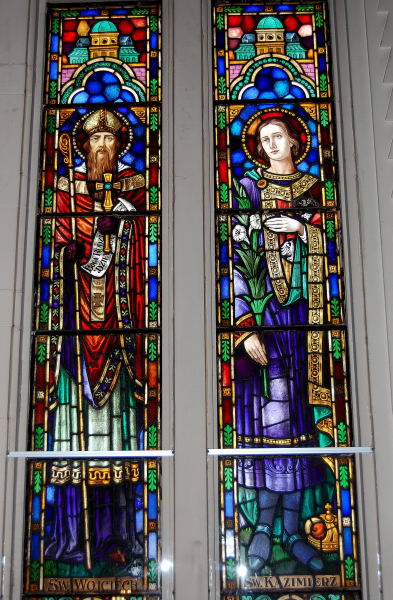
| Saint
Adalbert |
St.
Wojtech,
or St. Adalbert, was a Bohemian (Czech) monk who set out on a
mission to Christianize the Prussians (Germans) living
on the Baltic coast east of the Vistula River. He met his
death at the hands of the Prussians in 997 AD and was
canonized two years later. The oldest church in Cracow
(Poland) is St. Adalbert's Church, situated on the southeast
corner of the town square. Catholic Encyclopedia (March 2011): "Born 939 of a noble Bohemian [Czech] family; died 997. He assumed the name of the Archbishop Adalbert (his name had been Wojtech), under whom he studied at Magdeburg. He became Bishop of Prague [Czech Republic] , whence he was obliged to flee on account of the enmity he had aroused by his efforts to reform the clergy of his diocese. He betook himself to Rome, and when released by Pope John XV from his episcopal obligations, withdrew to a monastery and occupied himself in the most humble duties of the house. Recalled by his people, who received him with great demonstrations of joy, he was nevertheless expelled a second time and returned to Rome. "The people of Hungary were just then turning towards Christianity. Adalbert went among them as a missionary, and probably baptized King Geysa and his family, and King Stephen. "He afterwards evangelized the Poles, and was made Archbishop of Gnesen. [Note: Gnesen is spelled Gniezno in Polish; the Archbishop of Gniezno is the Primate of Poland.] But he again relinquished his see, and set out to preach to the idolatrous inhabitants of what is now the Kingdom of Prussia [Germany] . Success attended his efforts at first, but his imperious manner in commanding them to abandon paganism irritated them, and at the instigation of one of the pagan priests he was killed. This was in the year 997. " - Catholic Encyclopedia Adalbert is the patron saint of Bohemia [Czech Republic], Poland, Hungary, and Prussia [Germany]. Other patron saints of Poland: Black Madonna, Stanislaus, Andrew Bobola, Stanislaus Kostka) Adalbert's attributes: (March 2011)
|
Stained
glass: Assumption RC Church St. Stanislaus RC Church |
| Saint Adelhide, Adelaide | 931-999 Holy Roman Empress and perhaps the most prominent European woman of the 10th century. For more information, see Wikipedia: Adelaide of Italy 11/5/09 |
Stained glass: Saints Peter and Paul RC Church |
| Saint
Agatha |
||
| Saint
Agnes |
"The
Prefect Sempronius wished Agnes to marry his son, and on
Agnes' refusal he condemned her to death. As Roman law did not
permit the execution of virgins, Sempronius had a naked Agnes
dragged through the streets to a brothel. Various versions of
the legend give different methods of escape from this
predicament. In one, as she prayed, her hair grew and covered
her body. It was also said that all of the men who attempted
to rape her were immediately struck blind. In another the son
of the prefect is struck dead, but revived after Agnes prayed
for him, causing her release. There is then a trial from which
Sempronius excuses himself, and another figure presides,
sentencing her to death. When led out to die she was tied to a
stake, but the bundle of wood would not burn, or the flames
parted away from her, whereupon the officer in charge of the
troops drew his sword and beheaded her, or, in some other
texts, stabbed her in the throat. It is also said that the
blood of Agnes poured to the stadium floor where other
Christians soaked up the blood with cloths." _ Wikipedia (July
2010) Attribute: Lamb |
Stained
glass:
St. Adelbert Basilica St. Paul's Episcopal Cathedral |
| Saint
Ambrose |
Aurelius
Ambrosius, better known in English as Saint Ambrose, was a
bishop of Milan who became one of the most influential
ecclesiastical figures of the 4th century. Bishop of Milan from 374 to 397; born probably 340, at Trier, Arles, or Lyons; died 4 April, 397. He was one of the most illustrious Fathers and Doctors of the Church. Made bishop of Milan by popular acclamation in 374. Credited with promoting "antiphonal chant", a style of chanting in which one side of the choir responds alternately to the other, |
Sculpture:
Sforza Castle, Milan, Italy Stained glass: Cologne Cathedral, Germany Basilica of San Petronio, Bologna, Italy |
| Saint Amelia | Saint Amelia, who lived from approximately 741 to 772, is the patron saint of farmers, fishermen and those who suffer from pain in the arm or shoulder. Amelia resided as a nun at the women’s Benedictine abbey of Münster-Bilzen, Belgium. In the Belgian town of Temsche, Amelia founded a church that was dedicated to the Virgin Mary. Source | Stained glass: Saints Peter and Paul RC Church, HAMBURG (Andrle) |
| Saint Andrew the Apostle | Apostle
and the brother of Saint Peter. Both he and his brother Peter
were fishermen by trade. The Gospel of John teaches that Andrew was a disciple of John the Baptist, whose testimony first led him and John the Evangelist to follow Jesus (John 1:35-40). Andrew at once recognized Jesus as the Messiah, and hastened to introduce him to his brother (John 1:41). Patron of Scotland. Andrew is said to have been martyred by crucifixion at Patras on an X-shaped cross and commonly known as "Saint Andrew's Cross" or saltire or saltier. See also: Saints.SQPN: Saint Andrew the Apostle Depictions: Saltire or saltier See also: Episcopal Shield and Flag |
Sculpture:
Saint Andrew's Episcopal Church St. John's Grace Episcopal Church Grace Episcopal Church, Lockport St. Paul Episcopal Cathedral Painting: Buffalo Religious Arts Center Stained glass: Episcopal Church of the Ascension |
| Saint Andrew Bobola | Born
Sandomir, Poland, 1590; died Janow, 1657. Jesuit martyr, He was superior at Bobruisk, where he distinguished himself during the plague. His success in converting schismatics, in the Lithuanian mission, led to his torture and martyrdom by the Cossacks. |
Mural: St. Casimir RC Church |
| Saint Ann (Anne) | Mother
of the Virgin Mary, according to Christian tradition, and,
thereby, grandmother of Jesus. According to the apocryphal
Gospel of James, Anne and her husband Joachim, after years of
childlessness, were visited by an angel who told them that
they would conceive a child. She is normally shown as present at the Presentation of Jesus at the Temple and the Circumcision of Christ. In Western iconography, Anne may be recognized by her depiction in red robe and green mantle, often holding a book. Present at the Presentation of Jesus at the Temple and the Circumcision of Christ. Wears red robe and green mantle, often holding a book |
Stained
glass:
Saints Peter and Paul RC Church St. Ann RC Church St. Joseph RC Cathedral Sculpture: Felician Sisters Convent Chapel Church of Santa Anna |
|
C.
251–356
|
Stained
glass: St. Louis RC Church |
|
| Saint Anthony of Padua | Anthony
entered the Augustinian Abbey of St. Vincent on the outskirts
of Lisbon, but later joined the Franciscan order. He was known
as a gifted preacher: the crowd of people which came to hear
him frequently numbered 30,000 and more. He died at the age of
thirty-six years in 1231. Both St. Francis and the Infant Jesus appeared to St.Anthony. "...
in
Rimini, Anthony was challenged by a heretic to prove the reality of the
presence of Christ in the Eucharist.
The man, who sought to mock Anthony, brought out a
half-starved mule and showed it fresh fodder.
Saint Anthony showed the mule the monstrance containing the
Blessed Sacrament. The mule ignored the fodder and bowed
before the Blessed Sacrament." - Wikipedia
(online June 30, 2023)
|
Stained
glass:
Saints Peter and Paul RC Church Felician Sisters Convent Chapel Receiving Jesus from Mary Corpus Christi RC Church With donkey Assumption RC Church Murals: St. Casimir's RC Church |
| Saint Augustine of Hippo | 354-430. Bishop of Hippo Regius, Roman Africa Province. Libertine until his conversion to Christianity. Augustine, a Latin church father and pre-eminent Doctor of the Church, is one of the most important figures in the development of Western Christianity. Framed the concepts of original sin and just war. Attributes: child; dove; pen; shell, pierced heart |
Stained
glass: St. Louis RC Church Cologne Cathedral, Germany |
| Saint Barbara | Perhaps
best known as the patron saint of artillerymen, military
engineers, miners and others who work with explosives because
of her old legend's association with lightning, and also of
mathematicians and architects. Barbara -- one of the Fourteen Holy Helpers -- was the beautiful daughter of a rich and powerful pagan named Dioscuros. She grew up in Nikomedia (in modern Turkey). To keep her a virgin, her father locked her in a tower when he was away, a tower with only two windows. Upon his return from one journey, he found three windows in the tower instead of two. When he asked Barbara about this, she confessed that she'd become a Christian after being baptized by a priest disguised as a physician, and that she'd asked that a third window be made as a symbol of the Holy Trinity. She was then denounced by her father, who was ordered by the local authorities to put her to behead her. When he dealt the death blow, he was immediately struck by lightning. She is regarded as the patron saint in time of danger from thunderstorms, fires, and sudden death. During her time in the tower, she kept a branch from a cherry tree which she watered with water from her cup. On the day of she was killed, the cherry branch she'd kept blossomed. From this comes "Barbarazweig," the custom of bringing branches into the house on December 4 to hopefully bloom on Christmas (some reserve the custom for the unmarried). Depicted in art holding a small tower or standing near a tower or near a canon, and holding a chalice and/or the palm of martyrdom. |
Stained glass: Saints Peter and Paul RC Church |
| Saint Bartholomew | One
of the twelve
Apostles of Jesus. He is one of the apostles of whom no word is reported nor any individual action recorded in the New Testament. Traditions: 1. Bartholomew went on a missionary tour to India, where he left behind a copy of the Gospel of Matthew. 2. Missionary in Ethiopia, Mesopotamia, Parthia, and Lycaonia. 3. Brought Christianity to Armenia in the 1st century. 4. Bartholomew was associated with fishing "Along with his fellow apostle Jude Thaddeus, Bartholomew is reputed to have brought Christianity to Armenia in the 1st century. Thus, both saints are considered the patron saints of the Armenian Apostolic Church. He is said to have been martyred in Albanopolis in Armenia. According to one account, he was beheaded, but a more popular tradition holds that he was flayed alive and crucified, head downward." -Wikipedia (online April 2016) |
Stained
glass:
Buffalo Religious Art Center Basilica of San Petronio, Bologna, Italy Painting: Buffalo Religious Arts Center |
| 1090-1153. Cistercian monk. One of 33 Doctors of the Church. He and twelve other monks were sent to found a new monastery in what was then known as the Valley of Wormwood; within time it became even better known as the Valley of Light, or Clairvaux. 68 other abbeys sprang up from Clairveaux. Chosen to judge between rival popes ( 1130 schism in the church). By order of Pope Eugenius III, Bernard preached and promoted the Second Crusade to the Holy land. It was led by the French King, Louis VII and failed. Grisaille glazing was first favored by the Cistercian Order under St. Bernard, who found that figurative windows distracted monks from religious responsibilities. Dante depicts Bernard as his last guide in heaven in the Divine Comedy. |
Stained
glass: St. Louis RC Church |
|
| c.
672- 754. Missionary who propagated Christianity in the Frankish Empire during the 8th century. He is the patron saint of Germany and the first archbishop of Mainz. In 723, Boniface felled the holy oak tree of Jupiter[ near the present-day town of Fritzlar in northern Hesse. He did this with the Prophet Elijah in mind. Boniface called upon the god to strike him down if he cut the holy tree. According to St Boniface's first biographer, Willibald (an Anglo-Saxon priest come to Mainz after Boniface's death, not to be confused with the saint), Boniface started to chop the oak down, when suddenly a great wind, as if by miracle, blew the ancient oak over. When the god did not strike him down, the people were amazed and converted to Christianity. Although Boniface and 30 of his companions died as martyrs, he established Christianity in northern Europe. Attributes axe; book; fountain; fox; oak; raven; scourge; sword |
Stained
glass: St. Louis RC Church |
|
| St.
Briget of Sweden |
||
| Saint Casimir | 1458-1484 Prince of the Kingdom of Poland and of the Grand Duchy of Lithuania.Unmarried by choice. Patron saint of Lithuania, Poland. Born at Wawel. "Hungarian nobles prevailed upon Casimir’s father to send his 15-year-old son to be their king; Casimir obeyed, taking the crown, but refusing to exercise power. His army was outnumbered, his troops deserting because they were not paid. Casimir returned home, and was a conscientious objector from that time on. He returned to prayer and study, maintained his decision to remain celibate even under pressure to marry the emperor’s daughter. Reigned briefly as king during his father’s absence." - Saints.SQPN.com "Casimir showed great attention to the poor. Following the biblical injunction, he gave everything he had to the needy and wore only very plain clothing. From an early age, he demonstrated ascetical practices such as sleeping on the ground and wearing a haircloth shirt. A haircloth shirt is a garment made of rough animal hair and worn under clothing as a form of deep penance. The irritation of the skin is a constant reminder not to sin." - Study.com (online October 2019) See also Saint Casimir RC Church, Buffalo Usually depicted as a beardless young man with crown, sometimes hilding a lily (purity). |
Sculpture:
Buffalo Religious Art Center St. Casimir's RC Church Stained glass: St. Casimir's RC Church Assumption RC Church St. Stanislaus RC Church |
| Saint Catherine of Alexandria, V.M., Saint Catherine of the Wheel | "St.
Catherine of Alexandria, (died c. early 4th century,
Alexandria, Egypt; feast day November 25), one of the most
popular early Christian martyrs and one of the Fourteen Holy
Helpers (a group of Roman Catholic saints venerated for their
power of intercession). She is the patron of philosophers and
scholars and is believed to help protect against sudden death. "St. Catherine of Alexandria is not mentioned before the 9th century, and her historicity is doubtful. According to legend, she was an extremely learned young girl of noble birth, possibly a princess. She protested the persecution of Christians under the Roman emperor Maxentius—whose wife and several soldiers she converted while imprisoned—and defeated the most eminent scholars summoned by Maxentius to oppose her. During her subsequent torture, she professed that she had consecrated her virginity to Jesus Christ, her spouse, and was sentenced to death. The spiked wheel by which she was to be killed broke when she touched it (whence the term Catherine wheel), and she was then beheaded. "After her death, angels allegedly took her body to Mount Sinai, where, according to legend, it was discovered about 800 CE. In the Middle Ages, when the story of her mystical marriage to Christ was widely circulated, she was one of the most popular saints and one of the most important virgin martyrs. St. Joan of Arc claimed that Catherine’s was among the heavenly voices that spoke to her." - Source: Encyclopaedia Britannica (online April 2020) Early rose windows are also called Catherine windows after Saint Catherine of Alexandria who was sentenced to be executed on a spiked wheel. |
Painting: Pitti Palace, Florence, Italy Stained glass: Saints Peter and Paul RC Church, Hamburg Sculpture: Opera del Duomo Museum, Florence, Italy |
| Saint
Catherine
of Sienna |
Catherine
was
born in Sienna, Italy, in 1347, daughter of Giacomo Benincasa,
a dyer. From her earliest years she had mystic visions and
practiced austerities. At the age of 16 she joined the
Dominican order as a tertiary, and lived at home. In l370, in response to a vision, she began to take part in the public life of her time, sending letters to leaders of her day. She went to Avignon and helped persuade Pope Gregory XI to end the "Babylonian captivity" of the church and return the papal court to Rome, which he did in 1376. In 1375, she is reported to have received the stigmata, the fivewounds of Christ, which no one saw until after her death, She became the center of a spiritual revival, and gathered a large family of devoted followers. Though she never leaned to write, she dictated hundreds of letters and a notable mystic work, known as "The Dialogue of Saint Catherine of Siena" or "A Treatise on Divine Providence." Catherine died in 1380, at the age of 33. She was canonized in1461, and in 1970 was made a Doctor of the Church (an honorary title given by the Western Church to some 30 persons whose writings and teachings are considered orthodox; two women hold this honor, Catherine and Teresa of Avila). In 1939 she was made patron saint of Italy. Her feast day is April 29. |
Stained
glass:
St. Andrew's Episcopal Church |
| Saint Cecilia | Patron
saint of musicians and church music because she praised God,
singing to him, as she lay dying a martyr's death. Depicted in choir loft rose windows, often playing an organ; often surrounded by angels playing musical instruments. Other attributes: flute, organ, roses, violin, harp, harpsichord, singing. "There was in the city of Rome a virgin named Cecilia, who was given in marriage to a youth named Valerian. She wore sackcloth next to her skin, and fasted, and invoked the saints and angels and virgins, beseeching them to guard her virginity. And she said to her husband, "I will tell you a secret if you will swear not to reveal it to anyone." And when he swore, she added, "There is an angel who watches me, and wards off from me any who would touch me." He said, "Dearest, if this be true, show me the angel." "That can only be if you will believe in one God, and be baptized." She sent him to Pope S. Urban (223-230), who baptized him; and when he returned, he saw Cecilia praying in her chamber, and an angel by her with flaming wings, holding two crowns of roses and lilies, which he placed on their heads, and then vanished. Shortly after, Tibertius, the brother of Valerian, entered, and wondered at the fragrance and beauty of the flowers at that season of the year. "When he heard the story of how they had obtained these crowns, he also consented to be baptized. After their baptism the two brothers devoted themselves to burying the martyrs slain daily by the prefect of the city, Turcius Almachius. [There was no prefect of that name.] They were arrested and brought before the prefect, and when they refused to sacrifice to the gods were executed with the sword. "In the meantime, S. Cecilia, by preaching had converted four hundred persons, whom Pope Urban forthwith baptized. Then Cecilia was arrested, and condemned to be suffocated in the baths. She was shut in for a night and a day, and the fires were heaped up, and made to glow and roar their utmost, but Cecilia did not even break out into perspiration through the heat. When Almachius heard this he sent an executioner to cut off her head in the bath. The man struck thrice without being able to sever the head from the trunk. He left her bleeding, and she lived three days. Crowds came to her, and collected her blood with napkins and sponges, whilst she preached to them or prayed. At the end of that period she died, and was buried by Pope Urban and his deacons." - Catholic Online |
Stained
glass:
Corpus Christi RC Church Trinity Episcopal Church Assumption RC Church St. Margaret's RC Church Painting: Blessed Trinity RC Church Sculpture: Buffalo Religious Art Center |
| Saint Charles Borromeo | St.
Charles Borromeo (1538-1584) was a member of a noble family
and a nephew of Pope Pius IV. He was made a Cardinal at the
age of 23 and assisted the Pope in administering the affairs
of the Holy See and in governing the Church. Soon thereafter
he was made Archbishop of Milan. His endeavors on behalf of
the 19th Ecumenical Council of Trent (1545-1564) were
especially meritorious and fruitful. He then proceeded to
enforce its decrees in the Archdiocese of Milan and thoroughly
reformed Catholic life in his See. During a plague in Milan, he walked barefooted in the public streets, carrying a cross, with a rope around his neck, offering himself as a victim to God for the transgressions of his people. He worked during the period of the Counter-Reformation and was responsible for significant reforms in the Catholic Church, including the founding of seminaries for the education of priests. He died, dressed in sackcloth and ashes, holding a picture of Jesus Crucified in his hands, in 1584 at the age of forty-six. "St. Charles Borromeo (1538-1584) was the Latin archbishop of Milan and cardinal of the Catholic Church. He, along with St. Ignatius of Loyola and St. Philip Neri, were leading figures of the Counter-Reformation. He founded many seminaries for the education of priests." - Maureen Evans Depictions: Altar; chalice and host; rope around neck; casket and crucifix; cardinal's hat; word Humiltitas crowned. Bishop wearing a noose around his neck; cardinal wearing a noose around his neck. |
Stained
glass:
St. Joseph RC Cathedral Holy Family Church _________________________
Memorial:
Milan
Cathedral |
| Saint
Christopher |
Encyclopaedia
Britannica (online Dec. 2019):
"Saint Christopher, (flourished 3rd century; Western feast
day July 25; Eastern feast day May 9), legendary martyr of
the early church. Venerated as one of the 14 Auxiliary
Saints (Holy Helpers), he is the patron saint of travelers
and, beginning in the 20th century, of motorists. Though
one of the most popular saints, there is no
certainty that he existed historically. In 1969
his name was dropped from the calendar of the Roman
Catholic Church, and his feast day is no longer
obligatory. "According to the Roman martyrology, he died in Lycia under the Roman emperor Decius (c. 250). He is the hero of many later legends, which represent him as a giant who, after being converted, devoted his life to carrying travelers across a river. One day a small child asked to be transported, and in the middle of the river the child became so heavy that Christopher staggered under the burden, complained of the weight, and was told that he had borne upon his back the world and Him who created it. Hence, Christopher (Greek: “Christ-Bearer”) is generally represented in art carrying the Christ Child on his back." |
Sculpture: Cologne Cathedral, Germany Painting: Basilica of San Petronio, Bologna, Italy |
| Saint Clare | Born
at Assisi, 16 July, 1194; died there 11 August, 1253. She was the eldest daughter of Favorino Scifi, Count of Sasso-Rosso, the wealthy representative of an ancient Roman family, who owned a large palace in Assisi and a castle on the slope of Mount Subasio. \ She was eighteen years of age when St. Francis came to preach the Lenten course in the church of San Giorgio at Assisi. On Palm Sunday, 1212, St. Francis and his disciples met her with lights in their hands. Clare then laid aside her rich dress, and St. Francis, having cut off her hair, clothed her in a rough tunic and a thick veil. Cofoundress of the Order of Poor Ladies, or Clares, and first Abbess of San Damiano. St. Clare and her sisters wore no shoes, ate no meat, lived in a poor house, and kept silent most of the time. In art, St. Clare is shown carrying a monstrance or pyx in commemoration of the time that she warded away attackers at the gates of her convent by raising the sacred Host over the wall. |
Stained
glass:
St. Paul Episcopal Cathedral Corpus Christi RC Church St. Stephen RC Church Saints Peter and Paul RC Church, HAMBURG (Andrle) Felician Sisters Chapel, CHEEKTOWAGA |
| Saint
Denis |
First
Bishop of Paris, and martyr (about 275). Born in Italy, nothing is definitely known of the time or place, or of his early life. Pope Fabian (236-250) sent him and two other missionary bishops to Gaul. They were martyred, and after his head was chopped off, Denis is said to have picked it up and walked ten kilometres (six miles) from the summit of Mont Mars (now Montmartre), preaching a sermon the entire way to the site of the current church, thereby indicating where he wanted to be buried. A small shrine, erected over their buriel place, developed into the Saint Denis Basilica through the efforts of Saint Geneviève, the patron saint of France. The basilica became the burial place for the kings of France. Depiction: Denis is usually represented with his severed head in his hands. |
Sculpture: St. Denis Basilica, Paris _______________ Stained glass: St. Denis Basilica, Paris _______________ Paintings: Panthéon, Paris |
| Saint Dominic |
Founder
of
the Friars Preachers, popularly called the Dominicans.
|
Stained
glass:
St. Joseph RC Cathedral St. Louis RC Church Annunciation RC Church St. Stanislaus RC Church St. John Kanty RC Church |
| Saint Edward the Confessor | Edward
the Confessor (c. 1003 -1066) was one of the last Anglo-Saxon
kings of the English. His reign foreshadowed the country's
domination by the Normans, whose duke William of Normandy was
to defeat Edward's successor, Harold II, and seize the crown. In 1163, the newly sainted king's remains were enshrined in Westminster Abbey with solemnities presided over by Thomas Becket, Archbishop of Canterbury. His reputation for holiness, which began during his life, was based on his accessibility to his subjects, his generosity to the poor, and his supposedly unconsummated marriage with Edith, the daughter of Godwin, earl of Wessex. He was also reputed to have seen visions and cured scrofula (the King's Evil) by his touch. The important iconography of Edward is closely connected with his Legend. From the Bayeux Tapestry and his earliest Life there is a constant tradition of his physical appearance: he was a tall man with a long face, ash-blond hair and beard, ruddy complexion and long, thin fingers. The legend of his ring is that Edward gave a ring to a beggar near Westminster. Two years later some English pilgrims in the Holy Land (or in India) met an old man who said he was John the Apostle. He gave them the ring and told them to return it to Edward, whom they were charged to warn of impending death in six months' time. Tradition of his physical appearance: he was a tall man with a long face, ash-blond hair and beard, ruddy complexion and long, thin fingers. |
Stained
glass:
St. Joseph RC Cathedral Saints Peter and Paul RC Church, HAMBURG |
| Saint Elizabeth | St.
Elizabeth was the mother of St. John the
Baptist, cousin of the Virgin Mary Depicted in the Visitation of Mary and Elizabeth. Luke 1:5-41 13 But the angel said to him: "Do not be afraid, Zechariah; your prayer has been heard. Your wife Elizabeth will bear you a son, and you are to give him the name John. ... 18 Zechariah asked the angel, "How can I be sure of this? I am an old man and my wife is well along in years." 19 The angel answered, "I am Gabriel. I stand in the presence of God, and I have been sent to speak to you and to tell you this good news. |
Stained
glass:
Grace Episcopal Church, Lockport\ Our Lady of Victory RC Basilica Mary Visits Elizabeth Sculpture: Florence Baptistery, Italy |
| St. Elizabeth of Hungary | 1207-1231 Daughter of King Andrew II of Hungary. At age four she was brought to the court of the rulers of Thuringia in Central Germany, to become a future bride who would reinforce political alliances between the families. Elisabeth was married at the age of fourteen, bore three children, widowed at twenty. She was forced out of the castle with hr children. She later joined the Third Order of St. Francis at Marburg and continued to look after the poor and the sick. She died at the age of twenty-four. Attributes: Roses, Crown, Food basket |
Stained
glass: St. Louis RC Church |
| Saint Felix of Cantalice | St.
Felix's parents were devout peasants. He was a shepherd and a
ploughman. He entered the Capuchin monastery and became a lay
brother. He was spoken of as "the Saint." For his assignment,
he was sent to Rome where, for forty years, he filled the post
of questor, whose daily duty was to beg for food and alms for
himself and for the community. For everything he gave thanks
to God and the words "Deo Gratias" were so constantly on his
lips that the Roman street urchins called him Brother Deo
Gratias. The first Felician sisters took children, mostly
orphans, they cared for to a nearby church and prayed before
the statue of St. Felix. Soon the people began to call them
the sisters of St. Felix or Felician Sisters. St. Felix is usually depicted holding a bag for food. |
Stained
glass:
: Felician Sisters Convent Chapel Sculpture: Felician Sisters Convent Chapel |
| Saint Francis of Assisi | Saint
Francis of Assisi (Giovanni Francesco Bernardone; born
1181/1182-1226) was a deacon and the founder of the Order of
Friars Minor, more commonly known as the Franciscans. He is known as the patron saint of animals, the environment and Italy, Stigmata are bodily marks, sores, or sensations of pain in locations corresponding to the crucifixion wounds of Jesus (hands, feet and side). The term originates from the line at the end of Saint Paul's Letter to the Galatians. The first stigmata to be accepted by Church authorities as authentic, was that of Saint Francis. Wikipedia: Francis of Assisi: While he was praying on the mountain of Verna, during a forty-day fast in preparation for Michaelmas ), Francis is said to have had a vision on or about September 14, 1224, the Feast of the Exaltation of the Cross, as a result of which he received the stigmata. Brother Leo, who had been with Francis at the time, left a clear and simple account of the event, the first definite account of the phenomenon of stigmata. "Suddenly he saw a vision of a seraph, a six-winged angel on a cross. This angel gave him the gift of the five wounds of Christ." Depicted: With stigmata |
Painting:
Blessed Trinity RC Church Catalonian National Art Museum, Barcelona, Spain Pitti Palace, Florence, Italy Basilica of Santa Croce Sculpture: Felician Sisters Convent Chapel Stained glass: Felician Sisters Convent Chapel Transitus Corpus Christi RC Church Receiving the stigmata from Jesus St. Louis RC Church Converting natives |
| 1567-1622 One of 33 Doctors of the Church. PAtron of the Catholic Press. In 1602, he was consecrated bishop of Geneva, Switzerland, whose Cathedral had been seized by Calvinists and made headquarters of the present Presbyterian Church. He won thousands back to Catholicism. Co-founder of the Visitation Nuns with Saint Jane Frances de Chantal, Francis. |
Stained
glass: St. Louis RC Church |
|
| Saint Francis Xavier | Born
Francisco de Jaso y Azpilcueta (April 7, 1506, Javier, Spain - December 3, 1552 AD, Shangchuan Island, China) A Spanish pioneering Roman Catholic missionary of navarrese origin. He was a student of Saint Ignatius Loyola and one of the first seven Jesuits who dedicated themselves to the service of God at Montmarte in 1534. He led an extensive mission into Asia, mainly in the Asian Portuguese empire of the time. He was influential in the spreading and upkeep of Catholicism most notably in India (in Goa), but also ventured into Japan, Borneo, the Malaccas, and other areas which had thus far not been colonized. - Source: Wikipedia: Francis Xavier 10/5/09 |
Stained
glass:
Saints Peter and Paul RC Church, Hamburg St. Francis Xavier RC Church St. Louis RC Church Painting: Buffalo Religious Arts Center |
| Saint Gabriel, Archangel | ||
| Saint Genevieve of Paris | c.
419/422 - Paris 502/512. Patron saint of Paris. She was seven years old when St. Germain of Auxerre came to her native village on his way to great Britain to combat the heresy of Pelagius. The child stood in the midst of a crowd gathered around the man of God, who singled her out and foretold her future sanctity. When Attila was reported to be marching on Paris, the inhabitants of the city prepared to evacuate, but St. Genevieve persuaded them to avert the scourge by fasting and prayer. Her bodily denial was so severe that she ate only twice a week and fasted the rest of the time. This fasting continued until age 50 when her bishop commanded her to alter her diet. One day a gust of wind blew out her candle, leaving her in the dark, but she merely concluded that the devil was trying to frighten her. For this reason Geneviève is often depicted holding a candle, sometimes with an irritated devil standing near. |
Stained
glass: St. Louis RC Church |
| Saint George | Saint
George (ca. 275/281-303) was, according to tradition, a Roman
soldier in the Guard of Diocletian, who is venerated as a
Christian martyr. He is immortalized in the tale of Saint
George and the Dragon and is one of the Fourteen Holy Helpers
(see above).
"In the fully-developed Western version, which developed as part of the Golden Legend, a dragon makes its nest at the spring that provides water for the city of "Silene" ... . Consequently, the citizens have to dislodge the dragon from its nest for a time, in order to collect water. To do so, each day they offer the dragon at first a sheep, and if no sheep can be found, then a maiden must go instead of the sheep. The victim is chosen by drawing lots. One day, this happens to be the princess. The monarch begs for her life to be spared, but to no avail. She is offered to the dragon, but there appears Saint George on his travels. He faces the dragon, protects himself with the sign of the cross, slays the dragon, and rescues the princess. The grateful citizens abandon their ancestral paganism and convert to Christianity." -Wikipedia: St. George Alternate version: "When God decided to punish the people of Lybia for their disbelief, he sent a dragon to them that demanded human sacrifices. The king's daughter was to be devoured by the dragon. George who rode by that place told the girl to believe in Christ and defeat the dragon by her prayer to Him. The king, his wife and all the citizens adopted Christianity and were were baptized." - "The Russian Icon," by Irina Solovyova, et. al. Translated by Julia Redkina. 2006, p. 36. The Flag of England is the St. George's cross (illustration). Saint George became the patron saint of England in the thirteenth century, and the legend of Saint George slaying a dragon dates from the twelfth century. See also: Episcopal Shield and Flag |
Stained
glass:
Our Lady of Victory RC Basilica Episcopal Church of the Ascension Assumption RC Church -----------------
Sculpture:Church of San Giorgio Maggiore, Venice, Italy By Donatello |
| St. Gertrude the Great, Saint Gertrude of Helfta | 1256-1302 German Benedictine and mystic writer. Nothing is known of her parents, so she was probably an orphan. As a young girl, she joined the Benedictine monastery in Helfta. She dedicated herself to her studies, becoming an expert in literature and philosophy. She had various mystical experiences, including a vision of Jesus, who invited her to rest her head on his breast to hear the beating of his heart. Though St Gertrude was never formerly canonized, nevertheless she received equipotent canonization, and a universal feast day was declared in the year 1677 by Pope Clement XII. - Source: Wikipedia: Gertrude the Great |
Stained glass: Saints Peter and Paul RC Church, Hamburg |
| St. Gregory the Great | 540-604. Pope Gregory I. He was the first of the popes to come from a monastic background. Gregory is a Doctor of the Church and one of the six Latin Fathers |
Stained
glass: St. Louis RC Church Cologne Cathedral, Germany |
| Saint Hedwig, Duchess of Silesia | 1774-1243
At age 12, Hedwig married Henry I the Bearded of Silesia. In 1233 Henry became Duke of Greater Poland. Hedwig always helped the poor, went barefoot even in winter, and donated all her fortune to the Church and the poor. Widowed, she moved into the convent of Cistercian convent of Trzebnica (Trebnitz) where her daughter was abbess.The convent had been built by Henry at Hedwig's request. Attribute: holding a model of a church. |
Sculpture: Buffalo Religious Art Center |
| Saint
Hedwig of Poland |
Jadwiga
(1373/4-1399) was monarch of Poland from 1384 to her death.
Her official title was 'king' rather than 'queen', reflecting
that she was a sovereign in her own right and not merely a
royal consort. She is known in Polish as Jadwiga, in English and German as Hedwig. She is venerated by the Roman Catholic Church as Saint Hedwig, where she is the patron saint of queens and a United Europe. |
Stained
glass:
St. Stanislaus RC Church Buffalo Religious Art Center St. Margaret's RC Church St. Barbara RC Church |
| Saint Helena, Saint Helen | Ca.
246/50-330 Consort of Emperor Constantius, and the mother of Emperor Constantine I. She is traditionally credited with finding the relics of the True Cross, as well as the nails of the Cricifixion, part of Jesus Christ's tunic, pieces of the holy cross and the world's only pieces of the rope to which Jesus was tied with on the Cross. |
Sculpture:
Buffalo Religious Art Center Milan Cathedral Museum |
| Saint Henry II the Lame | Fifth
and last Holy Roman Emperor of the Saxon dynasty. He was
crowned King of Germany in 1002 and King of Italy in 1004. He
was the only German king to be canonized. He supported the bishops against the monastic clergy and aided them in establishing their temporal rule over broad territories. He strongly enforced clerical celibacy in order that the public land and offices he granted the church would not be passed on to heirs. |
Stained glass: Saints Peter and Paul RC Church |
| Saint Hyacinth of Cracow | 1185-1257 "While in Rome working with his uncle..., he witnessed a miracle performed by Saint Dominic de Guzman. He became of friend of Saint Dominic, and became one of the first Dominicans. The first Polish Dominican, he brought the Order to Poland, then evangelized throughout Poland, Pomerania, Lithuania, Sweden, Norway, Denmark, Scotland, Russia," - Saints.SQPN.com "One of his miracles is connected with the Tartarian attack on a monastery in Kiev. Hyacinth was about to save a Monstrance (or possibly a Ciborium, it is unknown exactly which one) containing the Blessed Sacrament when he heard the voice of Blessed Virgin Mary asking him to take her too. So he decided to take also the statue of the Holy Virgin. Despite the fact that it weighed far more than he could normally lift, it became miraculously weightless. Thus he saved both the Blessed Sacrament and the statue of Our Lady. For that reason the saint is usually shown holding these two items." - Wiklipedia: Saint Hyacinth Depictions: Wearing a Dominican robe; carrying statue of Mary; carrying monstrance or ciborium. |
Stained
glass:
Corpus Christi RC Church St. Stanislaus RC Church Statue: St. Casimir RC Church |
| Saint
Ignatius Loyola |
"Ignatius
of Loyola (Basque: Ignazio Loiolakoa, Spanish: Ignacio de
Loyola) (1491[1] – July 31, 1556) was a Spanish knight from a
Basque noble family, hermit, priest since 1537, and
theologian, who founded the Society of Jesus (Jesuits) and was
its first Superior General.[2] Ignatius emerged as a religious
leader during the Counter-Reformation." - Wikipedia
(July 2011) Attributes: Eucharist, chasuble, book, cross |
Stained
glass:
St.
Adalbert Basiiica |
| Saint
Jadwiga |
See St.
Hedwig of Poland above |
|
| Saint James the Apostle; James the Greater | James
the son of Zebedee and his brother John were among the twelve
disciples of Our Lord. They, together with Peter, were
privileged to behold the Transfiguration (Mark
9:2-7),
to witness the healing of Peter's mother-in-law and the
raising of the daughter of Jairus (see above),
and to be called aside to watch and pray with Jesus in the
garden of Gethsemane on the night before His death (Matt
26:
36-55) In 1 Corinthians 15:3-8, Jesus appears to James after his Resurrection but before his Ascension About AD 42, shortly before Passover (Acts 12), James was beheaded by order of King Herod Agrippa I, grandson of Herod the Great. James was the first of the Twelve to suffer martyrdom, and the only one of the Twelve whose death is recorded in the New Testament. James is often called James Major to distinguish him from other New Testament persons called James. Tradition has it that he made a missionary journey to Spain, and that after his death his body was taken to Spain and buried there. Well-equipped medieval pilgrim with an ample cape, sturdy boots, a broad-brimmed hat, and a walking stick with a hook for hanging a drinking gourd. The hat will be adorned with a scallop shell. St. James the Moor Slayer. |
Stained
glass:
St. John's Grace Episcopal Church Trinity Episcopal Church Painting: Buffalo Religious Arts Center |
| Saint James the Apostle, James the Less | Son
of Alphaeus St. James the Less, the "Brother of Jesus" who led the Christians of Jerusalem until that city's destruction in 70 AD. The traditional account is that he was martyred by being thrown from the parapet of the Temple, stoned, and finally beaten to death with a fuller's club. Depicted: Holding a clubDepicted: |
Stained
glass:
St.
John's Grace Episcopal Church Painting: Buffalo Religious Arts Center |
| Saint
Jerome |
Saint
Jerome was a Roman Christian priest, confessor, theologian and
historian, a Doctor of the Church. He is best known for his translation of the Bible into Latin (the Vulgate), and his commentaries on the Gospel of the Hebrews. (the Vulgate), and his commentaries on the Gospel of the Hebrews. In art, he is often represented as one of the four Latin doctors of the Church along with Augustine of Hippo, Ambrose, and Pope Gregory I. Even when he is depicted as a half-clad anchorite, with cross, skull and Bible for the only furniture of his cell, the red hat or some other indication of his rank as cardinal is as a rule introduced somewhere in the picture. He is also often depicted with a lion, in reference to a story telling how Jerome tamed a lion by healing its paw. He is also sometimes depicted with an owl, the symbol of wisdom and scholarship. Writing materials and the trumpet of final judgment are also part of his iconography |
Mosaic:
St.
Peter's
Basilica, Rome Stained glass: Holy Family Church |
| Saint Joachim | Father
of St. Mary Married to St Ann. |
Stained
glass:
St. Joseph RC Cathedral |
| Saint
Joan of Arc |
A
peasant girl born in eastern France who claimed divine
guidance, she led the French army to several important
victories during the Hundred Years' War, which paved the way
for the coronation of Charles VII. She was put on trial by the
pro-English Bishop of Beauvais for charges of "insubordination
and heterodoxy," and burned at the stake as a heretic in Rouen
when she was 19 years old. |
Paintings: Panthéon, Paris |
| Saint
John the Apostle / Saint John the Evangelist |
Icons: Hellenic Orthodox Church of the Annunciation |
|
| Saint
John the Baptist |
Son
of Zacharias, a priest, and Elizabeth,
cousin of the Virgin Mary (Gospel:
Luke,
Chapter 1) Gospel: Mark, Chapter 1 ... Gospel: Matthew, Chapter 3 ... Gospel: Luke, Chapter 1 Like the pregnacy of her cousin, Mary, mother of Jesus, John's mother's pregnancy was also miraculous and announced by an Angel [Gabriel, by tradition]. In Luke, Chapter 1, the angel says "And, behold, thy cousin Elisabeth, she hath also conceived a son in her old age: and this is the sixth month with her, who was called barren." Depictions:
See also: Baptism of Jesus and the Visitation of Mary and Elizabeth |
Painting: Pitti Palace, Florence, Italy: Raphael Child Pitti Palace, Florence, Italy: Gherardo di Giovanni Adult Pitti Palace, Florence, Italy: Lippi Boy Pitti Palace, Florence, Italy: Michelangelo Child Icon: Hellenic Orthodox Church of the Annunciation Adult Church of the Intercession, Kizhi, Russia Adult Mosaic: Deesis - Hagia Sophia, Istanbul, Turkey Adult Stained glass: Cologne Cathedral, Germany Adult Sculpture: Bargello, Florence, Italy Child Florence Baptistery South doors, Italy Opera del Duomo Museum, Florence, Italy |
| Saint John of Kanty | 1390-1473 "Polish country lad. Brilliant student at the University of Cracow, Poland. Priest. Professor of theology at University of Cracow. Falsely accused and ousted by university rivals, at age 41 he was assigned as parish priest at Olkusz, Bohemia... in the end he won their hearts. After several years in his parish, he returned to Cracow and taught Scripture the rest of his life. John was a serious, humble man, generous to a fault with the poor, sleeping little, eating no meat and little of anything else. Pilgrim to Jerusalem, hoping to be martyred by Turks." - SQPN 11/10 |
Mural:
St.
Casimer's RC Church Sculpture: St. John Kanty RC Church Rose window: St. John Kanty RC Church |
| Saint John Nepomuk | c.1345-1393 National saint of the Czech Republic who was drowned in the Vltava river at the behest of Wenceslaus, King of the Romans and King of Bohemia. Later accounts state that he was the confessor of the queen of Bohemia and refused to divulge the secrets of the confessional. On the basis of this account, John of Nepomuk is considered the first martyr of the Seal of the Confessional. See Wikipedia: John of Nepomuk 11/5/09 |
Stained glass: Saints Peter and Paul RC Church, Hamburg |
| Saint Joseph |
See also:
Joseph was a carpenter: Matthew 13:55 Joseph is last mentioned in Scripture when Jesus was 12 years old. Marriage of Mary and Joseph: Matthew 1: 18-25 The Repose in Egypt: Matthew 2:13-23 St. Joseph on His Deathbed: Nothing in the Bible. Depicted: Marriage of Mary and Joseph / Flowering rod / Teaching Jesus carpentry / Deathbed |
Stained
glass:
Felician Sisters Convent Chapel St. Joseph on His Deathbed St. Joseph RC Cathedral Series of windows about St. Joseph Our Lady of Victory Basilica Marriage of Mary and Joseph Annunciation RC Church Marriage of Mary and Joseph Trinity Episcopal Church The Repose in Egypt Holy Angels RC Church Holding Lilies Painting: Buffalo Religious Art Center Ite ad Ioseph |
| Saint Jude the Apostle, Jude Thaddeus | One
of the
Twelve Apostles of Jesus. He is generally identified with
Thaddeus, and is also variously called Jude of James, Jude
Thaddaeus, Judas Thaddaeus or Lebbaeus. Patron saint of lost causes (St. Jude's Hospital) Attributes: Axe, club, boat, oar, medallion |
Sculpture:
Buffalo
Religious
Art Center Stained glass: St. John's Grace Episcopal Church |
| Saint
Lawrence |
The
belief is that Saint Lawrence was martyred by Roman Emperor
Valerian in 258. He was burned to death on a gridiron
prepared with hot coals beneath it. After the martyr had
suffered pain for a long time, the legend concludes, he
cheerfully declared: "I'm well done on this side. Turn me
over!" From this St. Lawrence derives his patronage of cooks,
chefs, and comedians. Lawrence is especially honored in the city of Rome, of which he is considered the third patron after St. Peter and St. Paul. The Roman Catholic Church erected six churches on the sites in Rome traditionally associated with his martyrdom. Depicted: Sometimes depicted with a gridiron. |
Painting: Santa Maria Novella, Florence, Italy Basilica of St. Lawrence Stained glass: Santa Maria Novella, Florence, Italy Mosaic: Saint Louis Cathedral, Saint Louis, MO |
| Saint Lucy | Because
Lucy refused to be married, she was tortured by having her
eyes torn out. She was martyred by being stabbed with a
dagger. It is said that her vision was restored before she
died. Depicted: Dish with two eyeballs |
Sculpture:
Buffalo Religious Art Center Milan Cathedral Museum Painting: Santa Maria Novella, Florence, Italy |
| Saint Luke the Evangelst | ||
| Saint Margaret of Scotland | 1045-1093 Married Malcolm III, King of Scots, She founded several churches, including the Abbey of Dunfermline, built to enshrine her greatest treasure, a relic of the true Cross. She is buried before the high altar at Dunfermline. |
Stained
glass:
Episcopal Church of the Ascension |
| Saint Margaret Mary Alacoque | 1647-1690 French Roman Catholic nun of the Visitation Order and mystic, who promoted devotion to the Sacred Heart of Jesus in its modern form. After her First Communion at the age of nine, she practised in secret severe corporal mortification (including carving the name "Jesus" into her chest as an adolescent until paralysis confined her to bed for four years. At the end of this period, having made a vow to the Blessed Virgin to consecrate herself to religious life, she was instantly restored to perfect health. In a convent she had a vision of Jesus in which he exposed His Sacred Heart and urged her to spread devotion to His Heart. After Margaret Mary's death, in1690, the devotion to the Sacred Heart was fostered by the Jesuits and the subject of controversies within the Church. The practice was not officially recognized till 75 years after her death. |
Stained
glass:
St. Louis RC Church St. Stanislaus RC Church Felician Sisters Convent Chapel, CHEEKTOWAGA |
| Saint Mark the Evangelist | ||
| St. Martin of Tours | 316-397
Bornin Candes-Saint-Martin, Gaul (central France); buried November 11, 397, Candes, Gaul) A Bishop of Tours whose shrine became a famous stopping-point for pilgrims on the road to Santiago de Compostela. Some of the accounts of his travels may have been interpolated into his vita to give credence to early sites of his cult. His life was recorded by a contemporary, the hagiographer Sulpicius Severus. He is a patron saint of France and of soldiers. - Source: Wikipedia: Martin of Tours 11/5/09 |
Stained glass: Saints Peter and Paul RC Church, Hamburg |
| Saint Mary, Mother of Jesus | ||
| Saint Mary Magdalene | See
Resurrection
above (Mary was the first to see Jesus after he rose
from the dead) In Luke 8:2 Mary is said to have cured of evil spirits, i.e., seven demons. The "sinful woman" in Luke 7:36-50 is sometimes identified in tradition as Mary Magdalene, but there is no textual evidence for this. St. Mary Magdalene is sometimes depicted with the cross on which Jesus was crucified on Golgotha and with Adam's skull which tradition holds was also buried in Golgotha ("the place of the skull). Depictions: Alabaster box of ointment / Long hair at the foot of the cross / Holding a red egg (symbol of the resurrection) / Embracing the feet of Christ after the Resurrection |
Sculpture:
Buffalo Religious Art Center Opera del Duomo Museum, Florence, Italy Stained glass: Hellenic Orthodox Church of the Annunciation Buffalo Religious Art Center Baker Memorial United Methodist Church |
| Saint Matthew | ||
| Saint Matthias | According
to the Acts:
12-23,
Matthias was the apostle chosen by the remaining eleven
apostles to replace Judas Iscariot following Judas' betrayal
of Jesus and his suicide Depictions: Doubled-ax (an old pre-Christian symbol of expiation and redemption) superimposed upon a Bible. |
Stained
glass:
St. John's Grace Episcopal Church St. Paul's Episcopal Cathedral Painting: Buffalo Religious Arts Center |
| Saint Michael, Archangel | ||
| Saint Odile, St. Odilia | C.
662 - c. 720. Patroness of Alsace. She was born blind. Her father did not want her because she was a girl and blind, so her mother Bethswinda had her brought to Palma, where she was raised. When she was twelve, she was baptised, whereupon she miraculously recovered her sight. She is represented with a book on which lie two eyes. |
Stained
glass:
St. Louis RC Cathedral |
| Saint Patrick | Wikipedia:
Saint Patrick (c. 390 - 460) was a Celtic Briton and Christian
missionary, who is the most generally recognised patron saint
of Ireland. When he was about 14 he was captured by Irish raiders and taken as a slave to Ireland, where he lived for six years before escaping and returning to his family. After entering the Church, he later returned to Ireland as an ordained bishop in the north and west of the island. Pious legend credits Patrick with banishing snakes from the island, though all evidence suggests that post-glacial Ireland never had snakes; one suggestion is that snakes referred to the serpent symbolism of the Druids of that time and place. Legend also credits Patrick with teaching the Irish about the concept of the Trinity by showing people the shamrock, a 3-leaved clover. During his evangelising journey back to Ireland from his parent's home at Birdoswald, he is understood to have carried with him an ash wood walking stick or staff. He thrust this stick into the ground wherever he was evangelising. - |
Stained
glass:
St. Joseph RC Cathedral St. Margaret's RC Church Holy Family Church |
| Saint Paul | In
the west St. Paul and St. Peter are considered the two most
important apostles, although Paul was NOT one of the original
twelve apostles. Saint Paul was a Hellenistic Jew who called himself the "Apostle to the Gentiles" (Romans 11:13, Galatians 2:8). According to the Acts of the Apostles, his conversion took place on the road to Damascus. Thirteen epistles in the New Testament are attributed to Paul. Paul's influence on Christian thinking arguably has been more significant than any other New Testament author. - Wikipedia: Saint Paul St. Paul was on trial before Herod Agrippa II, King of Chalcis in Acts 26. In his defense, Paul talked about persecuting Christians: "On the authority of the chief priests I put many of the saints in prison, and when they were put to death, I cast my vote against them. Many a time I went from one synagogue to another to have them punished, and I tried to force them to blaspheme. In my obsession against them, I even went to foreign cities to persecute them." Depiction: Holding a manuscript (his gospel) and a sword because tradition - not the Bible - holds that Paul was beheaded in Rome during the reign of Nero around the mid-60s at Tre Fontane Abbey. Depiction: Wears a long, pointed beard. |
Stained
glass:
St. Paul Episcopal Cathedral 5 windows Trinity Episcopal Church Grace Episcopal Church, Lockport St. Joseph RC Cathedral Before Agrippa Episcopal Church of the Good Shepherd St. Louis RC Church Hellenic Orthodox Church of the Annunciation Painting: Buffalo Religious Arts Center Catalonian National Art Museum, Barcelona, Spain Catalonian National Art Museum, Barcelona, Spain El Greco painting Basilica of Saints Nazarius and Celsus, Carcassonne, France Martyrdom Sculpture: St. Joseph University St. Peter's Basilica, Vatican City |
| Saint Peter | One
of Twelve Apostles, a Galilean fisherman (along with his
brother St. Andrew) assigned a leadership role by Jesus in
Matthew 16:18, and was with Jesus during events witnessed by
only a few apostles, such as the Transfiguration in Matthew
17:29.
Roman Catholic tradition holds that he was the first Pope (from 30 AD to 64 AD), the author of two canonical epistles, and a martyr under Nero, crucified head down, and buried in Rome. Betrayed Jesus in the Garden of Gethsemane after a roosters crowed in Matthew 26:69. Keys: Matthew 16:17-20 (King James Version): 17 And Jesus answered and said unto him, Blessed art thou, Simon Barjona: for flesh and blood hath not revealed it unto thee, but my Father which is in heaven. 18 And I say also unto thee, That thou art Peter, and upon this rock I will build my church; and the gates of hell shall not prevail against it. 19 And I will give unto thee the keys of the kingdom of heaven: and whatsoever thou shalt bind on earth shall be bound in heaven: and whatsoever thou shalt loose on earth shall be loosed in heaven. 20 Then charged he his disciples that they should tell no man that he was Jesus the Christ. Depictions: Shown with keys to heaven / Always the oldest looking apostle, usually with a large beard |
Sculpture:
Buffalo Religious Art Center St. Peter's Basilica, Vatican City Painting: Buffalo Religious Arts Center Catalonian National Art Museum, Barcelona, Spain Catalonian National Art Museum, Barcelona, Spain El Greco painting Stained glass: First Presbyterian Church, Lockport Christ Calling the Fishermen First Presbyterian Church, Lockport Last Supper Grace Episcopal Church, Lockport Full-length portrait St. John's Grace Episcopal Church With other apostles St. John's Grace Episcopal Church Full-length portrait Our Lady of Victory RC Basilica Jesus Gives Peter the Key to Heaven St. Louis RC Church Jesus Gives Peter the Key to Heaven Holy Angels RC Church Keys to Heaven Hellenic Orthodox Church of the Annunciation Keys to Heaven Assumption RC Church Keys to Heaven Basilica of Saints Nazarius and Celsus, Carcassonne, France Martyrdom Cologne Cathedral, Germany |
| Saint Philip the Apostle | One
of the Twelve
Apostles of Jesus. Later Christian traditions describe Philip as the apostle who preached in Greece, Syria, and Phrygia. He was martyred by crucifixion in the city of Hierapolis. Acts 8:26-39: "St. Philip baptizes the Ethiopian eunuch" Depictions: Elderly bearded, man holding a basket of loaves and a Tau Cross |
Stained
glass:
St. John's Grace Episcopal Church St. John's Grace Episcopal Church Painting: Buffalo Religious Arts Center |
| Saint Rita | "One day, while living at the convent Rita said, "Please let me suffer like you, Divine Saviour". Suddenly, a thorn from a figure of the crucifixion of Jesus Christ fell from the crown of thorns and wounded Rita's forehead. As a result, depictions of St. Rita show a forehead wound to represent this event. The wound became a symbol on St Rita's forehead." - Wilipedia: Rita of Cascia | Stained glass: Saints Peter and Paul RC Church |
| Saint Rose of Lima | 1586-1617. Born in Lima, Peru. When she was a baby, a servant claimed to have seen her face transform into a rose, hence her name. She was very upset that she was beautiful - she disfigured her face with pepper and lye - and hurt herself to help others. She entered a Dominican convent in 1602. She died at the age of 31, having prophesied the date of her death exactly. She was the first Catholic in the Americas to be declared a saint.S he is the patroness of native Indian people of the Americas. Depictions: Rose, anchor, with Infant Jesus |
Stained
glass:
Saints Peter and Paul RC Church St. Louis RC Church |
| Saint
Salome (sa LOW me) (SALE o may) |
Wife of Zebedee and mother of James and John (Matt. 27: 56; cf. Matt. 20: 20), one of the women from Galilee who was present at the crucifixion (Mark 15: 40) and came to the tomb (Mark 16: 1) and received the message that Jesus had been raised. | Stained glass: Saints Peter and Paul RC Church |
| Saint
Sebastian |
Saint
Sebastian (died c. 288) was an early Christian saint and
martyr. It is said that he was killed during the Roman emperor
Diocletian's persecution of Christians. He is commonly depicted in art and literature tied to a post or tree and shot with arrows. Five
events
from Sebastian's
suffering and death:
|
Mosaic:
St.
Peter's
Basilica, Rome, Italy Sculpture: Milan Cathedral Museum, Italy Painting: Opera del Duomo Museum, Florence, Italy Basilica of San Lorenzo |
| Saint Simon, Shoemaker, Tanner | Saint Simon the Shoemaker (10th century), also known as Simon the Tanner is the Coptic Orthodox saint associated with the legend of the moving the Mokattam Mountain in Cairo, Egypt (between 953-975). | |
| Saint
Simon Stock See also: Brown Scapular |
"Saint
Simon Stock, an Englishman who lived in the 13th
century, was an early prior general of the Carmelite religious
order... The Blessed Virgin Mary is traditionally said to have
appeared to him and given him the Carmelite habit, the Brown
Scapular (above),
with a promise that those who die wearing it will be saved.
Thus, popular devotion to Saint Simon Stock is usually
associated with devotion to Our Lady of Mount Carmel." - Wikipedia:
Simon Stock "The first Carmelite hermits who lived on Mount Carmel in the Holy Land in the 12th century ... when the Carmelites moved to Europe in the mid 13th century and became a mendicant order of friars they adopted a new habit that included a brown belted tunic, brown scapular (above), a hood called a capuche, and white mantle." - Wikipedia: Scapular |
Stained glass: Annunciation RC Church |
| Saint Simon the Zealot | (Luke
6:15
and Acts
1:13) Little is known of St. Simon, the Cananean; he may have belonged to a Jewish patriotic group called the Zealots, Luke 6:15. Simon was a disciple. Depictions: Fish superimposed upon a Bible |
Stained
glass:
St. John's Grace Episcopal Church Basilica of San Petronio, Bologna, Italy Painting: Buffalo Religious Arts Center |
| Saint Stanislaus Kostka | 1550-1568 "Born to the Polish nobility, the son of a senator. Attended the Viennese Jesuit college from age 14 with his brother Paul, who badly mistreated him. While staying at the home of a Lutheran, he became gravely ill, but was not allowed to call for a priest. He prayed to his personal patron, Saint Barbara, who appeared to him in a vision with two angels, and administered Communion. He was then cured from his disease by Our Lady who told him to become a Jesuit, though it was against his family’s wishes. Attended the Jesuit college in Rome, Italy. Friend of Saint Peter Canisius. Jesuit novice from 28 October 1567. Student of Saint Francis Borgia." - Saints. SQPN.com (Nov. 2010) "On the eve of the feast of St. Lawrence, Stanislaus felt a mortal weakness made worse by a high fever, and clearly saw that his last hour had come. He wrote a letter to the Blessed Virgin begging her to call him to the skies there to celebrate with her the glorious anniversary of her Assumption. His confidence in the Blessed Virgin, which had already brought him many signal favours, was this time again rewarded; on 15 August, towards four in the morning, while he was rapt in pious utterances to God, to the saints, and to the Virgin Mary, he died." - Wikipedia: Stanislaus Kostka Depictions: (2010)
|
Stained glass: Corpus Christi RC Church |
| Saint Stanislaus of Krakow, Saint Stanislaus the Martyr | 1035
-1079 Patron saint of Poland. In a land dispute, Stanislaus performed a miracle and had Piotr rise from the dead to testify on Stanislaus's behalf. Stanisław Szczepanowski or Stanislaus of Szczepanów was a Bishop of Kraków, Poland - one of the earliest native Polish bishops - known chiefly for having been slain by Polish King Bolesław II himself after the Bishop excommunicated him. Stanislaus's body was cut into pieces. The murder stirred outrage through the land and led to the dethronement of King Bolesław II the Bold, who had to seek refuge in Hungary and was succeeded by his brother. Whether Stanisław should be regarded a traitor or a hero, remains one of the classic unresolved questions of Polish history. Stanisław is venerated in the Roman Catholic Church as Saint Stanislaus the Martyr. His remains are in Wawel Cathedral. Depictions:
|
Statue:
St. Casimer's RC
Church Stained glass: Assumption RC Church St. Stanislaus RC Church: The Ordination of Saint Stanislaus St. Stanislaus RC Church: St. Stanislaus Feeding the Poor |
| Saint Stephen | The
only first hand source of information on the life and death of
St. Stephen is the Acts
of the Apostles 6:1-8:2)
(online November 2020) The name Stephen is Greek, and chapter 6 of The Acts of the Apostles 6 tells us that he was a Hellenist (a foreign-born Jew who spoke Greek). He lived in Jerusalem and had become a Christian. One of seven deacons selected and specially ordained by the Apostles to take care of the temporal relief of the poorer members. Brought before the Sanhedrin, the supreme rabbinic court in Jerusalem circa the year 36 for "speaking blasphemous words against Moses and God.” (Acts, 6:11) . Died from stoning, he was first Christian martyr. Depictions: Often depicted in art with three stones and the martyrs' palm. / In Eastern Christian iconography he is shown as a young beardless man with a tonsure, wearing a deacon's vestments, and often holding a miniature church building or a censer. |
Stained
glass:
Grace Episcopal Church, Lockport St. Joseph RC Cathedral Westminster Presbyterian Church St. Stephen RC Church Mosaic: St. Stephen Walbrook, London, England Cologne Cathedral, Germany Painting: Opera del Duomo Museum, Flotrence, Italy |
| Saint Teresa of the Little Flowers | See Saint Theresa of Lisieux below | |
| Saint Thaddeus the Apostle, Saint Jude Thaddeus | See Saint Jude above | |
| Saint
Theresa of
Lisieux / Saint Theresa of the Little Flowers / The Little Flower of Jesus |
See
three photographs and biography of Theresa on Wikipedia:
Thérèse
of Lisieux Saint Thérèse entered the Carmelite order in 1889 with the name" Of the Child Jesus" and the "Holy Face [of Christ]." St. Thérèse is known today because of her spiritual memoir, L'histoire d'une âme ("Story of a Soul"). Together with St. Francis of Assisi, St. Thérèse of Lisieux is one of the most popular Catholic saints. Not to be confused with St. Theresa of Åvila (1515-1582) Attributes: Flowers, rosary |
Sculpture:
Buffalo Religious Art Center Holy Family Church Stained glass: Corpus Christi RC Church Murals: St. Casimer RC Church |
| Saint Thomas, Apostle | "Doubting
Thomas":
John
20:24-29 His primary attribute is most often a carpenter's square or T-square. This refers to the first episode of the Acts of the Holy Apostle Thomas, where the apostles draw lots to see who will bring the gospel to what countries. When St. Thomas draws India, he is reluctant to accept this difficult mission, but Jesus settles the issue by selling him to a royal official just arrived from India looking for a slave skilled in carpentry. Depictions: Placing his fingers into the wound in Christ's side / Holding a carpenter's square or T-square (skilled in carpentry / A spear (manner of his death) / Holding a book (sign of his apostolate) |
Stained
glass:
St. John's Grace Episcopal Church Basilica of San Petronio, Bologna, Italy Painting: Buffalo Religious Arts Center Holy Family Church |
| Saint Veronica | Saint
Veronica is not in the Bible. The most recent version of the
legend recounts that Veronica from Jerusalem encountered Jesus
along the Via Dolorosa on the way to Calvary. When she paused
to wipe the sweat off his face with her veil, his image was
imprinted on the cloth. The event is commemorated by one of
the Stations of the Cross. Depictions: Cloth with imprint of face of Jesus |
Stained
glass:
Saints
Peter
and
Paul
RC Church Painting: Galleria dell'Accademia di Firenze, Florence, Italy |
| Saint Vincent de Paul | 1581-1660 Ordained in 1600. Taken captive b y Turkish pirates, who brought him to Tunis and sold him into slavery. After converting his owner to Christianity, Vincent de Paul escaped in 1607. In 1625 De Paul founded the Congregation of the Mission, a society of missioning priests commonly known as the Vincentians. In 1633, with the assistance of Louise de Marillac he founded the Daughters of Charity. |
Cartoon and stained glass |
| Saint William Aquitaine | St.
William of Aquitaine was duke of Aquitaine in the time of
Charlemagne, and a famous statesman and warrior. Among other
exploits, he obtained a signal victory over the Saracens who
were ravaging southern France. In 808 he renounced the world
and became a Benedictine monk and died 812. Depictions: Usually represented in armor or in a monk's habit with his armor and ducal crown |
Stained
glass:
Saints
Peter
and Paul RC Church, HAMBURG Saints Peter and Paul RC Church, HAMBURG (Andrle) |
| Samaritan Woman at the Well, Christ and the | John 4:1-16 | Stained glass: St. Joseph RC Cathedral |
| Samson | In
the Bible, judge of Israel. His long hair was a symbol of his
vows to God, and because of this covenant Samson was strong.
The enemies of his people, the Philistines, accomplished his
destruction through the woman Delilah. By cutting his hair she
forced him to break his vow and thus destroyed his might.
Captured and blinded and chained in the temple of the
Philistines, he regained his strength as his hair grew long
again, and with his bare hands he pulled down the temple,
destroying himself along with his enemies. Judges 13–16 |
|
| Samuel | Last of the Judges and a Prophet of Israel who performed herculean feats of strength against the Philistines until he was betrayed to them by his mistress Delilah. | Stained
glass:
Grace Episcopal Church, Lockport St. Paul Episcopal Cathedral Samuel Brought Before Eli St. Paul Episcopal Cathedral The Infant Samuel |
| Sarah Laughing | Genesis
18:1-15: Three strangers appear to Abraham by the oaks of Mamre. When told that Sarah, then 99 years old, would bear a son, Sarah laughs.. When the boy was born, they named him Isaac, which in Hebrew means "He laughs." |
Stained glass: St. John's Grace Episcopal Church |
| Satyr |
"In
Greek mythology, a male nature spirit with ears and a
tail resembling those of a horse, as well as a permanent,
exaggerated erection. Early artistic representations sometimes
include horse-like legs, but, by the sixth century BC, they
were more often represented with human legs." - Wikipedia
(online March 2020) |
Sculpture:
By
Michaelangelo |
| Scallop
shell |
The
sea shell, especially the scallop shell, is the symbol of
Baptism, and is found frequently on Baptismal fonts. The dish
used by priests to pour water over the heads of catechumens in
Baptism is often scallop-shaped. The scallop, too, is a symbol for the Apostle James the Greater (above). |
|
| Scapular, Devotional | "In
its origin as a practical garment, a scapular was a type of
work apron, frequently used by monks, consisting of large
pieces of cloth front and back joined over the shoulders with
strips of cloth. It forms part of the habit of some religious
orders..." - Wikipedia:
Scapular "The devotional scapular typically consists of two small (usually rectangular) pieces of cloth, wood or laminated paper, a few inches in size which may bear religious images or text. These are joined by two bands of cloth and the wearer places one square on the chest, rests the bands one on each shoulder and lets the second square drop down the back." - Wikipedia: Scapular See also: St. Simon Stock |
Stained glass: Annunciation RC Church |
| Scarab / dung beetle | See illustrated Dictionary of Egyptian Mythology: Scarab | |
| Seashell | "The symbol of the seashell has been associated with baptism since the first centuries of the Christian church. We know this from paintings on the walls of the catacombs where early Christians worshiped which depict people being baptized with water poured from a seashell. That artistic theme has been carried down through the centuries, so that we now find seashells on church banners related to baptism, in stained glass windows, incorporated into the design of baptismal fonts and printed on baptism announcements." - Presbyterian Church: Seashells | Buffalo Religious Art Center Baptismal font |
| Sekhmet | See Illustrated Dictionary of Egyptian Mythology: Sekhmet | |
| Seraph See Angels above |
Stained
glass:
Trinity Episcopal Church Gibson's Sons window Trinity Episcopal Church Tiffany Christ Restoring Sight to the Blind Trinity Episcopal Church Tiffany Annunciation |
|
| Sermon on the Mount | ||
| 7 (Seven) | Pillars of Wisdom | |
| Sacraments, Seven | See Sacraments above | |
| Shamrock | Three-leafed
old white clover. Symbol of Ireland The four-leaf clover is often confused with the shamrock. Irish Christian symbol of the Holy Trinity |
Terra
cotta: Cement Brick Museum Boston Valley TC colored, glazed decorative shamrock |
| Shepherds Visit Infangt Jesus | ||
| Solomon | King
of Israel. Son of David. Builder of the First Temple in Jerusalem. 1 Kings 6:1-38 Wisdom of Solomon: 1 Kings 3 |
Stained glass: Westminster Presbyterian Church |
| Solar system | Stained glass: City Hall | |
| Sphinx | See Illustrated Architecture Dictionary: Sphinx | |
| Square |
Square - symbol of the man-made world Squares and circles ssem to have almost universal significance in symbolizing
|
|
| Stained glass | Light
as metaphor in premodern Europe: light is good, darkness is
bad. Genesis 1:1-4 1. In the beginning God created the heaven and the earth. 2 And the earth was without form, and void; and darkness was upon the face of the deep. And the Spirit of God moved upon the face of the waters. 3 And God said, Let there be light: and there was light. 4 And God saw the light, that it was good: and God divided the light from the darkness. John 1:4-5 4 In him was life; and the life was the light of men. 5 And the light shineth in darkness; and the darkness comprehended it not. Light was associated with light and power; light functioned as God's protection. Light through stained glass windows was a reflection of God who is light. |
Stained Glass Windows in Buffalo |
| Stalactite | ||
| Star of David | Symbol
of Jewish identity and Judaism. "The Star of David, like the Pentagram or the Swastika, was originally a magical protective symbol and was only later associated with the Jews. It didn't become generally associated with the Jews until the 17th century when the Jewish quarter of Vienna was formally distinguished from the rest of the city by a boundary stone having a hexagram on one side and a cross on the other. It didn't become internationally associated until it was adopted as the symbol of the Zionist movement after the Dreyfus affair in France in the 19th century. With the establishment of the state of Israel in 1948 the Star of David on the Flag of Israel has also become a symbol of Israel and has become associated with the Zionist movement." - Wikipedia: Star of David |
Stained
glass:
Buffalo
Religious Art Center Sculpture: Buffalo Religious Art Center Pulpit of St. Francis Xavier RC Church Painting: Holy Family Church |
| Stations of the Cross | ||
| Stigmata | ||
| Sunburst | ||
| Sun god, Egyptian | See illustrated Dictionary of Egyptian Mythology: Sun god |
| Tabernacle | The
Tabernacle ("residence" or "dwelling place" in Hebrew),
according to the Hebrew Torah/Old Testament, was the portable
dwelling place for the divine presence from the time of the
Exodus from Egypt through the conquering of the land of
Canaan. Built to specifications revealed by God (Yahweh) to
Moses at Mount Sinai, it accompanied the Israelites on their
wanderings in the wilderness and their conquest of the
Promised Land, and was eventually placed in the First Temple
in Jerusalem, which superseded it as the dwelling-place of God
among the Israelites. It is not mentioned after the
destruction of Jerusalem by the Babylonians. Within Catholicism, Eastern Orthodoxy and in some congregations of Anglicanism and Lutheranism, a tabernacle is a box-like vessel for the exclusive reservation of the consecrated Eucharist. It is normally made of metal, stone or wood, is lockable and secured to its altar to prevent the consecrated elements within from being removed without authorization. The "reserved Eucharist" is secured there for distribution at services, for availability to bring Holy Communion to the sick, and, especially in the Western Church, as the center of attention for meditation and prayer. Source: Wikipedia: Tabernacle |
Sculpture: Buffalo Religious Arts Museum/St. Francis Xavier RC Church Holy Family Church |
|
| Temple, Jesus in | |||
| Ten
Commandments See also Moses above |
Exodus10:2-17 See Lions With Ten Commandments |
Sculpture:
Buffalo Religious Art Center Includes lions , etc. Buffalo Religious Art Center Plaque on stand |
|
| Thistle | National
symbol of Scotland . Its thorns symbolize both evil and
protection. In Christianity it represents the suffering of Christ. |
Stained
glass:
Episcopal Church of the Ascension The Bishops' Window Episcopal Church of the Ascension St. Andrew | |
| Thoth | See illustrated Dictionary of Egyptian Mythology: Thoth | ||
| Three (3) | Three symbolizes the Trinity (below). | ||
| Tiara |
Crown
that
was worn by popes of the Catholic Church from as early as
the 8th century to the mid-20th. The three-tiered form that it took in the 14th century is also called the triple crown. |
Holy Family Church |
|
| Tongues of fire | Acts 2:1-4 | Stained glass: St. Joseph RC Cathedral | |
| Torah |
Five
Books of Moses. The Torah is the first of three parts of the Tanakh (Hebrew Bible), the founding religious document of Judaism, and is divided into five books: Genesis, Exodus, Leviticus, Numbers, and Deuteronomy The cloth covering for the Torah scrolls is a mantel. Also known as the Pentateuch. |
Temple
Beth Zion |
|
| Torch | Symbolizes
enlightenment and hope. Crossed reversed torches were signs of mourning that appear on Greek and Roman funerary monuments. A torch pointed downwards symbolizes death, while a torch held up symbolizes life, truth and the regenerative power of flame. In schools, the torch symbolizes the vision of education to provide enlightenment to all the students. |
Sculpture:
Kensington High School Stained glass: Wattles House Baker Memorial United Methodist Church, EAST AURORA Maison Forte de Reignac, Tursac, France |
|
| Transfiguration of Christ | |||
| Tree
of Jesse |
Jesse:
the father of King David. The genealogical diagram of Christ's lineage from David's father Jesse was inspired by Isaiah's prophecy: "There will come forth a rod out of the root of Jesse and a flower will rise up out of his root." The rod (virga in Latin) was interpreted as the Virgin Mary (virge Maria in Latin) and the flower as Jesus. Jesse appears as the root, from which sprouts a tree supporting the Virgin and Child. In its fullest form, the Tree of Jesse branches trace the forty-three generations between Jesse and Jesus, including Ezekiel, Isaiah and David (with harp). The Tree of Jesse is the only prophecy of the Old Testament to be so frequently and literally illustrated in Christian art. |
Stained
glass: Cologne Cathedral Furniture: Château de Bourdeilles, Dordogne, France |
|
| Trefoil | See Illustrated Architecture Dictionary: Trefoil... | ||
| Triangle |
A triangle can be a symbol of masculine while the circle is the feminine. To Christians, it
often represents the Trinity: The Father the Son and the
Holy Spirit
|
Mural:
St.
Casimir's
RC Church Stained glass: St. John's United Evangelical Church / St. John's United Church of Christ Sculpture: Holy Family Church |
|
| Tribes
of
Israel |
See
Twelve Tribes of Israel below |
||
| Trident | A
3-pronged spear serving in classical mythology as the
attribute of a sea god (such as Poseidon/Neptune).
It
is his principal weapon. In Ancient Greece, the trident was employed as a harpoon for spearing large fish, especially tuna fishing. Trishula/trishul is a trident, a divine symbol, commonly used as one of the principal symbols in Hinduism. It is wielded by the god Shiva and is said to have been used to sever the original head of Ganesha. Durga also holds a trishula, as one of her many weapons. |
Mosaic:
Baths
of
Caracalla Sculpture: Electric Tower (fireback) Boboli Gardens (Neptune) |
|
| Trinity | The
Trinity consists of three Persons: God (often a voice;
father), Jesus (son), Spirit (dove) Matthew 3:16, 28:19 Depictions: 3 intertwining circles |
Sculpture:
Blessed Trinity RC Church Blessed Trinity RC Church Blessed Trinity RC Church Trinity Church, BOSTON, MA Painting: Buffalo Religious Arts Center Mural: St. Luke's Roman Catholic Church/St. Luke's Mission of Mercy Stained glass: St. John's United Evangelical Church / St. John's United Church of Christ |
|
| Triquetra | See Illustrated Architecture Dictionary: Triquetra | ||
| Triton | |||
| Turtle | Symbolizes eternal life | Sculpture: McKinley Monument | |
| 12 (twelve) | Months Zodiac Apostles |
Sculpture:
Buffalo
City
Hall window jambs (months) Painting: Buffalo Savings Bank / Goldome / M&T Bank Branch: Zodiac |
|
| Twelve Tribes of Israel | Jacob
fathered 12 sons. They are the ancestors of the tribes of
Israel, and the ones for whom the tribes are named. Benjamin - Symbol: wolf Joseph - sheaf of grain Zebulun, Zevulun - ship Issachar - sun and stars Asher - tree, olive tree or ears of corn or fruit Gad - a camp, tent Naphtali - gazelle or running stag or donkey or deer Dan - scales of justice, snake Judah/Jehuda - lion Levi - high priest's breastplate Simeon/Shimon - sword, gate Reuben/Reuven - mandrakes or water |
||
| Unicorn |
|
||
| Uraeus | See illustrated Dictionary of Egyptian Mythology: Uraeus | ||
| Urn | See Illustrated Architecture Dictionary: Urn | ||
| Virgin Mary | |||
| Vulture | See illustrated Dictionary of Egyptian Mythology: Vulture | ||
| Wadjet | See illustrated Dictionary of Egyptian Mythology: Wadjet | ||
| Wheat | From
Jesus' parables, wheat came to represent believers over
against the "weeds" or "tares", which represent unbelievers. Wheat may also be used to represent the bread in Holy Communion and, further, the Body of Christ. Depictions: The divine harvest; old age, fruitful life, life fulfilled. |
Stained
glass:
Trinity Episcopal Church Unitarian Universalist Church Sgraffito: Assumption RC Church |
|
| Wheel | Symbol
of time, turning evoking endless repetition of day and night
year after year. Spokes create tan image of the sun Middle Ages: Wheel of Fortune. Metamorphoses into the rose window See Saint Catherine above See Illustrated Architecture Dictionary: Wheel window |
||
| Winged Victory of Samothrace | See Nike of Samothrace above | ||
| Wreath | Illustrated Architecture Dictionary: Wreath | ||
| Yin
and yang |
"In
Chinese philosophy, yin and yang (also, yin-yang or yin yang)
describes how apparently opposite or contrary forces are
actually complementary, interconnected, and interdependent in
the natural world, and how they give rise to each other as
they interrelate to one another. Many tangible dualities (such
as light and dark, fire and water, expanding and contracting)
are thought of as physical manifestations of the duality
symbolized by yin and yang. This duality lies at the origins
of many branches of classical Chinese science and philosophy,
as well as being a primary guideline of traditional Chinese
medicine, and a central principle of different forms of
Chinese martial arts and exercise, such as baguazhang,
taijiquan (t'ai chi), and qigong (Chi Kung), as well as
appearing in the pages of the I Ching, purportedly written in
1,000 BC and before." _ Wikipedia:
Yin
and yang (online July 2015) |
Sculpture: Chua Tu Hieu Buddhist Cultural Center |
|
| Zodiac | See
Astrological Signs of the Zodiac above |
See also: